Taishan, Guangdong
Template:Redirect Template:More citations needed Template:Stack begin Template:Main other{{#invoke:Infobox|infobox}}Template:Template other{{#invoke:Check for unknown parameters|check|unknown=Template:Main other|preview = Page using [[Template:Template:If empty]] with unknown parameter "_VALUE_"|ignoreblank=y|mapframe_args=y | alt | anthem | anthem_link | area_blank1_acre | area_blank1_dunam | area_blank1_ha | area_blank1_km2 | area_blank1_sq_mi | area_blank1_title | area_blank2_acre | area_blank2_dunam | area_blank2_ha | area_blank2_km2 | area_blank2_sq_mi | area_blank2_title | area_code | area_code_type | area_codes | area_footnotes | area_land_acre | area_land_dunam | area_land_ha | area_land_km2 | area_land_sq_mi | area_metro_acre | area_metro_dunam | area_metro_footnotes | area_metro_ha | area_metro_km2 | area_metro_sq_mi | area_note | area_rank | area_rural_acre | area_rural_dunam | area_rural_footnotes | area_rural_ha | area_rural_km2 | area_rural_sq_mi | area_total_acre | area_total_dunam | area_total_ha | area_total_km2 | area_total_sq_mi | area_urban_acre | area_urban_dunam | area_urban_footnotes | area_urban_ha | area_urban_km2 | area_urban_sq_mi | area_water_acre | area_water_dunam | area_water_ha | area_water_km2 | area_water_percent | area_water_sq_mi | blank_emblem_alt | blank_emblem_link | blank_emblem_size | blank_emblem_type | blank_emblem_sizedefault | blank_emblem_upright | blank_info | blank_info_sec1 | blank_info_sec2 | blank_name | blank_name_sec1 | blank_name_sec2 | blank1_info | blank1_info_sec1 | blank1_info_sec2 | blank1_name | blank1_name_sec1 | blank1_name_sec2 | blank2_info | blank2_info_sec1 | blank2_info_sec2 | blank2_name | blank2_name_sec1 | blank2_name_sec2 | blank3_info | blank3_info_sec1 | blank3_info_sec2 | blank3_name | blank3_name_sec1 | blank3_name_sec2 | blank4_info | blank4_info_sec1 | blank4_info_sec2 | blank4_name | blank4_name_sec1 | blank4_name_sec2 | blank5_info | blank5_info_sec1 | blank5_info_sec2 | blank5_name | blank5_name_sec1 | blank5_name_sec2 | blank6_info | blank6_info_sec1 | blank6_info_sec2 | blank6_name | blank6_name_sec1 | blank6_name_sec2 | blank7_info | blank7_info_sec1 | blank7_info_sec2 | blank7_name | blank7_name_sec1 | blank7_name_sec2 | caption | code1_info | code1_name | code2_info | code2_name | coor_pinpoint | coor_type | coordinates | coordinates_footnotes | demographics_type1 | demographics_type2 | demographics1_footnotes | demographics1_info1 | demographics1_info10 | demographics1_info2 | demographics1_info3 | demographics1_info4 | demographics1_info5 | demographics1_info6 | demographics1_info7 | demographics1_info8 | demographics1_info9 | demographics1_title1 | demographics1_title10 | demographics1_title2 | demographics1_title3 | demographics1_title4 | demographics1_title5 | demographics1_title6 | demographics1_title7 | demographics1_title8 | demographics1_title9 | demographics2_footnotes | demographics2_info1 | demographics2_info10 | demographics2_info2 | demographics2_info3 | demographics2_info4 | demographics2_info5 | demographics2_info6 | demographics2_info7 | demographics2_info8 | demographics2_info9 | demographics2_title1 | demographics2_title10 | demographics2_title2 | demographics2_title3 | demographics2_title4 | demographics2_title5 | demographics2_title6 | demographics2_title7 | demographics2_title8 | demographics2_title9 | dimensions_footnotes | dunam_link | elevation_footnotes | elevation_ft | elevation_link | elevation_m | elevation_max_footnotes | elevation_max_ft | elevation_max_m | elevation_max_point | elevation_max_rank | elevation_min_footnotes | elevation_min_ft | elevation_min_m | elevation_min_point | elevation_min_rank | elevation_point | embed | established_date | established_date1 | established_date2 | established_date3 | established_date4 | established_date5 | established_date6 | established_date7 | established_title | established_title1 | established_title2 | established_title3 | established_title4 | established_title5 | established_title6 | established_title7 | etymology | extinct_date | extinct_title | flag_alt | flag_border | flag_link | flag_size | footnotes | founder | geocode | governing_body | government_footnotes | government_type | government_blank1_title | government_blank1 | government_blank2_title | government_blank2 | government_blank2_title | government_blank3 | government_blank3_title | government_blank3 | government_blank4_title | government_blank4 | government_blank5_title | government_blank5 | government_blank6_title | government_blank6 | grid_name | grid_position | image_alt | image_blank_emblem | image_caption | image_flag | image_map | image_map1 | image_seal | image_shield | image_size | image_skyline | imagesize | image_sizedefault | image_upright | iso_code | leader_name | leader_name1 | leader_name2 | leader_name3 | leader_name4 | leader_name5 | leader_party | leader_title | leader_title1 | leader_title2 | leader_title3 | leader_title4 | leader_title5 | length_km | length_mi | map_alt | map_alt1 | map_caption | map_caption1 | mapsize | mapsize1 | module | motto | motto_link | mottoes | name | named_for | native_name | native_name_lang | nickname | nickname_link | nicknames | official_name | other_name | p1 | p10 | p11 | p12 | p13 | p14 | p15 | p16 | p17 | p18 | p19 | p2 | p20 | p21 | p22 | p23 | p24 | p25 | p26 | p27 | p28 | p29 | p3 | p30 | p31 | p32 | p33 | p34 | p35 | p36 | p37 | p38 | p39 | p4 | p40 | p41 | p42 | p43 | p44 | p45 | p46 | p47 | p48 | p49 | p5 | p50 | p6 | p7 | p8 | p9 | parts | parts_style | parts_type | pop_est_as_of | pop_est_footnotes | population | population_as_of | population_blank1 | population_blank1_footnotes | population_blank1_title | population_blank2 | population_blank2_footnotes | population_blank2_title | population_demonym | population_demonyms | population_density_blank1_km2 | population_density_blank1_sq_mi | population_density_blank2_km2 | population_density_blank2_sq_mi | population_density_km2 | population_density_metro_km2 | population_density_metro_sq_mi | population_density_rank | population_density_rural_km2 | population_density_rural_sq_mi | population_density_sq_mi | population_density_urban_km2 | population_density_urban_sq_mi | population_est | population_footnotes | population_metro | population_metro_footnotes | population_note | population_rank | population_rural | population_rural_footnotes | population_total | population_urban | population_urban_footnotes | postal_code | postal_code_type | postal2_code | postal2_code_type | pushpin_image | pushpin_label | pushpin_label_position | pushpin_map | pushpin_map_alt | pushpin_map_caption | pushpin_map_caption_notsmall | pushpin_map_narrow | pushpin_mapsize | pushpin_outside | pushpin_overlay | pushpin_relief | registration_plate | registration_plate_type | seal_alt | seal_link | seal_size | seal_type | seat | seat_type | seat1 | seat1_type | seat2 | seat2_type | settlement_type | shield_alt | shield_link | shield_size | short_description | subdivision_name | subdivision_name1 | subdivision_name2 | subdivision_name3 | subdivision_name4 | subdivision_name5 | subdivision_name6 | subdivision_type | subdivision_type1 | subdivision_type2 | subdivision_type3 | subdivision_type4 | subdivision_type5 | subdivision_type6 | template_name | timezone | timezone_DST | timezone_link | timezone1 | timezone1_DST | timezone1_location | timezone2 | timezone2_DST | timezone2_location | timezone3 | timezone3_DST | timezone3_location | timezone4 | timezone4_DST | timezone4_location | timezone5 | timezone5_DST | timezone5_location | total_type | translit_lang1 | translit_lang1_info | translit_lang1_info1 | translit_lang1_info2 | translit_lang1_info3 | translit_lang1_info4 | translit_lang1_info5 | translit_lang1_info6 | translit_lang1_type | translit_lang1_type1 | translit_lang1_type2 | translit_lang1_type3 | translit_lang1_type4 | translit_lang1_type5 | translit_lang1_type6 | translit_lang2 | translit_lang2_info | translit_lang2_info1 | translit_lang2_info2 | translit_lang2_info3 | translit_lang2_info4 | translit_lang2_info5 | translit_lang2_info6 | translit_lang2_type | translit_lang2_type1 | translit_lang2_type2 | translit_lang2_type3 | translit_lang2_type4 | translit_lang2_type5 | translit_lang2_type6 | type | unit_pref | utc_offset | utc_offset_DST | utc_offset1 | utc_offset1_DST | utc_offset2 | utc_offset2_DST | utc_offset3 | utc_offset3_DST | utc_offset4 | utc_offset4_DST | utc_offset5 | utc_offset5_DST | website | width_km | width_mi }}{{#invoke:Check for clobbered parameters|check | template = [[Template:Template:If empty]] | cat = Template:Main other | population; population_total | image_size; imagesize | image_alt; alt | image_caption; caption | settlement_type; type | utc_offset1; utc_offset | timezone1; timezone }}{{#if:
|
}}Template:Main other{{#ifexpr:{{#invoke:ParameterCount|main|mapframe|image_map|image_map1|pushpin_map}} >2 |Template:Main other}} Template:Infobox Chinese Template:Infobox Chinese Template:Stack end
TaishanTemplate:Efn is a county-level city in the southwest of Guangdong province, China. It is administered as part of the prefecture-level city of Jiangmen. During the 2020 census, there were 907,354 inhabitants (941,095 in 2010), but only 433,266 were considered urban. Taishan calls itself the "First Home of the Overseas Chinese". An estimated half a million Chinese Americans are of Taishanese descent.<ref name=LAT2>Template:Cite news</ref>
It was named Xinning (新宁) until 1914, which was romanised as "Sunning".
Geography
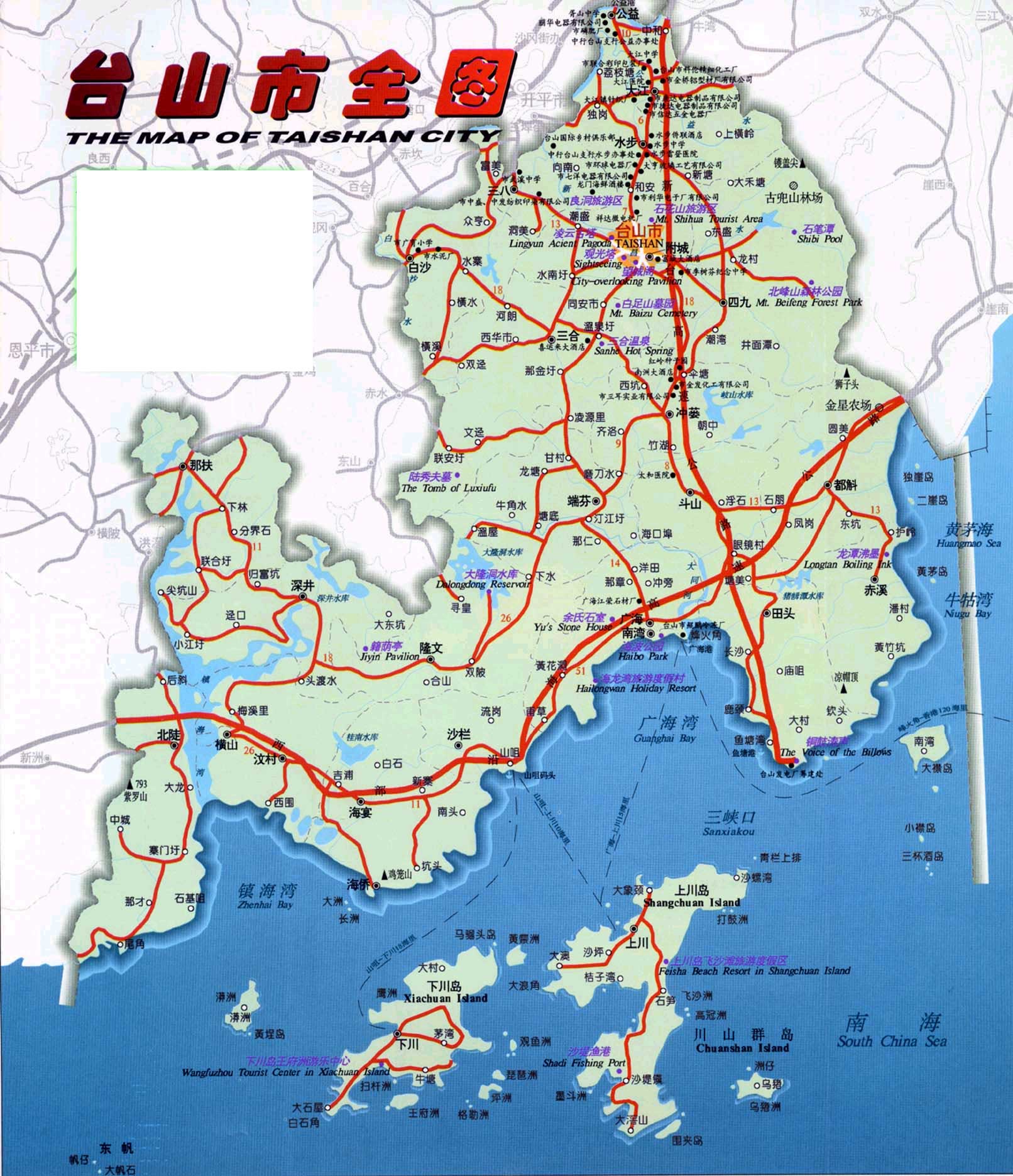
Taishan is in the Pearl River Delta, in southwestern Jiangmen Prefecture. It has 95 islands and islets, including Shangchuan Island, Guangdong's largest island now that Hainan is a separate province. Taishan is one of Guangdong's "Four Counties" (Sze Yup), which excluded Heshan and is now part of the Greater Taishan Region.
Climate
History
During the Ming dynasty, the area of present-day Taishan was carved out of Xinhui County on 12 February 1499 as "Xinning County". By the 19th century, Xinning was already a source of migrant and emigrant workers, but a series of subsequent natural and political disasters in the area exacerbated the situation. Aside from the disruption of the Sea Ban regulations (Haijin) themselves, their revocation led to an influx of northern settlers who began long-running feuds with the returning locals; this erupted into full-scale war in the 1850s and '60s.<ref>{{#invoke:citation/CS1|citation |CitationClass=web }}</ref> The 1842 Treaty of Nanking that ended the First Opium War opened China to greater foreign trade just before the California Gold Rush made the prospect of emigration to the United States appealing. Many also served as contract workers abroad, as in Hawaii, Peru and Cuba and—most famously—for the Central Pacific half of America's Transcontinental Railroad, where the Chinese made up 80% of the company's workforce as they laid track over the mountains and deserts of the west.<ref>Mutze. "Remembering origins from Taishan, China" DailyQi. 2008-11-03</ref> By 1870, there were 63,000 Chinese in the U.S., almost all in California.<ref>{{#invoke:citation/CS1|citation |CitationClass=web }}</ref>
Chin Gee Hee's Sun Ning Railway Company connected Sun Ning (Xinning) with its hinterland in 1908 and reached Jiangmen (Kongmoon) in 1913. It was notable as one of only three railways financed, built, owned, and run by the Chinese themselves before the 1949 Communist victory in the Chinese Civil War.<ref name="railway">Chinese Emigration, the Sunning Railway and the Development of Toisan by Lucie Cheng and Liu Yuzun with Zheng Dehua, Amerasia 9(1): 59–74, 1982.</ref>
In 1914, the new Republican government renamed the area Taishan County to avoid confusion with other places named Xinning.<ref>Template:Citation.</ref><ref name=":0">{{#invoke:citation/CS1|citation |CitationClass=web }}</ref> (Foreign sources now frequently confuse it with Mount Tai in Shandong.) During the Second World War, the Sun Ning Railway was destroyed to prevent its use by the Japanese.<ref name="railway"/> Japanese soldiers entered Taicheng, the county seat, in March 1941 and killed nearly 280 people. One quarter of the "Flying Tigers", a joint American and Chinese group of airmen who fought the Japanese before the U.S. entered the Second World War, hailed from Taishan.<ref>{{#invoke:citation/CS1|citation |CitationClass=web }}</ref>
Taishan was promoted to county-level city status on 17 April 1992, reflecting its increasing level of urbanization.<ref name=":0" />
Administration

Taishan administers one subdistrict and 16 towns,<ref name=":1">{{#invoke:citation/CS1|citation |CitationClass=web }}</ref> which in turn are subdivided into 313 administrative villages (Template:Lang-zh), and residential communities (Template:Lang-zh).<ref name=":0" /> The city has 3,655 natural villages, but they do not function as administrative divisions (Template:Lang-zh).<ref name=":0" />
Taishan's township-level divisions are:
Some of the city's natural villages include Annanjiangchao (Template:Lang-zh), Bihou (Template:Lang-zh), Jilong, and Guanbuli (Template:Lang-zh).
Demographics
Counting the total Greater Taishan Region or Sze Yap Region, which includes Kaiping, Xinhui, Enping and Taishan, there are about 8 to 9 million Taishanese people worldwide. According to American historian Him Mark Lai, approximately 430,000 or 70% of Chinese Americans in the 1980s were Taishanese according to 1988 data.<ref name=roots>Template:Cite news</ref> About 500,000 Chinese Americans claim Taishanese origins today.<ref name=roots/>
While Taishan itself has a population of about 1 million, there are around 1.3 million Taishanese people overseas, distributed in 91 countries and regions.<ref>{{#invoke:citation/CS1|citation |CitationClass=web }}</ref> It is estimated that, up to the mid- to late-20th century, over 75% of all overseas Chinese in North America claimed origin in Taishan, so Taishan has been called the "Home of Overseas Chinese".<ref name=LAT2/><ref>Template:Cite book</ref>
Language
Taishan's main dialect is Taishanese (Template:Lang-zh).Template:Citation needed Most Taishanese today use Mandarin in school or formal occasions, but Taishanese is the lingua franca.Template:Citation needed Schools require their students to speak Mandarin in the classroom, and teachers are required to lecture in Mandarin.Template:Citation needed
Taishanese is a language of the Yue Chinese, a large group that includes, but is broader than, the Cantonese spoken in Hong Kong and Guangzhou.Template:Citation needed Cantonese and Taishanese are thus related but distinct.<ref>{{#invoke:citation/CS1|citation |CitationClass=web }}</ref> Cantonese is also widely known in Taishan, as it serves as Guangdong Province's lingua franca.Template:Citation needed
Before the 1980s, Taishanese was the predominant Chinese language spoken throughout North America's Chinatowns.<ref name="LAT2"/>
Economy
In 2018, Taishan's GDP reached 43.25 billion Yuan, government revenue was 2.92 billion Yuan, fixed-asset investment was 27.33 billion Yuan, retail sales totaled 25.52 billion Yuan, and foreign trade totaled 13.76 billion Yuan.<ref name=":2">{{#invoke:citation/CS1|citation |CitationClass=web }}</ref>
Power generation
Taishan is home to two major power plants: the Guohua Taishan Power Station and the Taishan Nuclear Power Plant.<ref name=":2" />
Culture
Sports
Taishan is nicknamed the "hometown of volleyball",<ref name=":2" /> after the game was introduced to the city in 1915 by Lingnan University student Wu Xiumin (Template:Lang-zh).<ref name=":3">{{#invoke:citation/CS1|citation |CitationClass=web }}</ref> Many prominent Chinese volleyball players have hailed from Taishan.<ref name=":3" /> In recent years, local governments in the city have invested in the area's volleyball programs, and the city hosted a number of Volleyball Women's Nations League matches in 2018.<ref name=":3" /> 9-man is a form of volleyball from Taishan brought to American Chinatowns by Taishanese immigrants.
Music and Entertainment
Taishan and Guangzhou are the birthplaces of Guangdong music.Template:Citation needed
Parts of the movie Let the Bullets Fly were filmed in Taishan in 2010.<ref>Kaiping Location of "Let the Bullets Fly", CRI English.com, 3 December 2010</ref><ref>Travel Around Taishan, CNTV, March 2011</ref>
Education
Education enjoys significant support from Overseas Chinese professionals and businessmen. Many secondary schools were built and financed by Chinese living in China's Special Administrative Regions, as well as various foreign countries, such as the United States, Canada, and Brazil. To honor their benefactors, these schools often bear either their names or the names of said donor's parents.
The Peng Quan School (Template:Lang-zh) is a prime example, which was constructed during 1999–2001 and is now integrated into Taishan's public school system. It is situated on the west side of Taicheng and was built by a Hong Kong businessman.<ref>tspqz.com</ref>
There are many middle schools and high schools in Taishan but no academic universities. Students must study rigorously in order to be accepted at universities located in other cities.
Taishan schools include:
University:
- Taishan Panshi Television University (Template:Lang-zh)
Secondary schools (including combined junior-senior high schools and senior high schools): Template:Div col
- Taishan No. 1 High School (Template:Lang-zh)
- Taishan Overseas Chinese Middle School (Template:Lang-zh)
- Taishan Peiying Vocational Technical School (Template:Lang-zh)
- Taishan Taishi Senior High School (Template:Lang-zh)
- Taishan City Peng Quan School (Template:Lang-zh)
- Taishan Litan Gengkai Memorial Middle School (Template:Lang-zh)
- Taishan Peizheng School (Template:Lang-zh)
- Taishan Renyuan Middle School (Template:Lang-zh)
- Taishan Guang Hai School (Template:Lang-zh)
- Taishan Shuibu Middle School (Template:Lang-zh)
- Taishan Lishufen Memorial Middle School (Template:Lang-zh)
- Taishan Chonglou Middle School (Template:Lang-zh)
- Taishan Xueye Junior Middle School (Template:Lang-zh)
- Taishan Xinning Middle School (Template:Lang-zh)
- Taishan Yizhong Dajiang Experimental Middle School (Template:Lang-zh)
- Taishan Najin Middle School (Template:Lang-zh)
- Taishan Ningyang Middle School (Template:Lang-zh)
Transportation
.jpg)
Taishan is accessible by bus with a long-distance bus station in Taicheng, and through a port at GongYi on the Tan River which flows into the Pearl River Delta.Template:Citation needed The ferry service between GongYi and Hong Kong has been discontinued.Template:Citation needed
Ferry
Ferry services connect the island of Shangchuan with the mainland, sailing between the Sanzhou Harbor (Template:Lang-zh) on Shangchuan, and Shanzui Harbor (Template:Lang-zh) in the town of Chuandao.<ref>{{#invoke:citation/CS1|citation |CitationClass=web }}</ref><ref name=":4">{{#invoke:citation/CS1|citation |CitationClass=web }}</ref> There are also daily ferry services between Sanzhou Harbor and the nearby island of Xiachuan.<ref name=":4" />
Rail
In 2018, Taishan railway station opened in Taicheng Subdistrict, connecting the city via rail.<ref>{{#invoke:citation/CS1|citation |CitationClass=web }}</ref> The station, located Template:Convert north of the city center, is a stop on the Shenzhen–Zhanjiang high-speed railway, and has a couple dozen trains a day running to Guangzhou South railway station.Template:Citation needed
Notes
References
External links
Template:Portal Template:Sister project Template:Wikivoyage
- China Taishan Web
- Taishan City Government Template:Webarchive
- Chinese Genealogy
- Map of Taishan Template:Webarchive
- Hoisanese to English Dictionary
- Taishan Culture & Loisirs (Association of the Taishan expatriate community)Template:Dead link
Template:County-level divisions of Guangdong Template:Towns in Jiangmen Template:Pearl River Delta Template:Authority control