Web annotation
Template:Short description Template:Update
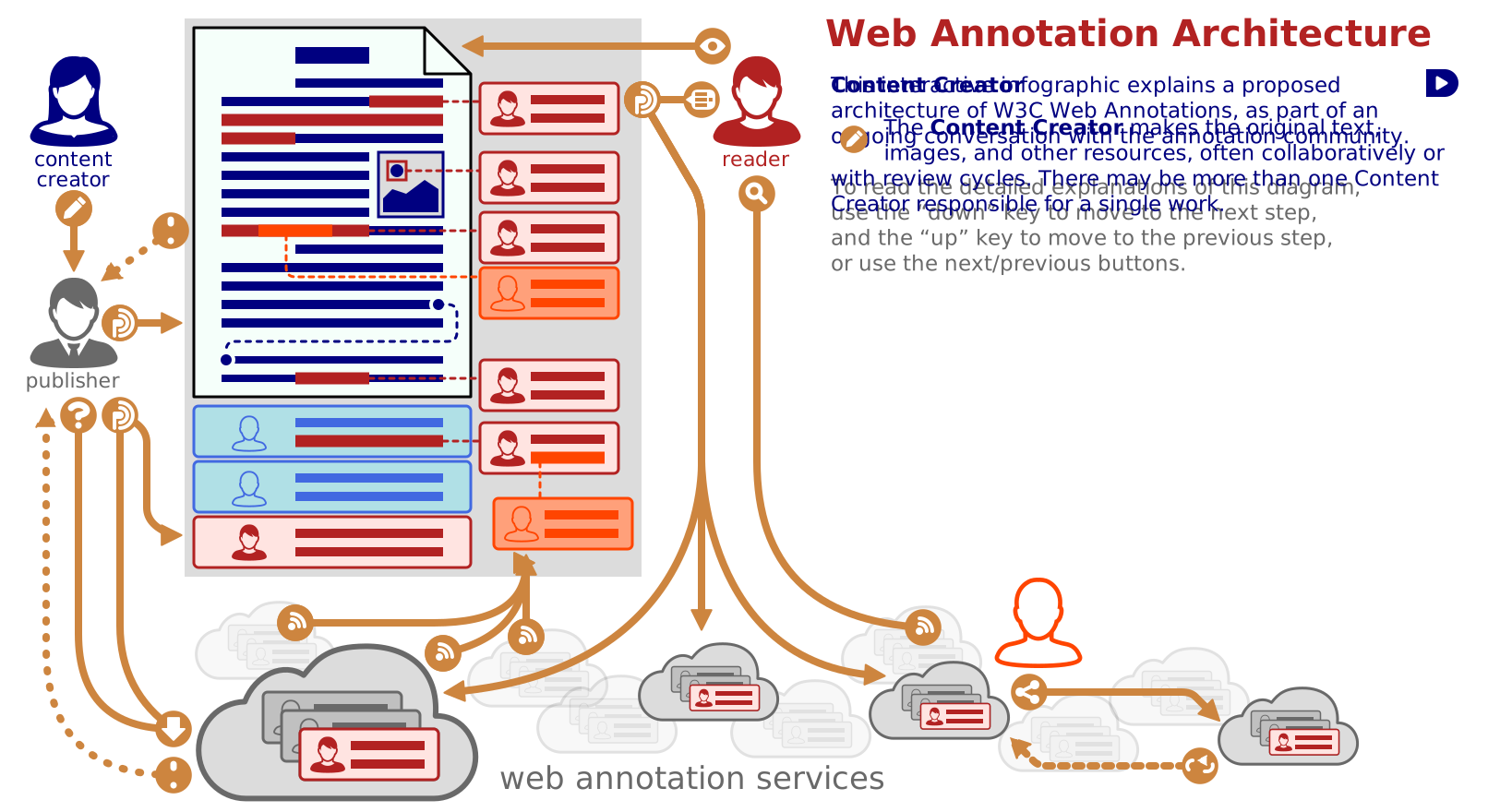
Web annotation can refer to online annotations of web resources such as web pages or parts of them, or a set of W3C standards developed for this purpose. The term can also refer to the creations of annotations on the World Wide Web and it has been used in this sense for the annotation tool INCEpTION,<ref>{{#invoke:citation/CS1|citation |CitationClass=web }}</ref> formerly WebAnno.<ref>{{#invoke:citation/CS1|citation |CitationClass=web }}</ref> This is a general feature of several tools for annotation in natural language processing or in the philologies.
Annotation of web resources
With a web annotation system, a user can add, modify or remove information from a Web resource without modifying the resource itself. The annotations can be thought of as a layer on top of the existing resource, and this annotation layer is usually visible to other users who share the same annotation system. In such cases, the web annotation tool is a type of social software tool. For Web-based text annotation systems, see Text annotation.
Web annotation can be used for the following purposes:
- to rate a Web resource, such as by its usefulness, user-friendliness, suitability for viewing by minors.
- to improve or adapt its contents by adding/removing material (like wiki).
- as a collaborative tool, e.g. to discuss the contents of a certain resource.
- as a medium of artistic or social criticism, by allowing Web users to reinterpret, enrich or protest against institution or ideas that appear on the Web.
- to quantify transient relationships between information fragments.
- to save, retain and synthesize selected information.
Annotations can be considered an additional layer with respect to comments. Comments are published by the same publisher who hosts the original document. Annotations are added on top of that, but may eventually become comments which, in turn, may be integrated in a further version of the document itself.<ref>{{#invoke:citation/CS1|citation |CitationClass=web }}</ref>
Web Annotation standard
In the Web Annotation standard, Template:Quote

The basic data structures of Web Annotation are
- target (the element being annotated, e.g., a web document or a part of it),
- body (the content of the annotation, e.g., a string value), and
- annotation (the element that serves to relate body and target of an annotation)
The body can be a literal value or structured content (a URI). The target can be identified by an URI (e.g., fragment identifiers) and/or a selector that defines a domain-, resource- or application-specific access protocol, e.g., offset-based, XPath-based, etc.
Web Annotation was standardized on February 23, 2017 with the release of three official Recommendations by the W3C Web Annotation Working Group:<ref>{{#invoke:citation/CS1|citation |CitationClass=web }}</ref><ref name="Whaley2017">{{#invoke:citation/CS1|citation |CitationClass=web }}</ref>
- Web Annotation Data Model<ref>{{#invoke:citation/CS1|citation
|CitationClass=web }}</ref>
- Web Annotation Vocabulary<ref>{{#invoke:citation/CS1|citation
|CitationClass=web }}</ref>
- Web Annotation Protocol<ref>{{#invoke:citation/CS1|citation
|CitationClass=web }}</ref>
These recommendations were accompanied by additional working group notes that describe their application:
- Embedding Web Annotations in HTML<ref>{{#invoke:citation/CS1|citation
|CitationClass=web }}</ref>
- Selectors and States<ref>{{#invoke:citation/CS1|citation
|CitationClass=web }}</ref>
The Web Annotation data model is also provided in machine-readable form as the Web Annotation ontology.<ref>{{#invoke:citation/CS1|citation
|CitationClass=web
}}</ref>
Note that this ontology defines the Web Annotation namespace (https://www.w3.org/ns/oa#), and that this namespace is conventionally abbreviated as oa. This is the abbreviation for Open Annotation, a W3C Community Group whose specifications formed the basis for the Web Annotation standard.<ref>{{#invoke:citation/CS1|citation
|CitationClass=web
}}</ref>
Web Annotation supersedes other standardization initiatives for annotations on the web within the W3C, e.g., the earlier Annotea project discontinued after 2003.<ref>{{#invoke:citation/CS1|citation |CitationClass=web }}</ref><ref>{{#invoke:citation/CS1|citation |CitationClass=web }}</ref>
Related specifications
Web Annotation can be used in conjunction with (or as an alternative to) fragment identifiers that describe how to address elements within a web document by means of URIs. These include
- RFC 5147 (URI fragment identifiers for the text/plain media type)<ref>Template:Cite journal</ref>
- RFC 7111 (URI fragment identifiers for the text/csv media type)<ref>Template:Cite journal</ref>
- RFC 8118 (URI fragment identifiers for the application/pdf media type)<ref>Template:Cite journal</ref>
- SVG fragment identifiers<ref>{{#invoke:citation/CS1|citation
|CitationClass=web }}</ref>
- XPointer (for addressing components of XML documents)<ref>{{#invoke:citation/CS1|citation
|CitationClass=web }}</ref>
- Media Fragments (for addressing components of media files)<ref>{{#invoke:citation/CS1|citation
|CitationClass=web }}</ref>
Other, non-standardized fragment identifiers are in use, as well, e.g., within the NLP Interchange Format.<ref>{{#invoke:citation/CS1|citation |CitationClass=web }}</ref>
Independently from Web Annotation, more specialized data models for representing annotations on the web have been developed, e.g., the NLP Interchange Format (NIF)<ref>{{#invoke:citation/CS1|citation |CitationClass=web }}</ref> for applications in language technology. In early 2020, the W3C Community Group "Linked Data for Language Technology" launched an initiative to harmonize these vocabularies and to develop a consolidated RDF vocabulary for linguistic annotations on the web.<ref>{{#invoke:citation/CS1|citation |CitationClass=web }}</ref>
Web Annotation Systems
Comparison of web annotation systems
Many of these systems require software to be installed to enable some or all of the features below. This fact is only noted in footnotes if the software that is required is additional software provided by a third party. Template:Sort-under
| Annotation system | Template:Verth | Template:Verth | Template:Verth | Template:Verth | Template:Verth | Template:Verth | Archives | Viewing annotations | API | Open Source | Template:Verth | Notes | ||||
|---|---|---|---|---|---|---|---|---|---|---|---|---|---|---|---|---|
| A.nnotate | Template:Yes | Template:Yes | Template:No | Template:Yes<ref>See A.nnotate notifications</ref> | Template:Yes | Template:No | Template:Yes | Template:Yes | Template:No (proprietary) | Template:Unknown | Can annotate PDF, ODF, .doc, .docx, images, as well as web pages (but only a limited number in the free version) | |||||
| citation | CitationClass=web
}}</ref> |
Template:Yes, via Google Firebase plugin<ref>{{#invoke:citation/CS1|citation | CitationClass=web
}}</ref> |
Template:Yes | Template:Yes (BSD)<ref>{{#invoke:citation/CS1|citation | CitationClass=web
}}</ref> |
Template:Yes<ref>{{#invoke:citation/CS1|citation | CitationClass=web
}}</ref> |
JavaScript image annotation library and plugin to OpenSeadragon, also supports simple text annotations | |||||||
| Diigo | Template:Yes | Template:Yes | Template:Yes | Template:Yes | Template:Yes | Template:No | Template:Yes | Template:Yes | Template:No (proprietary) | Template:Unknown | Public annotations are only allowed for establishedTemplate:Definition needed users. Group tag dictionary feature to encourage tagging consistently within a group. | |||||
| Hypothes.is | Template:Yes | Template:Yes | Template:Yes | Template:Yes | Template:Yes | Template:Yes | Chrome, via.hypothes.is | Template:Yes | Template:Yes (MIT, BSD) | Template:No,<ref>{{#invoke:citation/CS1|citation | CitationClass=web
}}</ref> but listed on Web Annotation wiki|| In February 2015, different features were announced,<ref>{{#invoke:citation/CS1|citation |
CitationClass=web
}}</ref> such as private group annotation, semantic tagging, moderation, etc. Web Annotation integration was discussed in 2014.<ref>{{#invoke:citation/CS1|citation |
CitationClass=web
}}</ref><ref>{{#invoke:citation/CS1|citation |
CitationClass=web
}}</ref> | ||
| Org-mode (with extensions) | Template:Yes | Template:No | Template:No<ref>Technically, public annotations are possible via the "publish to HTML" feature of org mode -- but no method for notifications or discovery of public annotations written by others is currently known.</ref> | Template:No<ref>But local annotations can be exposed to a firefox browser using Fireforg.</ref> | Template:No | Template:Yes | Template:No | Template:Yes | Template:Unknown | Emacs-based; requires technical knowledge to set up; not as user-friendly as some other solutions; non-Latin characters allowed in notes but not in tags | ||||||
| citation | CitationClass=web
}}</ref> |
Template:Yes | Template:Yes | Template:Yes | Template:Yes | Template:Yes | Template:Yes | Template:Yes (Apache) | Template:Yes | Annotation of named entities, linking with maps and knowledge graphs, developed by the Pelagios network,<ref>{{#invoke:citation/CS1|citation | CitationClass=web
}}</ref> popular in Digital Humanities |
Discontinued web annotation systems
| System | Notes | Date Discontinued | ||
|---|---|---|---|---|
| Mosaic Browser | citation | CitationClass=web
}}</ref> but never passed the test state. |
Never passed the test state | |
| CritLink | citation | CitationClass=web
}}</ref> CritLink worked as an HTML "mediator", hence not requiring additional software or browser extensions but having limited support for modern JavaScript-driven websites. |
||
| Annotea | A W3C project that tried to establish a standard for web annotation. Annotea was conceived as part of the semantic web. According to the website, Annotea development stalled in October 2005.<ref>{{#invoke:citation/CS1|citation | CitationClass=web
}}</ref> |
||
| ThirdVoice | citation | CitationClass=web
}}</ref> led by independent web hosts which likened ThirdVoice to "Web graffiti."<ref>{{#invoke:citation/CS1|citation |
CitationClass=web
}}</ref> It was shut in April 2001 because it couldn't generate enough advertising revenue to stay in business.<ref>Third Voice Trails Off, Wired News, April 4, 2001</ref> |
April 2001 |
| Delicious | Founded in 2003 and provided cloud bookmarks with optional descriptions (a form of annotation) of up to 1000 characters. It was rumoured that it would be shut down in 2010, but it was only actually finally shut down in 2017 when it was acquired by Pinboard, a competitor. | 2017 | ||
| Wikalong | A Firefox plugin created in 2004 that provided a publicly editable mediawiki page in the margin of any webpage. (It was later accessible in other browsers via a bookmarklet.) Common uses were note-taking and discussion about the website. On Google, the Wikalong margin provided a variety of useful tips and shortcuts for searching. The project was discontinued in 2009 when the storage wiki went offline. It had been suffering from link spam abuse.<ref>Wikalong Firefox Addon, Oct 1, 2006</ref><ref>{{#invoke:citation/CS1|citation | CitationClass=web
}}</ref> |
2009 | |
| Fleck* | Launched in 2005 with much publicity as a stick-it notes application for the web. A patent, funding and marketing didn't stop it from failing. Discontinued in 2010.<ref>Farewell Fleck.com, "The Next Web", May 10, 2010</ref> | 2010 | ||
| stet | Stet was the Gplv3 comment system.<ref>{{#invoke:citation/CS1|citation | CitationClass=web
}}</ref> |
||
| Crocodoc | citation | CitationClass=web
}}</ref> and the web annotation side of it was shut down two years later.<ref>{{#invoke:citation/CS1|citation |
CitationClass=web
}}</ref> |
2009 |
| Blerp | Launched in 2009. A multimedia, extensible tool for annotating web pages with widgets viewable by any other Blerp user. | |||
| Google Sidewiki | Launched in 2009. A part of Google Toolbar that allowed users to write comments alongside any web page. It was discontinued in December 2011. | December 2011 | ||
| SharedCopy | An AJAX based web annotation tool that allowed users to mark-up, highlight, draw, annotate, cache, sticky-note and finally share any website. | |||
| Genius Web Annotator | citation | CitationClass=web
}}</ref> As of May 2022, the Chrome and Wordpress extensions are discontinued, and the bookmarklet provided on the official website does not work. As of August 2022, it is not possible to log in and leave new annotations. |
See also
- Comparison of notetaking software
- Social bookmarking
- Some reference management software packages also support web annotations
- Backlinks
- Online deliberation
- Perusall
- Folksonomy
- Metadata
- Threaded discussion
- Virtual graffiti
- Comparison of software saving Web pages for offline use
References
Further reading
- Template:Cite conference
- Signer, Beat: "An Architecture for Open Cross-Media Annotation Services", Proceedings of WISE 2009, 10th International Conference on Web Information Systems Engineering, Poznan, Poland, October 2009
- On Web Annotations: Promises and Pitfalls of Current Web Infrastructure. Venu Vasudevan and Mark Palmer, Proceedings of the 32nd Hawaii International Conference on System Sciences - 1999
- A Survey of Web Annotation Systems. Rachel M. Heck, Sarah M. Luebke, Chad H. Obermark. 1999.
- New ways of using Web annotations. Laurent Denoue, Laurence Vignollet.
- Ricardo Kawase, George Papadakis, Eelco Herder, Wolfgang Nejdl: The impact of bookmarks and annotations on refinding information. ACM Hypertext Conference 2010: 29-34
- Ricardo Kawase, Eelco Herder, George Papadakis, Wolfgang Nejdl: In-Context Annotations for Refinding and Sharing. Webist (Selected Papers) 2010: 85-100
External links
- W3C Web Annotation Working Group Recommendations (as of February 23, 2017):
- Web Annotation Architecture, W3C's interactive illustration