Yamal (icebreaker)
Template:Short description {{#invoke:other uses|otheruses}} Template:Use dmy dates
Template:Infobox ship imageTemplate:Infobox ship careerTemplate:Infobox ship characteristicsYamal (Template:Langx) is a Russian Template:Sclass nuclear-powered icebreaker operated by Atomflot (formerly by the Murmansk Shipping Company). She is named after the Yamal Peninsula in Northwest Siberia; the name means End of the Land in Nenets.
Laid down in Leningrad in 1986, and commissioned in October 1992, after the breakup of the Soviet Union, she filled her designed role of keeping shipping lanes open and also carried passengers on Arctic excursions. In July 1994 Yamal took an excursion to the North Pole, with the NSF (National Science Foundation – US), to celebrate the official maiden voyage. While at the exact North Pole (verified by GPS & Inmarsat satellite coordinates) the crew and passengers celebrated with a barbeque – the ambient temperature was Template:Convert (wind gusts were measured at Template:Convert). Because of the ship 90/90 coordinates the ship captain (Smirnov) organized a swimming party with Will Rountree (US) being recorded as the first person to ever swim there (21 July 1994) – water temperature was below freezing, ranging from Template:Convert. Template:Citation needed In 2007 Lewis Gordon Pugh swam a kilometer at the North Pole, having sailed there aboard Yamal.<ref>{{#invoke:citation/CS1|citation |CitationClass=web }}Template:Dead link</ref>
Yamal is equipped with a double hull. The outer hull is Template:Convert thick where ice is met and Template:Convert elsewhere and has a polymer coating to reduce friction. There is water ballast between the inner and outer hulls which can be shifted in order to aid icebreaking. Icebreaking is also assisted by an air bubbling system which can deliver Template:Convert of air from jets Template:Convert below the surface. Yamal can break ice while making way either forwards or backwards.
Yamal is one of the Russian Template:Sclass family of icebreakers, the most powerful icebreakers in the world. These ships must cruise in cold water to cool their reactorsTemplate:Failed verification, so they cannot pass through the tropics to undertake voyages in the Southern Hemisphere.<ref name="coolantarctica">{{#invoke:citation/CS1|citation |CitationClass=web }}</ref>
Yamal carries one helicopter and several Zodiac boats. Radio and satellite communications systems are installed which can provide navigation, telephone, fax, and email services. Amenities include a large dining room (capable of holding all 100 passengers in one sitting), a library, passenger lounge, auditorium, volleyball court, gymnasium, heated indoor swimming pool, a sauna, and an infirmary. She is equipped with 50 passenger cabins and suites, all with toilets, exterior windows, a television, and a desk.
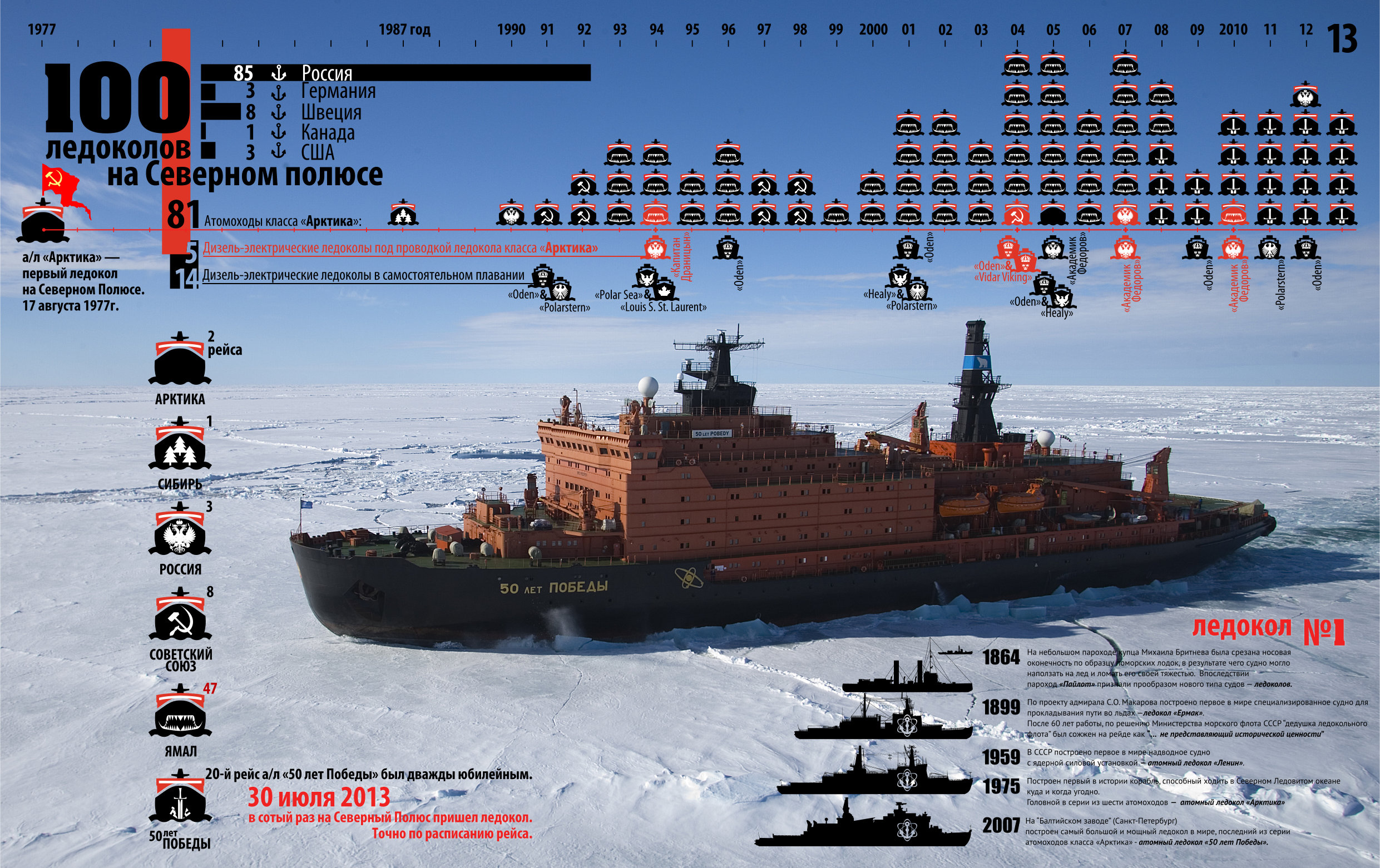
Yamal also played a significant role in creation of annual travel expeditions to the North Pole, being one of the few vessels capable of getting there and bringing tourists with it in safety. Since 1993 the icebreaker was operated by Murmansk Shipping Company and in 2001–2008 the operation was made by Murmansk Shipping Company and Poseidon Expeditions.<ref>{{#invoke:citation/CS1|citation |CitationClass=web }}</ref> Yamal has made a total of 47 voyages<ref>"Infographic in Russian describing the amount of voyages to the North Pole among Russian icebreakers</ref> to the North Pole.
In August 2025 a woman, Marina Starovoitova, became the captain of Yamal. She is the world’s first female captain of a nuclear icebreaker. She rose through the ranks from a sailor to Senior Assistant Captain and then Captain.<ref>Marina Starovoitova Is World’s First Female Captain of Nuclear Icebreaker </ref>


Events
North Pole-36 and North Pole-37
From August to September 2009 the icebreaker took part in the scheduled evacuation of drifting ice stations. Each station houses 18 polar explorers, dogs, and more than 150 tons of cargo. The evacuation of station personnel and cargo from a drifting ice floe requires three days of continuous, round-the-clock work. This high-latitude Arctic work was supervised by expedition leader Vladimir Sokolov.<ref>Template:Cite news</ref>
Incidents and accidents
- On 23 December 1996, a crew member was killed when a fire broke out on board the icebreaker. The nuclear reactor powering the ship was not affected by the fire. The crew extinguished the blaze within 30 minutes.
- On 16 March 2009 Yamal collided with the product tanker Template:Ship in Yenisei Gulf in the Kara Sea. While the tanker suffered a Template:Convert crack on the main deck, no damage was reported for Yamal.<ref name="portworld">Ice-breaker collides with tanker in Arctic Ocean, PortWorld News, 30 March 2009.</ref><ref name="barentsobserver">Nuclear powered icebreaker collided with oil tanker, BarentsObserver, 24 March 2009.</ref>
References
External links
Template:Commons category-inline
- Template:YouTube
- Field reports from tourists made aboard Yamal
- Icehunters: Russian conquerors of the North Pole
Template:Nuclear-powered icebreakers Template:Nuclear surface ships