Ghost knifefish
Template:Short description {{#invoke:other uses|otheruses}} Template:Automatic taxobox
The ghost knifefishes consist of the family Apteronotidae, which are ray-finned fishes in the order Gymnotiformes. These fish are native to Panama and South America.<ref name="Nelson">Template:Cite book</ref> They inhabit a wide range of freshwater habitats, but more than half the species in the family are found deep in rivers (typically deeper than Template:Cvt) where there is little or no light. The genus Apteronotus is "artificial" and some of the species do not actually belong in it; it is polyphyletic.<ref>Template:Cite journal</ref>
They are distinguished from other gymnotiform fishes by the presence of a caudal fin (all other families lack a caudal or tail fin) as well as a fleshy dorsal organ represented by a longitudinal strip along the dorsal midline.<ref name="Nelson" /> They vary greatly in size, ranging from about Template:Convert in total length in the smallest species to Template:Convert in the largest.<ref name=Sleen2017>Template:Cite book</ref> It has been claimed that Apteronotus magdalenensis is up to Template:Convert,<ref name="Nelson" /> but this is not supported by recent studies, which indicate that it does not surpass about Template:Convert.<ref name=Sleen2017/><ref>Template:Cite journal</ref> These nocturnal fish have small eyes, and some species may exhibit sexual dimorphism in their snout shape and jaws.<ref name="Fishbase" />
Like all gymnotiformes, Apteronotids are electric fish, using a high frequency tone-type (also called wave-type) electric organ discharge (EOD) to communicate.<ref name="Fishbase" />
Many Apteronotids are aggressive predators of small aquatic insect larvae and fishes, though there is great variation in their diets. Species of the genus Sternarchella are very unusual, preying on the tails of other electric fishes. Other species, such as Sternarchorhynchus and Sternarchorhamphus, have tubular snouts and forage for aquatic insect larvae and other small animals which burrow into the river bed (the benthos). At least one species (Sternarchogiton nattereri) eats freshwater sponges which grow on submerged trees, stumps, and other woody debris. Some species are even planktivorous.Template:Clarify
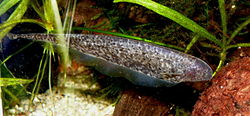
The black ghost knifefish (Apteronotus albifrons) and brown ghost knifefish (Apteronotus leptorhynchus) are readily available as aquarium fish. Others are known to appear in the trade but are quite rare.
Genera
FishBase lists 89 species in 16 genera,<ref name="Fishbase">Template:FishBase family</ref> However, after a number of recent taxonomic advances,<ref name=Evans2017>Template:Cite journal</ref><ref name=Bernt2017>Template:Cite journal</ref><ref name=Bernt2018>Template:Cite journal</ref><ref name=Bernt2020>Template:Cite journal</ref> Eschmeyer's Catalog of Fishes recognizes 94 species in 16 genera and 2 subfamilies.<ref name=":13">Template:Cite web</ref>
- Subfamily Apteronotinae Jordan, 1923
- Genus Adontosternarchus Ellis, 1912
- Genus Apteronotus Lacépède, 1800
- Genus Compsaraia Albert, 2001
- Genus Megadontognathus Mago-Leccia, 1994
- Genus Melanosternarchus Bernt, Crampton, Orfinger & Albert, 2018
- Genus Parapteronotus Albert, 2001
- Genus Pariosternarchus Albert & Crampton, 2006
- Genus Platyurosternarchus Mago-Leccia, 1994
- Genus Porotergus Ellis, 1912
- Genus Sternarchella Eigenmann, 1905
- Genus Sternarchogiton Eigenmann, 1905
- Genus Sternarchorhynchus Castelnau, 1855
- Genus Tembeassu Triques, 1998
- Genus Tenebrosternarchus Bernt, Fronk, Evans & Albert, 2020
- Subfamily Sternarchorhamphinae Albert, 2001
- Genus Orthosternarchus Ellis, 1912
- Genus Sternarchorhamphus Eigenmann, 1905
- Members of Apteronotidae
-
-

-

-

-

-

-


