Cabinet Office
Template:Short description Template:About Template:Use dmy dates Template:Infobox government agency Template:PoliticsUK
The Cabinet Office is a ministerial department of the Government of the United Kingdom. It is responsible for supporting the prime minister and Cabinet.<ref>This should be distinguished from the prime minister's personal staff who form the Prime Minister's Office.</ref> It is composed of various units that support Cabinet committees and coordinate the delivery of government objectives via other departments. Template:As of it had more than 10,200 staff, mostly civil servants, some of whom work in Whitehall. Staff working in the Prime Minister's Office are part of the Cabinet Office.
Responsibilities
The Cabinet Office's core functions are:<ref>{{#invoke:citation/CS1|citation |CitationClass=web }}</ref>
- Supporting collective government, helping to ensure the effective development, coordination, and implementation of policy;
- Supporting the National Security Council and the Joint Intelligence Organisation, coordinating the government's response to crises, and managing the UK's cyber security;
- Promoting efficiency and reform across government through innovation, transparency, better procurement, and project management, transforming the delivery of services, and improving the capability of the Civil Service;
- Political and constitutional reform
The Cabinet Office has responsibility for the following at the UK national level:
- the Home Civil Service
- the Independent Parliamentary Standards Authority
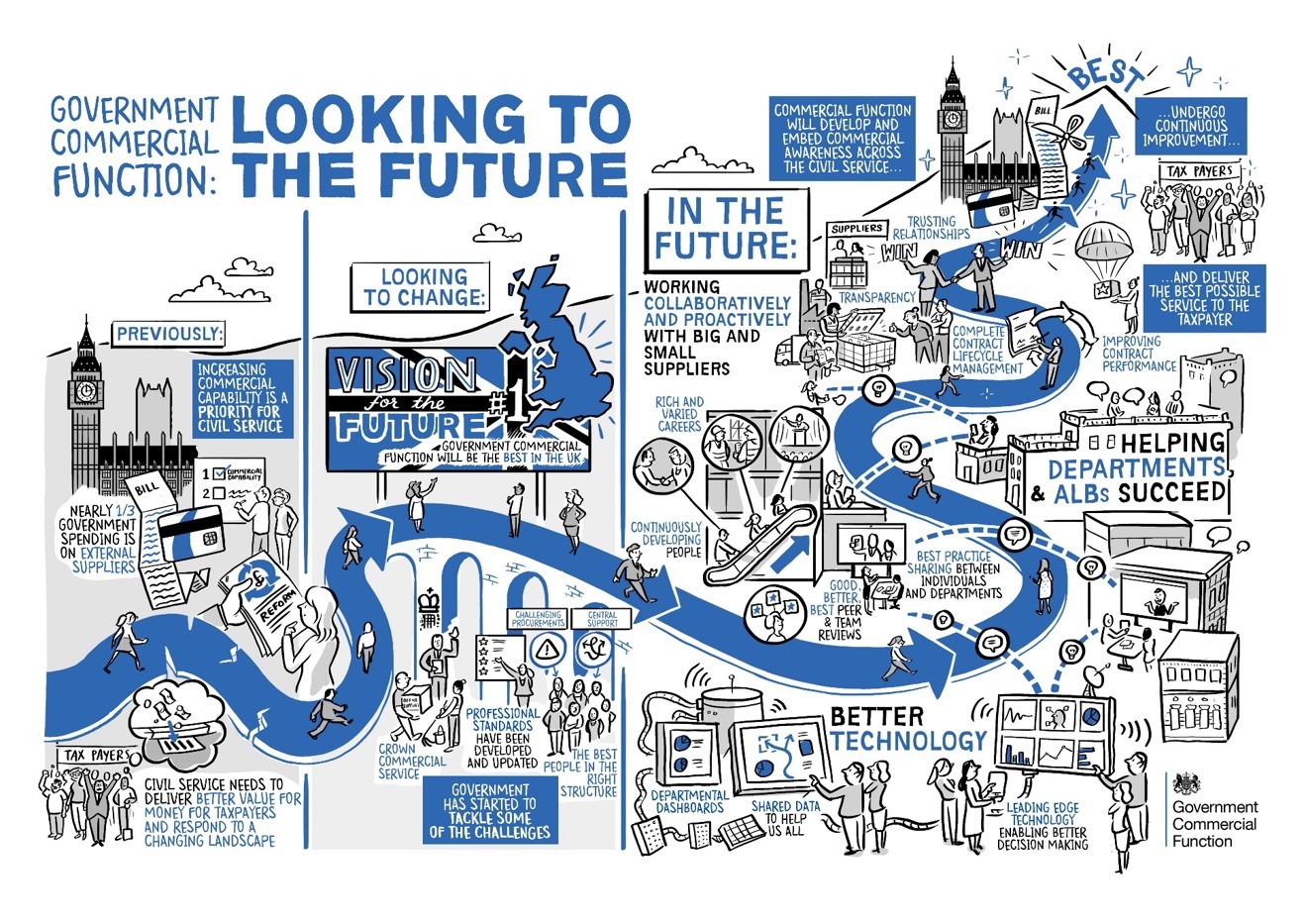
- the Government Commercial Function<ref>Government Commercial Function: Looking to the Future, accessed 5 May 2019</ref> and the Government Commercial Organisation.<ref>Government Commercial Function, Government Commercial Organisation, published 5 June 2018, accessed 5 May 2019</ref>
- the government's digital, data, and technology (DDaT) function is through the Government Digital Service<ref>Government Functional Standard GovS 005: Digital, Data and Technology, published 2 July 2020, accessed 26 Nov 2020</ref>
History
The department was formed in December 1916 from the secretariat of the Committee of Imperial Defence<ref>{{#invoke:citation/CS1|citation |CitationClass=web }}</ref> under Sir Maurice Hankey, the first Cabinet Secretary.
Traditionally the most important part of the Cabinet Office's role was facilitating collective decision-making by the Cabinet, through running and supporting Cabinet-level committees. This is still its principal role, but since the absorption of some of the functions of the Civil Service Department in 1981 the Cabinet Office has also helped to ensure that a wide range of Ministerial priorities are taken forward across Whitehall.
It also contains miscellaneous units that do not sit well in other departments. For example:
- The Historical Section was founded in 1906 as part of the Committee for Imperial Defence and is concerned with Official Histories.<ref>{{#invoke:citation/CS1|citation
|CitationClass=web }}</ref>
- The Joint Intelligence Committee was founded in 1936 and transferred to the department in 1957. It deals with intelligence assessments and directing the national intelligence organisations of the UK.
- The Ceremonial Branch was founded in 1937 and transferred to the department in 1981. It was originally concerned with all ceremonial functions of state, but today it handles honours and appointments.
In modern times the Cabinet Office often takes on responsibility for areas of policy which are the priority of the Government of the time. The units that administer these areas migrate in and out of the Cabinet Office as government priorities (and governments) change.
Ministers and civil servants
| Minister | Portrait | Office | Portfolio | |||
|---|---|---|---|---|---|---|
| The Rt Hon. Sir Keir Starmer KCB KC MP | .jpg)
|
Prime Minister First Lord of the Treasury Minister for the Civil Service |
Head of government; oversees the operation of the Civil Service and government agencies; appoints members of the government; he is the principal government figure in the House of Commons. | |||
| The Rt Hon. Darren Jones MP | _2.jpg)
|
Chancellor of the Duchy of Lancaster Minister for Intergovernmental Relations Chief Secretary to the Prime Minister (Minister of State) |
citation | CitationClass=web
}} Additionally as Minister for Intergovernmental Relations leads coordination with the devolved administrations on the Prime Minister’s behalf, working closely with the Territorial Offices, to make sure that across government work is being done on behalf of the entire United Kingdom.<ref>{{#invoke:citation/CS1|citation |
CitationClass=web
}} Furthermore, as Chief Secretary to the Prime Minister responsible for overseeing work across Government to support the delivery of the Prime Minister’s priorities and the Government’s Plan for Change.<ref>{{#invoke:citation/CS1|citation |
CitationClass=web
}} |
| Template:Small Nick Thomas-Symonds MP FRHistS | .jpg)
|
Minister for the Cabinet Office Paymaster General |
Delivery of the government's efficiency programme; Civil Service Modernisation and Reform; Places for growth programme; Cabinet Office business planning and performance; Infected Blood Inquiry; Public bodies reform programme; Spend controls reform; Oversight of the cross-cutting functions and government functional strategy.
Additionally supports the Deputy Prime Minister on: Driving delivery of the government's priorities; Civil contingencies and resilience.<ref>{{#invoke:citation/CS1|citation |
CitationClass=web
}} | ||
| Anna Turley MP | 
|
Minister of State without Portfolio | citation | CitationClass=web
}} | ||
| Major Dan Jarvis MBE MP | .jpg)
|
Minister of State in the Cabinet Office | ||||
| Satvir Kaur MP | 
|
Parliamentary Secretary | ||||
| Josh Simons MP | 
|
Parliamentary Secretary | ||||
| Chris Ward MP | 
|
Parliamentary Secretary |

Leaders of the Commons and Lords
Leaders of the Houses of Commons and Lords, supported by the Cabinet Office, are as follows:
| Minister | Portrait | Office | Portfolio |
|---|---|---|---|
| The Rt Hon. Sir Alan Campbell MP | .jpg)
|
Leader of the House of Commons Lord President of the Council |
The Government's Legislative Programme, chairing the Cabinet Committee; Managing and announcing the business of the House of Commons weekly and facilitating motions and debate in the Chamber, particularly on House business; Government's representative in the House (sitting on the House of Commons Commission, Public Accounts Commission, and the Speaker's Committees on the Independent Parliamentary Standards Authority); House of Commons representative in Government; Parliamentary reform and policy; Ministerial responsibility for the Privy Council Office. |
| The Rt Hon. The Baroness Smith of Basildon PC | _2.jpg)
|
Leader of the House of Lords Lord Privy Seal |
Management and delivery of the Government's legislative programme (through the House of Lords) and facilitating the passage of individual bills; Leading the House (in the Chamber and as a key member of domestic committees to do with procedure, conduct, and the internal governance of the House); Issues connected to the House of Lords and its governance; Speaking for the Government in the Chamber on a range of issues, including repeating in the House of Lords statements made to the Commons by the Prime Minister; Ceremonial and other duties as the Lord Keeper of the Privy Seal. |
| The Rt Hon. The Lord Collins of Highbury | 
|
Deputy Leader of the House of Lords | The Deputy Leader of the House of Lords supports the House of Lords in its job of questioning government ministers, improving legislation and debating topics of national significance. |
Civil servants
The Cabinet Office's most senior civil servants are as follows, as of February 2025:<ref>{{#invoke:citation/CS1|citation |CitationClass=web }}</ref>
| Name | Portrait | Position | Term start | |
|---|---|---|---|---|
| Sir Chris Wormald Template:Post-nominals<ref>{{#invoke:citation/CS1|citation | CitationClass=web
}}</ref> |

|
Cabinet Secretary Head of the Home Civil Service |
Template:Start date and age |
| Cat Little Template:Post-nominals<ref>{{#invoke:citation/CS1|citation | CitationClass=web
}}</ref> |
Permanent Secretary to the Cabinet Office Chief Operating Officer of the Home Civil Service |
Template:Start date and age | |
| Sarah Harrison<ref>{{#invoke:citation/CS1|citation | CitationClass=web
}}</ref> |
Chief Operating Officer for the Cabinet Office | Template:Start date and age | |
| Simon Baugh<ref>{{#invoke:citation/CS1|citation | CitationClass=web
}}</ref> |
Chief Executive of Government Communications | Template:Start date and age | |
| Richard Hornby<ref>{{#invoke:citation/CS1|citation | CitationClass=web
}}</ref> |
Chief Financial Officer and Director of Assurance, Finance and Controls, Cabinet Office | Template:Start date and age | |
| Vincent Devine<ref>{{#invoke:citation/CS1|citation | CitationClass=web
}}</ref> |
Government Chief Security Officer | Template:Start date and age | |
| Kathryn Al-Shemmeri<ref>{{#invoke:citation/CS1|citation | CitationClass=web
}}</ref> |
Chief People Officer, Cabinet Office | Template:Start date and age | |
| Darren Tierney<ref>{{#invoke:citation/CS1|citation | CitationClass=web
}}</ref> |

|
Director General, Propriety and Constitution Group | Template:Start date and age |
| Jonathan Powell<ref>{{#invoke:citation/CS1|citation | CitationClass=web
}}</ref> |

|
National Security Adviser | Template:Start date and age |
| Madeleine Alessandri Template:Post-nominals<ref>{{#invoke:citation/CS1|citation | CitationClass=web
}}</ref> |
Chair of the Joint Intelligence Committee | Template:Start date and age | |
| Clara Swinson<ref>{{#invoke:citation/CS1|citation | CitationClass=web
}}</ref> |
Second Permanent Secretary in the Cabinet Office, Head of Mission Delivery Unit | Template:Start date and age | |
| Michael Ellam | Second Permanent Secretary in the Cabinet Office, European Union and International Economic Affairs | Template:Start date and age |
The Cabinet Office also supports the work of the Whips Offices of the House of Lords and House of Commons.
The Parliamentary Private Secretary to the Cabinet Office supports the work of ministers.
Committees
{{#invoke:Labelled list hatnote|labelledList|Main article|Main articles|Main page|Main pages}} Cabinet committees have two key purposes:<ref name="CO report">{{#invoke:citation/CS1|citation |CitationClass=web }}</ref>
- To relieve the burden on the Cabinet by dealing with business that does not need to be discussed at full Cabinet. Appeals to the Cabinet should be infrequent, and Ministers chairing Cabinet Committees should exercise discretion in advising the prime minister whether to allow them.
- To support the principle of collective responsibility by ensuring that, even though a question may never reach the Cabinet itself, it will be fully considered. In this way, the final judgement is sufficiently authoritative that Government as a whole can be expected to accept responsibility for it. In this sense, Cabinet Committee decisions have the same authority as Cabinet decisions.
Buildings

The main building of the Cabinet Office is at 70 Whitehall, adjacent to Downing Street. The building connects three historically distinct properties, as well as the remains of Henry VIII's 1530 tennis courts, part of the Palace of Whitehall, which can be seen within the building. The Whitehall frontage was designed by Sir John Soane and completed by Sir Charles Barry between 1845 and 1847 as the Treasury Buildings. Immediately to the west Dorset House (1700) connects the front of the building to William Kent's Treasury (1733–36), which faces out onto Horse Guards Parade. The latter is built over the site of the Cockpit, used for cock fighting in the Tudor period, and subsequently as a theatre. In the early 1960s the buildings were restored and many of the Tudor remains were exposed and repaired. Significant renovations between 2010 and 2016 converted many of the floors to open plan and created new office space. The Cabinet Office Briefing Rooms are located on this site.
The department occupies other buildings in Whitehall and the surrounding area, including part of the Government Offices Great George Street at 1 Horse Guards, as well as sites in other parts of the country.
See also
- British Civil Service
- Cabinet Office Briefing Rooms
- Prime Minister's Strategy Unit
- Social Exclusion Task Force
- United Kingdom budget
References
External links
Template:Cabinet Office Template:Departments of the United Kingdom Government Template:Authority control