Yonaguni, Okinawa


Template:Nihongo is a town located entirely on Yonaguni Island in Yaeyama District, Okinawa Prefecture, Japan. It is the westernmost municipality in Japan, and is known for billfish fishing and as a diving spot. In 1987, divers discovered the Yonaguni Monument, a rock formation that some believe may be man-made.
It is also home to two Ryūkyūan writing systems, pictographic "kaida-di" (also used on Ishigaki and Taketomi islands where it is called "kaida-ji") and the symbols used to indicate family names, "dāhan" (also used on Ishigaki Island where they are called "yāban").
History
Presently, the oldest confirmed ruins are the ruins in Tuguru Beach. Due to the southern style stone tools found, it is thought that a culture influenced by Southeast Asia existed here at one time.
After this point, the history of the island of Yonaguni is unclear, but in the Gusuku Era, settlements were formed on the top of the plateau. The Shima Nakamura Ruins are one example, and it is known for being the birth village of the famous woman chief, San’ai Isoba.
From the time of the Ryūkyū Kingdom, Yonaguni prospered as a commerce center with Taiwan. Due to World War II, until it was placed under control of the United States Civil Administration of the Ryukyu Islands, the number of people involved in smuggling surged in the area. The population in 1947 had reached 12,000, but although Yonaguni became incorporated as a town, a crackdown on smuggling led to a sharp decrease in the population.<ref>「与那国「国境交流特区」がめざすもの」 Template:Webarchive (Yonaguni), page 1 Template:In lang</ref>
Ishigaki and the surrounding towns and cities are discussing a merger, with the exception of Yonaguni which abstained, cutting the members of parliament from 12 in half, down to 6.
- 1522: Yonaguni was Invaded by the Ryūkyū army and became a territory of the Ryūkyū Kingdom.
- 1872: The Ryūkyū Kingdom is abolished; in its place, the Ryūkyū Domain is established and the island becomes a territory of the Ryūkyū Domain.
- 1879: The Ryūkyū Domain is abolished and becomes Okinawa-ken.
- 1908: The island municipal system abolishes the magiri system, and the Ishigaki-magiri, Ōhama-magiri, and Miyara-magiri join the island of Yonaguni to become Yaeyama-son.
- 1914: Through a division of Yaeyama-son, the village of Yonaguni-son is formed.
- 1948: Yonaguni-chō is incorporated as a town.
Geography
- Yonaguni is the westernmost locality of Japan and is the midpoint between Ishigaki and Taiwan. At Cape Irizaki (Yonagunian language: Irinzati) on the western edge of the island, there is a monument inscribed with the words: "The westernmost point in Japan."
- The western third of the island is not part of Japan's air defense identification zone or flight information region; instead, it sits in Taiwan's Air Defense Identification Zone and flight information region. (Please refer to the article on Yonaguni Airport for more details.)
- The distance between Template:Ill (Japanese: トゥイシ) — a rocky formation about 120 m northwest of Cape Irizaki that forms part of the town's territory — and Wuyanjiao (Chinese: 烏岩角) in Su'ao Township, Yilan County, Taiwan is Template:Convert and therefore closer than Ishigaki, which is Template:Convert away. For further comparison, Yonaguni is much closer to Taipei (the capital of Taiwan) at approximately Template:Convert than its own capital (Tokyo), which is about Template:Convert away. Due to this, it is attempting to establish closer relations with Taiwan, including attempting to set up easier access to and from cities in Taiwan, with irregular service to Hualien already established. Further cooperation has been opposed by the central government, thus the lack of further progress.Template:Citation needed
Rivers
Population
Template:Historical populations Template:Japan prefectures population
Climate
Administration
- Mayor Ken'ichi Itokazu
Transportation

Airport
- Japan Transocean Air (JTA) – JAL group
- Ishigaki Airport 30 min., one round trip flight daily (Boeing 737–400)
- Ryūkyū Air Commuter (RAC) – JAL and JTA groups
- Naha Airport 80 min., four round trip flights per week (Bombardier Dash 8 DHC-8-100)
- Ishigaki Airport 30 min., four round trip flights per week (Bombardier Dash 8 DHC-8-100)
Harbours
- Fukuyama Maritime "Ferry Yonakuni"
- Ishigaki Harbour 4 hr. 30 min. (only two round trips per week)
- Naha Harbour (irregular schedule)
Roads
- Okinawa Prefectural Road 216 – Yonaguni Island Route
- Okinawa Prefectural Road 217 – Yonaguni Harbor Route
(Rental cars are available)
Bus
Region
Education
- Hikawa Elementary School
- Kubura Elementary School
- Kubura Junior High School – Japan's westernmost school
- Yonaguni Elementary School
- Yonaguni Junior High School
Because there are no high schools on the island, students entering high school must attend on the Okinawa mainland or on the island of Ishigaki, and 100% of junior-high schoolers continue on to high school.<ref>『日本の島ガイド SHIMADAS(シマダス)』Foundation of Japanese Outlying Islands, Inc., 2004 Template:In lang</ref>
Famous places and historic sites
- Agaisati (Template:Nihongo2, Eastern Cape)
- Irisati (Template:Nihongo2, Western Cape)
- Tatigan (Template:Nihongo2, Standing God Rock)
- Gunkan icibugu (Template:Nihongo2, Battleship Rock)
- The open set of the TV drama series, Dr. Kotō's Clinic
- tuyama ugan (Template:Nihongo2, Ten Mountain Shrine) – Japan's westernmost Shinto shrine
Cultural and natural assets
Yonaguni Town hosts eighteen designated or registered tangible cultural properties and monuments, at the national, prefectural or municipal level.<ref>Template:Cite web</ref><ref>Template:Cite web</ref>
- Name (Japanese) (Type of registration)
- Irifukuhama Family Residence (main house) (Template:Nihongo2) (National)
- Kubura Family Residence (main house, stone wall) (Template:Nihongo2) (National)
- Tōgei Family Residence (main house, stone wall, well, stone water tank, water tank) (Template:Nihongo2) (National)
- Kubura-bari and Kubura-furishi Sceneries (Template:Nihongo2) (National)
- Kubura-barii area (Template:Nihongo2) (Prefectural)
- Template:Ill (Template:Nihongo2) (National) (Prefectural)
- Template:Ill (Template:Nihongo2) (National)
- Atlas moth habitat in Mount Urabu on Yonaguni Island (Attacus atlas ryukyuensis) (Template:Nihongo2) (Prefectural)
- Large deigo tree of Irimaka (Template:Nihongo2) (Municipal)
- Mitto Wetland of Kubura (Template:Nihongo2) (Municipal)
- Mount Kubura Natural Protected Area on Yonaguni Island (Template:Nihongo2) (Prefectural)
Yonaguni Monument
-
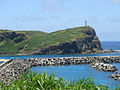 Irisati (Template:Nihongo2)
 -
 Tatigan (Template:Nihongo2)
 -
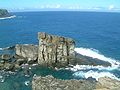 Gunkan icibugu (Template:Nihongo2)
 -
 The open set of the TV drama series, Dr. Coto's Clinic


Animals of special significance
- Atlas moth – Called ayami habiru locally, this is the world's largest moth. In Japan, it is found only in Yonaguni.
- Yonaguni horse – One of eight traditional Japanese horses, the smallest horse in Japan. Unable to be seen anywhere other than the island of Yonaguni.
Broadcasting
Television broadcasts consist of translator stations in Yonaguni and Uchimichi and radio broadcasts are established from the Yonaguni television translator station. It is also the only place in Japan where all three NHK radio stations are on the FM band. In addition, Yonaguni receives Taiwanese television broadcasts (Taiwan Television (TTV), China Television (CTV), and Chinese Television System (CTS) by using the European DVB-T system), along with Taiwanese radio broadcasts.
List of broadcast station frequencies
TV translator frequencies
| Location | NHK General TV | NHK Educational TV | Ryukyu Broadcasting Corporation (RBC) | Okinawa Television (OTV) |
|---|---|---|---|---|
| Yonaguni | 37 | 39 | 41 | 43 |
| Uchimichi | 49 | 51 | 53 | 55 |
Radio translator frequencies (MHz)
| Location | NHK1 | NHK2 | NHK3 | Ryukyu Broadcasting Corporation (RBCi) | Radio Okinawa (ROK) |
|---|---|---|---|---|---|
| Yonaguni | 83.5 | 80.3 | 85.8 | 84.7 | 79.5 |
Other information
Through the cell towers on the east side of Taiwan that are geographically close to Yonaguni, it is possible depending on the weather to receive GSM phone service on Taiwanese phones from Irizaki (and it is possible that GSM phones from international carriers could use the service while roaming).