Monarchy of Cambodia
Template:Short description Template:For Template:Use dmy dates Template:More citations needed Template:Infobox monarchy Template:Sidebar with collapsible lists {{#invoke:Sidebar|sidebar | name = History of Cambodia | bodyclass = vcard plainlist | title = Template:Region history sidebar title | headingstyle = background:LightSteelBlue | contentclass = nowraplinks
| heading1 = Early history | content1 = Template:Flatlist | heading2 = Post-Angkor period | content2 = Template:Flatlist | heading3 = Colonial period | content3 =
| heading4 = Independence and conflict | content4 = Template:Flatlist | heading5 = Peace process | content5 =
- Cambodian Conflict (1979–1998)
- 1991 Paris Peace Agreements
- United Nations Administration (UNTAC) (1992-1993)
- 1993 election
- Khmer Rouge PGNUNSC
| heading6 = Modern Cambodia | content6 = Template:Flatlist
| heading7 = By topic | content7 = Template:Flatlist
| content8style = padding:0.2em; border-top:#aaa 1px solid; | content8 =
| belowstyle = border-top:#aaa 1px solid; border-bottom:#aaa 1px solid; | below = {{#invoke:portal-inline|main|Cambodia|size=tiny}}
}} The monarchy of Cambodia is the constitutional monarchy of the Kingdom of Cambodia. The king of Cambodia (Template:Langx) is the head of state and head of the ruling Royal House of Norodom. In the contemporary period, the king's power has been limited to that of a symbolic figurehead. The monarchy had been in existence since at least 50 AD except during its abolition from 1970 to 1993. Since 1993, the king of Cambodia has been an elected monarch, making Cambodia one of the few elective monarchies of the world. The king is elected for life by the Royal Council of the Throne, which consists of several senior political and religious figures. Candidates are chosen from among male descendants of King Ang Duong who are at least 30 years old, from the two royal houses of Cambodia (the House of Norodom and the House of Sisowath).
Role
Cambodia's constitution, promulgated in 1993, stipulated the king's role as a mainly ceremonial one. It declared that the king "shall reign, but not govern"<ref>The Constitution of the Kingdom of Cambodia, Chapter II, Article 7.</ref> as well as being the "symbol of national unity and continuity".<ref>The Constitution of the Kingdom of Cambodia, Chapter II, Article 8.</ref>
The king performs important functions of state as required by the constitution. This includes but is not limited to:
- Appointing the prime minister and the Cabinet.<ref>The Constitution of the Kingdom of Cambodia, Chapter X, Article 119.</ref>
- Convening over the opening of the two legislative bodies, the National Assembly of Cambodia and the Senate of Cambodia.<ref>The Constitution of the Kingdom of Cambodia, Chapter VII, Article 82.</ref><ref>The Constitution of the Kingdom of Cambodia, Chapter VIII, Article 106.</ref>
- Serving as the supreme commander of the Royal Cambodian Armed Forces.<ref>The Constitution of the Kingdom of Cambodia, Chapter II, Article 23.</ref>
- Presiding over the Supreme Council of the National Defense.<ref>The Constitution of the Kingdom of Cambodia, Chapter II, Article 24.</ref>
- Meeting with the prime minister on a semi-monthly basis in which the king is briefed on matters of state.<ref>The Constitution of the Kingdom of Cambodia, Chapter II, Article 20.</ref>
- Signing the royal code/decree that gives effect to laws enacted by the legislature and proposals by the cabinet.<ref>The Constitution of the Kingdom of Cambodia, Chapter II, Articles 26 and 28.</ref>
- Acting as "supreme arbiter" to enable the functioning of state institutions.<ref>The Constitution of the Kingdom of Cambodia, Chapter II, Article 9.</ref>
- Receiving credentials from ambassadors.<ref>The Constitution of the Kingdom of Cambodia, Chapter II, Article 25.</ref>
- Possessing the power of commutation and pardon.<ref>The Constitution of the Kingdom of Cambodia, Chapter II, Article 27.</ref>
- Presiding over the Supreme Council of the Magistracy.<ref>The Constitution of the Kingdom of Cambodia, Chapter II, Article 21.</ref><ref>The Constitution of the Kingdom of Cambodia, Chapter XI, Article 134.</ref>
- Appointing a fixed number of members to serve on state institutions such as the Senate and the Constitutional Council.<ref>The Constitution of the Kingdom of Cambodia, Chapter VIII, Article 100.</ref><ref>The Constitution of the Kingdom of Cambodia, Chapter XII, Article 137.</ref>
- Awarding of national honours.<ref>The Constitution of the Kingdom of Cambodia, Chapter II, Article 29.</ref>
The king also fulfils other roles not explicitly mentioned in the constitution in his capacity as head of state, for example, presiding over events of national significance<ref>"Cambodian king,..."</ref> including religious ceremonies and traditions integral to the Khmer nation,<ref>"Cambodia marks..."</ref> supporting humanitarian and philanthropic causes,<ref>"$1 million royal gift..."</ref> and representing Cambodia abroad when undertaking official visits overseas.<ref>{{#invoke:citation/CS1|citation |CitationClass=web }}</ref> Although there have been female rulers in the past, the 1993 constitution currently forbids women from succeeding to the throne.<ref>{{#invoke:citation/CS1|citation |CitationClass=web }}</ref>
Ministry of the Royal Palace
The Ministry of the Royal Palace, currently overseen by Minister Kuy Sophal in conjunction with the Supreme Privy Advisory Council, formerly headed by the King's half-brother Prince Norodom Ranariddh and now headed by former Prime Minister Hun Sen assists and advises the king accordingly in carrying out his duties as monarch.<ref>Template:Cite news</ref><ref>Template:Cite news</ref><ref>Template:Cite news</ref>
Mythological history
- Sage Kambu Swayambhuva
Ancient period (68–1431)
Funan (68–627)
| Order | Monarch | Name in foreign texts | Reign |
|---|---|---|---|
| 1 | Queen Soma | Chinese Call: Liǔyè (traditional Khmer call: Neang Neak) |
68 – later 1st century |
| 2 | Kaundinya I | Chinese Call: Hùntián (traditional Khmer call: Preah Tong) |
later 1st century |
| 3 | Native name unknown | Pán Huàng | later 2nd century – 198 |
| 4 | Native name unknown | Hun Pan-pan | 198–201 |
| 5 | Śrīmāraña | Fan Shiman | 201–225 |
| 6 | Native name unknown | Template:Ill | 225 |
| 7 | Native name unknown | Template:Ill | 225–244 |
| 8 | Native name unknown | Template:Ill | 244 |
| 9 | Native name unknown | Template:Ill | 244–289 |
| Unknown rulers: 289–c.357 | |||
| 10 | Candana | Tiānzhú Zhāntán | c.357 |
| Unknown rulers: c.357–410 | |||
| 11 | Kaundinya II | Qiáochénrú | 410–434 |
| 12 | Template:Ill | Chílítuóbámó | 434–435 |
| Unknown rulers: 435–484 | |||
| 13 | Jayavarman Kaundinya | Shéyébámó | 484–514 |
| 14 | Queen Kulaprabhavati | Chinese name unknown | 514–517 |
| 15 | Rudravarman | Liútuóbámó | 514–550 |
| Unknown rulers: 550–627 | |||
Source:<ref name="pelliot">Template:Cite book</ref><ref name="lost">Template:Cite book</ref>
Chenla (550–802)
| Order | Monarch | Personal name | Reign |
|---|---|---|---|
| 1 | Srutavarman | Srutavarman | 550–555 |
| 2 | Sreshthavarman | Sreshthavarman | 555–560 |
| 3 | Vīravarman | Viravarman | 560–575 |
| 4 | Queen Kambuja-raja-lakshmi | Kambujarajalakshmi | 575–580 |
| 5 | Bhavavarman I | Bhavavarman | 580–600 |
| 6 | Mahendravarman | Chet Sen | 600–616 |
| 7 | Isanavarman I | Isanavarman | 616–635 |
| 8 | Bhavavarman II | Bhavavarman | 639–657 |
| 9 | Jayavarman I | Jayavarman | 657–681 |
| 10 | Queen Jayadevi | Jayadevi | c.681–713 |
| Female successors of Sambhupura | |||
| 11 | Queen Indrani | Indrani | c.713–760 |
| 12 | Queen Nṛpatendradevī | Nrpatendradevi | c.760–780 |
| 13 | Queen Jayendrabhā | Jayendrabha | c.780–802 |
| 14 | Queen Jyeṣṭhāryā | Jyestharya | c.802–803 |
| Male successors of Template:Ill | |||
| 11 | Template:Ill | Pushkaraksha | c.713–730 |
| 12 | Template:Ill | Shambhuvarman | c.730–760 |
| 13 | Template:Ill | Rajendravarman | c.760–770 |
| 14 | Mahipativarman | Mahipativarman | c.770–780 |
| 15 | Jayavarman II | Jayavarman | c.780–802 |
Source:<ref name="pelliot"/><ref name="lost"/>
Khmer Empire (802–1431)
| Order | Monarch | Personal name | Reign |
|---|---|---|---|
| 1 | Jayavarman II | Jayavarman | 802–850 |
| 2 | Jayavarman III | Jayavarthon | 850–877 |
| 3 | Indravarman I | Indravarman | 877–889 |
| 4 | Yasovarman I | Yasovarthon | 889–910 |
| 5 | Harshavarman I | Harshavarman | 910–923 |
| 6 | Ishanavarman II | Isanavarman | 923–928 |
| 7 | Jayavarman IV | Jayavarman | 928–941 |
| 8 | Harshavarman II | Harshavarman | 941–944 |
| 9 | Rajendravarman II | Rajedravarman | 944–968 |
| 10 | Jayavarman V | Jayavarman | 968–1001 |
| 11 | Udayadityavarman I | Udayadityavarman | 1001–1002 |
| 12 | Jayavirahvarman | Jayavirahvarman | 1002–1006 |
| 13 | Suryavarman I | Suryavarman | 1006–1050 |
| 14 | Udayadityavarman II | Udayadityavarman | 1050–1066 |
| 15 | Harshavarman III | Harshavarman | 1066–1080 |
| 16 | Nripatindravarman | Nripatindravarman | 1080–1113 |
| 17 | Jayavarman VI | Jayavarman | 1080–1107 |
| 18 | Dharanindravarman I | Dharanindravarman | 1107–1113 |
| 19 | Suryavarman II | Suryavarman | 1113–1150 |
| 20 | Dharanindravarman II | Dharanindravarman | 1150–1156 |
| 21 | Yasovarman II | Yasovarman | 1156–1165 |
| 22 | Tribhuvanadityavarman | Tribhuvanadityavarman | 1165–1177 |
| Cham invasion by Jaya Indravarman: 1177–1181 | |||
| 23 | Jayavarman VII | Jayavarthon | 1181–1218 |
| 24 | Indravarman II | Indrakumara | 1218–1243 |
| The first major Thai kingdom was created in Sukhothai, an area formerly ruled by Lavo in vassalage to Angkor: 1238 | |||
| 25 | Jayavarman VIII | Jayavarman | 1243–1295 |
| 26 | Indravarman III | Srei Indravama | 1295–1308 |
| 27 | Indrajayavarman | Srei Jayavama | 1308–1327 |
| 28 | Jayavarman IX | Jayavama Borommesvarah | 1327–1336 |
| 29 | Trasak Paem | Ponhea Chey | 1336–1340 |
| 30 | Nippean Bat | Ponhea Kreak | 1340–1346 |
| 31 | Sithean Reachea | Sidhanta Raja | 1346–1347 |
| 32 | Lompong Reachea | Trasak Peam | 1347–1352 |
| Occupation by Uthong of Ayutthaya: 1352–1357 | |||
| 33 | Soryavong | Soryavong | 1357–1363 |
| 34 | Barom Reameathibtei | Damkhat | 1363–1373 |
| 35 | Thomma Saok | Kaeo Fa | 1373–1393 |
| Occupation by Ramesuan of Ayutthaya: 1394 (5 months) | |||
| 36 | Borom Reachea I | Ponhea Yat | 1394–1431 |
| Ayutthaya invasion and fall of Angkor: 1431 | |||
Middle period (1431–1863)
Chaktomuk era (1431–1525)
| Name | Portrait | Personal Name | Reign |
|---|---|---|---|
| Borom Reachea I {{#invoke:Lang|lang}} |
.svg) |
lang}} | 1431–1463 |
| Noreay Reameathiptei {{#invoke:Lang|lang}} |
|
lang}} | 1463–1469 |
| Reachea Reameathiptei {{#invoke:Lang|lang}} |
|
lang}} | 1469–1475 |
| Srei Soriyotei {{#invoke:Lang|lang}} |
|
Rajadhiraja | 1472–1475 |
| Thommo Reachea I {{#invoke:Lang|lang}} |
|
Dhammarajadhiraja | 1476–1504 |
| Srei Sukonthor {{#invoke:Lang|lang}} |
|
Damkhat Sukonthor | 1504–1512 |
Longvek era (1525–1594)
| Name | Portrait | Personal Name | Reign | |
|---|---|---|---|---|
| Srei Chettha {{#invoke:Lang|lang}} |
 |
lang}} | 1512–1521 | |
| Civil war: Srei Chettha and Chan Reachea war: 1516–1525 | ||||
| Chan Reachea {{#invoke:Lang|lang}} |
|
lang}} | 1516–1566 | |
| Baraminreachea {{#invoke:Lang|lang}} |
|
Satha Mahindharaja | 1566–1576 | |
| Satha I {{#invoke:Lang|lang}} |
|
lang}} | 1576–1584 | |
| Chey Chettha I {{#invoke:Lang|lang}} |
|
lang}} | 1584–1594 | |
| Ayutthaya invasion and fall of Longvek: 1591–1594 | ||||
Srei Santhor era (1594–1620)
| Name | Portrait | Personal Name | Reign |
|---|---|---|---|
| Preah Ram I {{#invoke:Lang|lang}} |
|
lang}} | 1594–1596 |
| Preah Ram II {{#invoke:Lang|lang}} |
|
Keo Ban On | 1596–1597 |
| Paramaraja II (Barom Reachea II) {{#invoke:Lang|lang}} |
|
lang}} | 1597–1599 |
| Paramaraja III (Barom Reachea III) {{#invoke:Lang|lang}} |
|
lang}} | 1599–1600 |
| Kaev Hua I {{#invoke:Lang|lang}} |
|
lang}} | 1600–1603 |
| Paramaraja IV (Barom Reachea IV) {{#invoke:Lang|lang}} |
|
lang}} | 1603–1618 |
Oudong era (1620–1863)
| Name | Portrait | Personal Name | Reign | Relationship to predecessor |
|---|---|---|---|---|
| Chey Chettha II {{#invoke:Lang|lang}} |
|
1618–1628 | Son | |
| Dhammaraja II (Thommo Reachea II) {{#invoke:Lang|lang}} |
|
lang}} | 1628–1631 | Son |
| Ang Tong Reachea {{#invoke:Lang|lang}} |
|
lang}} | 1631–1640 | Brother |
| Padumaraja (Batom Reachea) {{#invoke:Lang|lang}} |
|
lang}} | 1640–1642 | CousinTemplate:Efn |
| Ramadhipati (Reameathiptei I) or Sultan Ibrahim {{#invoke:Lang|lang}} |
|
lang}} | 1642–1658 | Cousin |
| Paramaraja V (Barom Reachea V) {{#invoke:Lang|lang}} |
|
lang}} | 1658–1672 | Cousin |
| Chey Chettha III {{#invoke:Lang|lang}} |
|
1672–1673 | NephewTemplate:Efn | |
| Kaev Hua II {{#invoke:Lang|lang}} |
|
lang}} | 1673–1674 | CousinTemplate:Efn |
| Batom Reachea III {{#invoke:Lang|lang}} |
|
Ang Nan | 1674 | Template:Efn |
| Chey Chettha IV {{#invoke:Lang|lang}} |
|
Ang Sor | 1675–1695, 1696–1699, 1700–1702 and 1703–1706 | Template:Efn |
| Queen Tey {{#invoke:Lang|lang}} |
|
1687 | Mother<ref>Template:Cite book</ref> | |
| Outey I {{#invoke:Lang|lang}} |
|
lang}} | 1695–1696 | Cousin once removedTemplate:Efn |
| Parama Ramadhipati (Barom Reameathiptei) {{#invoke:Lang|lang}} |
|
Ang Em | 1699–1700 and 1710–1722 | Template:Efn |
| Dhammaraja III (Thommo Reachea III) {{#invoke:Lang|lang}} |
|
Ang Tham | 1702–1703, 1706–1709 and 1736–1747 | Template:Efn |
| Satha II {{#invoke:Lang|lang}} |
|
lang}} | 1722–1736 and 1749 | Template:Efn |
| Dhammaraja IV (Thommo Reachea IV) {{#invoke:Lang|lang}} |
|
lang}} | 1747 | Template:Efn |
| Ramadhipati III (Reameathiptei III) {{#invoke:Lang|lang}} |
|
lang}} | 1748–1749, 1755–1758 | Brother-in-law |
| Chey Chettha V {{#invoke:Lang|lang}} |
|
lang}} | 1749–1755 | Brother-in-law |
| Udayaraja II (Outey Reachea II) {{#invoke:Lang|lang}} |
|
lang}} | 1758–1775 | Cousin twice removedTemplate:Efn |
| Ream Reachea {{#invoke:Lang|lang}} |
|
lang}} | 1775–1779 | Cousin once removedTemplate:Efn |
| Narayanaraja III (Neareay Reachea III) {{#invoke:Lang|lang}} |
|
lang}} | 1779–1782, 1794–1796 | Cousin twice removedTemplate:Efn |
| Regency, Outey Reachea III being a minor: 1796–1806 | ||||
| Udayaraja III (Outey Reachea III) {{#invoke:Lang|lang}} |
|
lang}} | 1806–1834 | Son |
| Queen Ang Mey {{#invoke:Lang|lang}} |
 |
Ksat Trey | 1835–1840, 1844–1846 | Daughter |
| Hariraksa Rama Issaradhipati (Harireak Reamea Issarathiptei) {{#invoke:Lang|lang}} |
.jpg) |
lang}} | 1848–1860 | Uncle |
| Norodom Prohmbarirak {{#invoke:Lang|lang}} |
 |
lang}} | 19 October 1860 – 11 August 1863 |
Son |
Modern period (1863–present)
French protectorate of Cambodia (1863–1953)
| Name | Portrait | House | Birth | Death | Relationship to predecessor |
|---|---|---|---|---|---|
| Norodom Prohmbarirak {{#invoke:Lang|lang}} 11 August 1863 – 24 April 1904 Template:Small |
|
Norodom | 3 February 1834 Angkor Borei |
24 April 1904 Phnom Penh Aged: Template:Age in years and days |
Son |
| Sisowath Chamchakrapong {{#invoke:Lang|lang}} 27 April 1904 – 9 August 1927 Template:Small |
 |
Sisowath | 7 September 1840 Mongkol Borey |
9 August 1927 Phnom Penh Aged: Template:Age in years and days |
Half-brother |
| Sisowath Monivong {{#invoke:Lang|lang}} 9 August 1927 – 23 April 1941 Template:Small |
.jpg) |
Sisowath | 27 December 1875 Phnom Penh |
23 April 1941 Kampot Aged: Template:Age in years and days |
Son |
| Norodom Sihanouk<ref>{{#invoke:citation/CS1|citation | CitationClass=web
}}</ref> |

First Kingdom of Cambodia (1953–1970)
| Name | Portrait | House | Birth | Death | Relationship to predecessor |
|---|---|---|---|---|---|
| King Norodom Suramarit {{#invoke:Lang|lang}} 3 March 1955 – 3 April 1960 Template:Small |
_(cropped_3x4).jpg) |
Norodom | 6 March 1896 Phnom Penh |
3 April 1960 Phnom Penh Aged: Template:Age in years and days |
Father |
| Queen Sisowath Kossamak {{#invoke:Lang|lang}} 20 June 1960 – 9 October 1970 Template:SmallTemplate:Efn |
_(crop_2x3).jpg) |
Sisowath Template:Small Norodom Template:Small |
9 April 1904 Phnom Penh |
27 April 1975 Beijing Aged: Template:Age in years and days |
Consort |
Second Kingdom of Cambodia (1993–present)
| Name | Portrait | House | Birth | Death | Relationship to predecessor |
|---|---|---|---|---|---|
| Norodom Sihanouk {{#invoke:Lang|lang}} 24 September 1993 – 7 October 2004 Template:Small |
.jpg) |
Norodom | 31 October 1922 Phnom Penh |
15 October 2012 Beijing Aged: Template:Age in years and days |
Son |
| Norodom Sihamoni {{#invoke:Lang|lang}} 14 October 2004 – present Template:Small |
.jpg) |
Norodom | 14 May 1953 Phnom Penh |
Living Age: Template:Age in years and days |
Son |
Royal symbols
-
 Royal Arms of Cambodia (1953–1970), restored 1993
 -
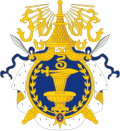 Royal Arms of Cambodia (1864–1953), lesser arms (1953–1970)
 -
 Royal Standard of the King of Cambodia (until 1970)
 -
 Royal Standard of The King of Cambodia (since 1993)

.svg)
.svg)

See also
- Monarchs' family tree
- List of heads of state of Cambodia
- Prime Minister of Cambodia
- Devaraja
- Abolition of monarchy
Notes
References
External links
- "$1 million royal gift for Kantha Bopha" in Khmer Times Template:Webarchive
- "Cambodia marks beginning of farming season with royal ploughing ceremony" in Xinhuanet
- "Cambodian king, PM wrap up annual Water Festival" in Xinhuanet
- {{#invoke:citation/CS1|citation
|CitationClass=web }}
{{#invoke:Navbox|navbox}} Template:Monarchs of Cambodia Template:Country topics Template:Southeast Asian leaders Template:Heads of state and government of Asia