Árpád
Template:Short description Template:About Template:Good article Template:Infobox royalty

Árpád ({{#invoke:IPA|main}}; Template:Circa 845 – Template:Circa 907) was the head of the confederation of the Magyar tribes at the turn of the 9th and 10th centuries. He might have been either the sacred ruler or kende of the Hungarians, or their military leader or gyula, although most details of his life are debated by historians, because different sources contain contradictory information. Despite this, many Hungarians refer to him as the "founder of our country", and Árpád's preeminent role in the Hungarian conquest of the Carpathian Basin has been emphasized by some later chronicles. The dynasty descending from Árpád ruled the Kingdom of Hungary until 1301.
Biography
Early life
Template:Further Árpád was the son of Álmos who is mentioned as the first head of the confederation of the Magyar tribes by all Hungarian chronicles.Template:SfnTemplate:Sfn His mother's name and family are unknown.Template:Sfn According to historian Gyula Kristó, Árpád was born around 845.Template:Sfn His name derived from the Hungarian word for barley, árpa.Template:Sfn
The Byzantine emperor Constantine Porphyrogenitus (r. 913–959) states that the Hungarians "had never at any time had any other prince" before Árpád, which is in sharp contrast to the Hungarian chronicles' report of the position of Árpád's father.<ref name="Constantine_Porphyrogenitus_173">Constantine Porphyrogenitus: De Administrando Imperio (ch. 38), p. 173.</ref>Template:Sfn In Porphyrogenitus's narration, the Khazar khagan initiated the centralization of the command of the Hungarian tribes in order to strengthen his own suzerainty over them.Template:SfnTemplate:Sfn The khagan initially wanted to appoint a chieftain named Levedi to lead the Hungarians.Template:Sfn However, Levedi did not accept this offer and suggested that either Álmos or Árpád should be promoted instead of him.Template:Sfn The khagan approached the Hungarians with this new proposal.Template:Sfn They preferred Árpád to his father, because he was "greatly admired for wisdom and counsel and valour, and capable of this rule".<ref name="Constantine_Porphyrogenitus_173"/>Template:Sfn Thereafter, Árpád was made "prince according to the custom ... of the Chazars, by lifting him upon a shield."<ref name="Constantine_Porphyrogenitus_173"/>Template:Sfn Constantine Porphyrogenitus erroneously refers to the Magyars as Turks.Template:SfnTemplate:Sfn<ref name="Howorth2008">Template:Cite book</ref> This was a misnomer, as while the Magyars do have some Turkic genetic and cultural influence, and their historical social structure was of Turkic origin,<ref>Template:Cite book</ref> they are not a Turkic people.<ref>A MAGYAROK TÜRK MEGNEVEZÉSE BÍBORBANSZÜLETETT KONSTANTINOS DE ADMINISTRANDOIMPERIO CÍMÛ MUNKÁJÁBAN - Takács Zoltán Bálint, SAVARIAA VAS MEGYEI MÚZEUMOK ÉRTESÍTÕJE28 SZOMBATHELY, 2004, pp. 317–333 [1]</ref>
The reliability of the Byzantine emperor's report of Árpád's election is debated by modern historians: for instance, Victor Spinei states that it is "rather vague and scarcely credible", but András Róna-Tas writes that its core is reliable.Template:SfnTemplate:Sfn The latter historian adds that Árpád's election was promoted by Álmos, who forced Levedi to renounce his position as kende. Accordingly, in Róna-Tas's view, Árpád succeeded Levedi as sacred ruler, or kende, which enabled his father to preserve his own position as the actual leader of the Hungarians, or gyula.Template:Sfn
The 17th century Volga Bulgar compilation Ja'far Tarikh (a work of disputed authenticity) represents Arbat (i.e Árpád) as the son and successor of Almuş (i.e Álmos) and brother of Khássán (i.e Kurszan). <ref> {{#invoke:citation/CS1|citation |CitationClass=web }}</ref>
Towards the Hungarian Conquest
Template:Further The earliest reliable source of Árpád's life is an early 10th-century document, the Continuation of the Chronicle by George the Monk.Template:SfnTemplate:SfnTemplate:Sfn It narrates that the Byzantine Emperor Leo VI the Wise (r. 886–912) sent his envoy Nicetas Sclerus to the Hungarians in 894 or 895 "to give presents" and incite them against the Bulgarian Empire.Template:Sfn Sclerus met with their two leaders, Árpád and Kurszán, at the Lower Danube.Template:SfnTemplate:Sfn Sclerus's mission succeeded: a Hungarian army soon crossed the Danube on Byzantine ships against Bulgaria.Template:SfnTemplate:Sfn An interpolation in Porphyrogenitus's text suggests that the invading Hungarians were under the command of Árpád's son, Liüntika.Template:Sfn
The positions held by Árpád and Kurszán at the time of their negotiations with Sclerus are debated by historians. Spinei wrote that Árpád was the gyula, and Kurszán was the kende.Template:Sfn In contrast, Kristó said that Kurszán was the gyula and Árpád represented his father, Álmos kende.Template:SfnTemplate:Sfn

The Hungarian army defeated the Bulgarians, but the latter hired the Pechenegs against them.Template:SfnTemplate:Sfn The Bulgarians and Pechenegs simultaneously invaded the Hungarians' territories in the western regions of the Pontic steppes in 895 or 896.Template:Sfn The destruction of their dwelling places by the Pechenegs forced the Hungarians to leave for a new homeland across the Carpathian Mountains towards the Pannonian Plain.Template:Sfn
The Illuminated Chronicle says that Árpád's father Álmos "could not enter Pannonia, for he was killed in Erdelw" or Transylvania.Template:SfnTemplate:Sfn<ref>The Hungarian Illuminated Chronicle (ch. 28), p. 98.</ref> Engel, Kristó and Molnár, who accept the reliability of this report, wrote that Álmos's death was a ritual murder, similar to the sacrifice of the Khazar khagans in case of a disaster affecting their people.Template:SfnTemplate:SfnTemplate:Sfn In contrast with them, Róna-Tas states that even if the report on Álmos's murder "reflects true event, the only possible explanation would be that Árpád or someone in his entourage" killed the aged prince.Template:Sfn Spinei rejects the Illuminated Chronicle's report on Álmos's murder in Transylvania, because the last mention of Álmos in the contrasting narration of the Gesta Hungarorum is connected to a siege of Ungvár (Uzhhorod, Ukraine) by the Hungarians.Template:Sfn The latter chronicle says that Álmos appointed Árpád "as leader and master" of the Hungarians on this occasion.Template:Sfn<ref>Anonymus, Notary of King Béla: The Deeds of the Hungarians (ch. 13), p. 37.</ref>
Reign

Árpád's name "is completely unknown" to all sources written in East Francia, which was one of the main powers of the Carpathian Basin at the turn of the 9th and 10th centuries.Template:Sfn These sources, including the Annales Alamannici and the Annales Eisnidlenses, only mention another Hungarian leader, Kurszán.Template:Sfn According to Kristó and other historians, these sources suggest that Kurszán must have been the gyula commanding the Hungarian forces, while Árpád succeeded his murdered father as the sacred kende.Template:SfnTemplate:Sfn Proposing a contrasting theory, the Romanian historian Curta wrote that Kurszán was the kende and Árpád gyula only succeeded him when Kurszán was murdered by Bavarians in 902 or 904.Template:SfnTemplate:Sfn
In contrast to nearly contemporaneous sources, Hungarian chronicles written centuries after the eventsTemplate:Mdashfor instance, the Gesta Hungarorum and the Illuminated ChronicleTemplate:Mdashemphasize Árpád's pre-eminent role in the conquest of the Carpathian Basin.Template:SfnTemplate:Sfn The Gesta Hungarorum also highlights Árpád's military skills and his generosity.Template:Sfn This chronicle also emphasizes that Tétény, one of the heads of the seven Hungarian tribes, acquired "the land of Transylvania for himself and his posterity" only after Árpád had authorized him to conquer it.<ref>Anonymus, Notary of King Béla: The Deeds of the Hungarians (ch. 24), p. 59.</ref>Template:Sfn
The Gesta Hungarorum says that Árpád took "an oath of the leading men and warriors of Hungary," and "had his son, Prince Zoltán elevated" to prince in his life.<ref name="Anonymus p. 115">Anonymus, Notary of King Béla: The Deeds of the Hungarians (ch. 52), p. 115.</ref>Template:Sfn However, the reliability of this report and the list of the grand princes in the Gesta Hungarorum is dubious.Template:Sfn For instance, it ignores Fajsz, who ruled when Constantine VII Porphyrogenitus was completing his De Administrando Imperio around 950.Template:Sfn
Death

The date of Árpád's death is debated.Template:Sfn The Gesta Hungarorum states that he died in 907.Template:SfnTemplate:Sfn However, Kristó wrote that he actually died in 900 or later because the Gesta says 903 is the starting date of the Hungarian "land-taking" instead of its actual date around 895.Template:Sfn If the Gesta's report on his funeral is reliable, Árpád was buried "at the head of a small river that flows through a stone culvert to the city of King Attila" where a village, Fehéregyháza, developed near Buda a century later.<ref name="Anonymus p. 115"/>Template:Sfn
Legacy
The Hungarians arrived in their new homeland within the Carpathians under Árpád.Template:Sfn Árpád is the principal actor in the Gesta Hungarorum, which attributes "almost all memorable events" of the "Hungarian land-taking" to him.Template:Sfn Furthermore, until the extinction of the male line of his dynasty in 1301, Hungary was ruled by "a single line of princes", all descending from Árpád.Template:Sfn Árpád is known among Hungarians as honalapító or the "founder of our homeland".Template:Sfn
Family

Porphyrogenitus says Árpád "had four sons: first, Tarkatzous; second, Ielech; third, Ioutotzas; fourth, Zaltas".Template:SfnTemplate:Sfn<ref>Constantine Porphyrogenitus: De Administrando Imperio (ch. 40), p. 179.</ref> However, he also refers to one "Liuntikas, son of" Árpád; Kristó wrote that Liuntikas (Liüntika) was an alternative name of Tarkatzous (Tarhos).Template:Sfn<ref>Constantine Porphyrogenitus: De Administrando Imperio (ch. 40), p. 177.</ref> The name and family of the mother of Árpád's sons are unknown.Template:Sfn The following is a family tree presenting Árpád's ancestors and his descendants to the end of the 10th century:Template:Sfn
Template:Tree chart/start
Template:Tree chart
Template:Tree chart
Template:Tree chart
Template:Tree chart
Template:Tree chart
Template:Tree chart
Template:Tree chart
Template:Tree chart
Template:Tree chart
Template:Tree chart
Template:Tree chart
Template:Tree chart
Template:Tree chart
Template:Tree chart
Template:Tree chart
Template:Tree chart/end
*Liüntika and Tarkatzus are supposed to have been identical.
**The father of Tas was one of Árpád's four or five sons, but his name is unknown.
***All later grand princes and kings of Hungary descended from Taksony.
Depictions of Árpád
-
 Árpád with Turul shield and princely hat in the center among the seven chieftains of the Hungarians (Chronicon Pictum, 1358)
 -
 Árpád, the First Captain (Chronicon Pictum, 1358)
 -
 Árpád tastes the water of the Danube, the Hungarians are shouting the name of God three times (Chronicon Pictum, 1358)
 -
 Árpád, the First Captain (Chronica Hungarorum, 1488)
 -
 Árpád (Nádasdy Mausoleum, 1664)
 -
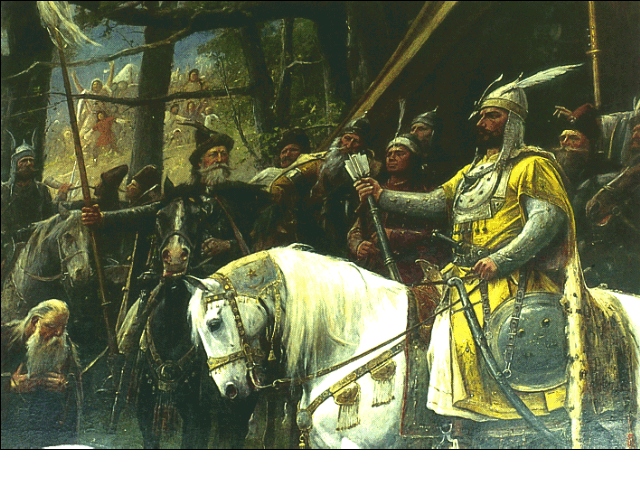
 Prince Árpád (painting by Árpád Feszty in 1900)
 -
 Árpád on Feszty's Panorama (painting by Árpád Feszty in 1892–1894)
 -
 Árpád's statue at the Heroes' Square (Budapest)
 -
 Árpád, Grand Prince of the Hungarians (Richárd Juha, Nyíradony, 2014)


See also
Footnotes
References
Primary sources
- Anonymus, Notary of King Béla: The Deeds of the Hungarians (Edited, Translated and Annotated by Martyn Rady and László Veszprémy) (2010). In: Rady, Martyn; Veszprémy, László; Bak, János M. (2010); Anonymus and Master Roger; CEU Press; Template:ISBN.
- Constantine Porphyrogenitus: De Administrando Imperio (Greek text edited by Gyula Moravcsik, English translation by Romillyi J. H. Jenkins) (1967). Dumbarton Oaks Center for Byzantine Studies. Template:ISBN.
- The Hungarian Illuminated Chronicle: Chronica de Gestis Hungarorum (Edited by Dezső Dercsényi) (1970). Corvina, Taplinger Publishing. Template:ISBN.
- The Taktika of Leo VI (Text, translation, and commentary by George T. Dennis) (2010). Dumbarton Oaks. Template:ISBN.
Secondary sources
- Template:Cite book
- Template:Cite book
- Template:Cite book
- Template:Cite book
- Template:Cite book
- Template:Cite book
- Template:Cite book
- Template:Cite book
- Template:Cite book
External links
- {{#invoke:citation/CS1|citation
|CitationClass=web }}
Template:Sister project Template:S-start Template:S-hou Template:S-reg |- Template:Succession box Template:S-end