Eddie Lang
Template:Short description Template:For Template:Infobox musical artist
Eddie Lang (born Salvatore Massaro; October 25, 1902 – March 26, 1933) was an American musician who is credited as the father of jazz guitar.<ref name="jf">Template:Cite book</ref> During the 1920s, he gave the guitar a prominence it previously lacked as a solo instrument, as part of a band or orchestra, and as accompaniment for vocalists.<ref name="Yanow">Template:Cite book</ref> He recorded duets with guitarists Lonnie Johnson and Carl Kress and jazz violinist Joe Venuti, and played rhythm guitar in the Paul Whiteman Orchestra and was the favoured accompanist of Bing Crosby.
Biography

.jpg)
The son of an Italian American instrument maker, Lang was born in Philadelphia, Pennsylvania,<ref name="hl">Template:Cite book</ref><ref name="McQuade">{{#invoke:citation/CS1|citation |CitationClass=web }}</ref> and grew up as friends with violinist Joe Venuti. He started playing the violin, his first instrument, when he was seven. He performed on violin in 1917 and became a member of a trio. In 1920, he dropped the violin for banjo and worked with Charlie Kerr, then Bert Estlow, Vic D'Ippolito, and Billy Lustig's Scranton Siren Orchestra. A few years later, he traded the banjo for guitar when he became a member of Red McKenzie's Mound City Blue Blowers.<ref name="Great">Template:Cite book</ref> In 1924, he recorded one of the first guitar solos on "Deep 2nd Street Blues".<ref name="McQuade" /> His performances with McKenzie's band drew attention, and he found many jobs as a freelance guitarist.<ref name="Great" /> Before him, the guitar hadn't been a prominent instrument in jazz bands and dance orchestras, playing primarily a rhythm part.<ref name="McQuade" />
Lang and Joe Venuti recorded with Roger Wolfe Kahn and Jean Goldkette and performed with the Adrian Rollini Orchestra.<ref name="Great" /> Lang recorded with blues guitarist Lonnie Johnson under the name Blind Willie Dunn to hide his race<ref name="Yanow" /><ref name="hl" /><ref name=obrecht/> and as a tribute to blues guitarist Blind Lemon Jefferson.<ref name="McQuade" /> He also worked with Frankie Trumbauer, Hoagy Carmichael, Annette Hanshaw, Red Nichols, Jack Pettis, Bessie Smith, and Clarence Williams.<ref name="Great" />
Friendship with Bing Crosby
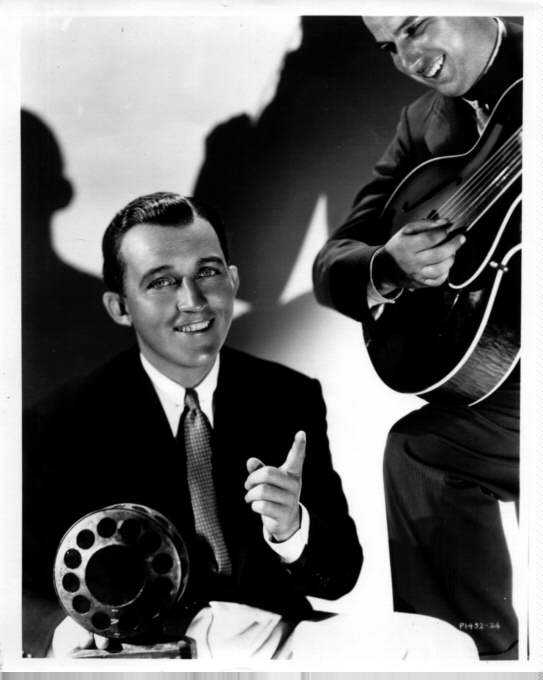
In 1929, Lang and Venuti became members of the Paul Whiteman Orchestra, and again Lang made an impact. Whiteman was impressed by his ability to learn songs quickly, though Lang had little education and could not read music. During the same year, vocalist Bing Crosby made his first solo recordings. His guitarist was Snoozer Quinn, but for the second session he invited Lang. Their friendship grew when Crosby joined the Whiteman Orchestra on its trip west to Hollywood to make the movie King of Jazz in which Lang and Venuti appeared. In 1930, when Crosby was looking for a job in radio, he insisted on having Lang as his accompaniment. Aside from his friendship with Crosby, he had experience accompanying vocalists, such as Rube Bloom and Ruth Etting. When Crosby toured soon after, Lang sat on a stool next to him to share the microphone. Lang's wife Kitty, a Ziegfeld girl, was friends with Crosby's wife, Dixie.<ref name="McQuade" /> He became a regular in Crosby's orchestra in 1932, the same year he appeared in the movie The Big Broadcast (1932).<ref name="Yanow" />
Death
Lang suffered from occasional laryngitis, chronic sore throat, and digestion problems. After a doctor recommended a tonsillectomy, Crosby urged Lang to have the operation.<ref name="McQuade" /><ref name="Sallis">Template:Cite book</ref> Assured that the operation was routine, Lang entered Park West Hospital in Manhattan, but he never awoke from the surgery. He died at the age of thirty in 1933.<ref name="McQuade" /><ref name="Mandell">Template:Cite journal</ref> The cause of his death is uncertain.<ref name="Sallis" /><ref name="Mandell" /> Lang is buried at Holy Cross Cemetery in Yeadon, Pennsylvania.<ref name="Mandell" />
Influence

Lang, along with New Orleans born Lonnie Johnson, were among the first single-string guitar soloists. He played the melody on one string while adding occasional chords. He demonstrated that the guitar could be a solo instrument in addition to being an accompaniment.<ref name="McQuade" />
While most bands of the time had a banjo player, Lang was skilled enough to make his acoustic guitar heard against the other instruments by using heavy gauge strings and a high action. He was so influential that, according to George Van Eps, banjo players had no choice but to switch to guitar.<ref name=obrecht>Template:Cite magazine</ref>
George Harrison once cited Lang as one of his favourite guitarists.<ref>{{#invoke:citation/CS1|citation |CitationClass=web }}</ref>
Lang played Gibson L-4 and L-5 guitars.<ref name="jb">Template:Cite book</ref><ref name="McQuade" />
Honors
In 1977, Lang's recording of "Singin' the Blues" with Frankie Trumbauer and Bix Beiderbecke, was inducted into the Grammy Hall of Fame and in 2006 was placed on the U.S. Library of Congress National Recording Registry. He was inducted into the ASCAP Jazz Wall of Fame (1986)<ref name="wall">{{#invoke:citation/CS1|citation |CitationClass=web }}</ref> and the Big Band and Jazz Hall of Fame (2010).
On October 23, 2016, Philadelphia's Mural Arts organization dedicated the mural Eddie Lang: The Father of Jazz Guitar, by artist Jared Bader. The mural stands by Lang's childhood home and the James Campbell School that stood at 8th and Fitzwater where Lang learned to play.<ref>Template:Cite news</ref> The mural was championed by area guitarist Richard Barnes, who started "Eddie Lang Day in Philadelphia" in 2010, an annual charity event.<ref name="Day">{{#invoke:citation/CS1|citation |CitationClass=web }}</ref>
Compositions
Lang's compositions, based on the Red Hot Jazz database, include "Wild Cat" with Joe Venuti, "Perfect" with Frank Signorelli, "April Kisses", "Sunshine", "Melody Man's Dream", "Goin' Places", "Black and Blue Bottom", "Bull Frog Moan", "Rainbow Dreams", "Feelin' My Way", "Eddie's Twister", "Really Blue", "Penn Beach Blues", "Wild Dog", "Pretty Trix", "A Mug of Ale", "Apple Blossoms", "Beating the Dog", "To To Blues", "Running Ragged", "Kicking the Cat", "Cheese and Crackers", "Doin' Things", "Blue Guitars", "Guitar Blues" with Lonnie Johnson, "Hot Fingers", "Have to Change Keys to Play These Blues", "A Handful of Riffs", "Blue Room", "Deep Minor Rhythm Stomp", "Two-Tone Stomp". "Midnight Call Blues", "Four String Joe", "Goin' Home", and "Pickin' My Way" with Carl Kress.<ref name="red">{{#invoke:citation/CS1|citation |CitationClass=web }}</ref>
Discography
Albums
- Stringing the Blues with Joe Venuti (CBS, 1962)
- Jazz Guitar Virtuoso (Yazoo, 1977)
- A Handful of Riffs (ASV/Living Era, 1989)
- Pioneers of Jazz Guitar 1927–1938 (Yazoo, 1992)
- Blue Guitars, Vols. 1 & 2 with Lonnie Johnson (BGO, 1997)
- The Quintessential Eddie Lang (Timeless, 1998)
- The New York Sessions 1926–1935 with Joe Venuti (JSP, 2003)
- The Classic Columbia and Okeh Joe Venuti and Eddie Lang (Mosaic, 2002)
- 1927–1932 (Chronological Classics, 2004)<ref name="Great" />
Singles
| Song | Musicians | Recording date | Label |
|---|---|---|---|
| Stringin' the Blues | Joe Venuti | November 8, 1926 | |
| Hurricane | Red Nichols and His Five Pennies | January 12, 1927 | |
| Wild Cat | Joe Venuti | January 24, 1927 | Okeh |
| Sunshine | Joe Venuti | January 24, 1927 | Okeh |
| Singin' the Blues | Bix Beiderbecke, Frankie Trumbauer | February 4, 1927 | Okeh |
| April Kisses b/w Eddie's Twister | April 1, 1927 | Okeh | |
| Doin' Things | Joe Venuti | May 4, 1927 | |
| Goin' Places | Joe Venuti | May 4, 1927 | |
| For No Reason at All in C | Bix Beiderbecke, Frankie Trumbauer | May 13, 1927 | Okeh, Columbia, Parlophone |
| Beating the Dog | Joe Venuti, Adrian Rollini | June 28, 1927 | Okeh |
| Wringin' an' Twistin' | Bix Beiderbecke, Frankie Trumbauer | September 17, 1927 | OKeh |
| Perfect | Frank Signorelli | October 21, 1927 | Okeh |
| Four String Joe | Joe Venuti's Blue Four | November 15, 1927 | |
| Guitar Blues | Lonnie Johnson | May 7, 1929 | Okeh |
| Knockin' a Jug | Louis Armstrong, Jack Teagarden | March 5, 1929 | |
| Kitchen Man | Bessie Smith | May 8, 1929 | |
| A Bench in the Park | Paul Whiteman and His Orchestra | March 21, 1930 | |
| Georgia on My Mind | Hoagy Carmichael, Bix Beiderbecke | September 15, 1930 | Victor |
| Pickin' My Way | Carl Kress | January 15, 1932 | Brunswick |
| Feelin' My Way | Carl Kress | January 17, 1932 | Brunswick |
| Please | Bing Crosby | September 16, 1932 | |
| Jigsaw Puzzle Blues | Joe Venuti, Eddie Lang's Blue Five | February 28, 1933 |
Bibliography
- Berend, Dave. Seven Original Compositions for the Guitar by the Great Eddie Lang: Transcribed and Arranged for Plectrum Guitar Solos with Guitar Accompaniment. Robbins Music, 1961.
- Mazzoletti, Adriano. Eddie Lang: Stringin' the Blues. Rome, Italy: Pantheon Editore, 1997.
- Peters, Mike. The Classic Columbia and Okeh Joe Venuti and Eddie Lang Sessions. Notes by Mike Peters, Marty Grosz, Richard M. Sudhalter, Scott Wenzel. Mosaic Records, 2002.
- Sallis, James, editor. Jazz Guitar: An Anthology. Quill Publishers, 1984.
- Worsfold, Sally-Ann. The Quintessential Eddie Lang, 1925–1932. Timeless Records, 1997.
References
External links
- Eddie Lang: Profiles in Jazz at The Syncopated Times
- Eddie Lang (1902-1933) at the Red Hot Jazz Archive
- Photo of Lang with Bing Crosby
- Eddie Lang recordings at the Discography of American Historical Recordings.
- Eddie Lang: Man and Music at VenutiLang.com.
- Template:Find a Grave
- Pages with broken file links
- 1902 births
- 1933 deaths
- 20th-century American guitarists
- American jazz guitarists
- Burials at Holy Cross Cemetery (Yeadon, Pennsylvania)
- Okeh Records artists
- American people of Italian descent
- American jazz musicians
- Guitarists from Philadelphia
- American male guitarists
- Jazz musicians from Pennsylvania
- 20th-century American male musicians
- American male jazz musicians
- Victor Recording Orchestra members
- Mound City Blue Blowers members