Gerry Conway
Template:Short description Template:About Template:Use mdy dates Template:Infobox comics creator Gerard Francis Conway<ref name="MSH43">Thomas, Roy. "Roy's Rostrum" ("Bullpen Bulletins") in Marvel Super-Heroes #43 and other Marvel Comics cover-dated May 1974.</ref> (born September 10, 1952)<ref name=foom>Template:Cite news</ref> is an American comic book writer, comic book editor, science fiction writer,<ref>https://www.isfdb.org/cgi-bin/ch.cgi?3287 Retrieved August 19, 2024.</ref> screenwriter, television writer, and television producer. He is known for co-creating the Marvel Comics vigilante antihero the Punisher as well as Peter Parker's clone Ben Reilly, the super villain Jackal, and the first Ms. Marvel, and also writing the death of the character Gwen Stacy during his long run on The Amazing Spider-Man in the story arc "The Night Gwen Stacy Died".
At DC Comics, he is known for co-creating the superheroes Firestorm, Power Girl, Jason Todd, and the villain Killer Croc, and for writing the Justice League of America for eight years. Conway wrote the first major, modern-day intercompany crossover, Superman vs. the Amazing Spider-Man.
Early life
Conway was born in Brooklyn, New York,<ref name=foom /> and was a fan of comics from a young age. A letter from him appears in Fantastic Four #50 (May 1966), written when Conway was 13.Template:Citation needed
He attended New York University for a time.<ref name=foom />
Career
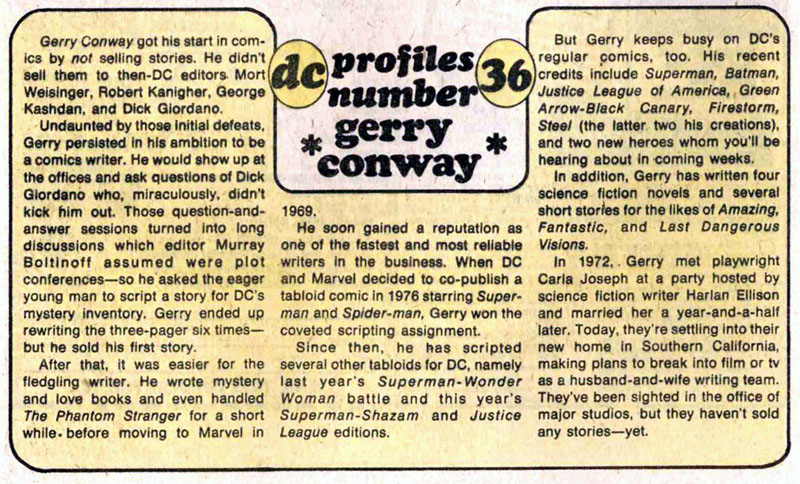
Conway published his first professional comic book work at 16,<ref name= "biocapsule">{{#invoke:citation/CS1|citation |CitationClass=web }}</ref> with the 6Template:Frac-page horror story "Aaron Philips' Photo Finish" in DC Comics' House of Secrets #81 (Sept. 1969). He continued selling such anthological stories for that series and for Marvel's Chamber of Darkness and Tower of Shadows through the end of 1970, by which time he had also published one-page text short stories in DC's All-Star Western #1 (Sept. 1970) and Super DC Giant #S-14 (Oct. 1970). He published his first continuing-character story in DC's semi-anthological occult comic The Phantom Stranger #10 (Dec. 1970).<ref name= gcd>Template:Gcdb and Template:Gcdb</ref>
Conway recalled breaking into Marvel Comics through Marvel editor Roy Thomas:
<templatestyles src="Template:Blockquote/styles.css" />
|}}{{#if:|
— {{#if:|, in }}Template:Comma separated entries
}}{{#invoke:Check for unknown parameters|check|unknown=Template:Main other|preview=Page using Template:Blockquote with unknown parameter "_VALUE_"|ignoreblank=y| 1 | 2 | 3 | 4 | 5 | author | by | char | character | cite | class | content | multiline | personquoted | publication | quote | quotesource | quotetext | sign | source | style | text | title | ts }}
Following his first continuing-character story for Marvel, with his script for the jungle lord Ka-Zar in Astonishing Tales #3 (Dec. 1970), Conway began writing superhero stories with Daredevil #72 (Jan. 1971). He quickly went on to assignments on Iron Man, The Incredible Hulk, and both "The Inhumans" and "The Black Widow" features in the split book Amazing Adventures. He scripted the first Man-Thing story, in 1971,<ref>Template:Cite book</ref> sharing co-creation credit with Stan Lee and Roy Thomas.<ref name= gcd /> Conway eventually scripted virtually every major Marvel title, and co-created (with writers Roy and Jean Thomas and artist Mike Ploog) the lead character of the feature "Werewolf by Night", in Marvel Spotlight #2 (Feb. 1972);<ref>Sanderson "1970s" in Gilbert (2008), p. 154: "Roy Thomas came up with the idea for a series called 'I, Werewolf', narrated in the first person by a teenager who transformed into a werewolf. Stan Lee liked the concept but decided to name it 'Werewolf by Night'. The initial creative team on the series was scripter Gerry Conway and artist Mike Ploog."</ref> he also wrote the premiere issue of Marvel's The Tomb of Dracula, introducing the longstanding literary vampire into the Marvel universe.<ref>Sanderson "1970s" in Gilbert (2008), p. 155: "Following the revision of the Comics Code, Stan Lee was eager to do a comics series about the archetypal vampire, novelist Bram Stoker's Dracula. Based on a few ideas from Lee, Roy Thomas plotted the first issue of The Tomb of Dracula, which Gerry Conway then scripted. The interior art was penciled by Gene Colan."</ref>
Spider-Man and intercompany rotation
At 19, Conway began scripting The Amazing Spider-Man, succeeding Stan Lee as writer of one of Marvel's flagship titles.<ref>Template:Cite book</ref> His run, from issues #111–149 (August 1972 – October 1975), included the landmark death of Gwen Stacy story in #121 (June 1973).<ref>Sanderson "1970s" in Gilbert (2008), p. 159: "In June [1973], Marvel embarked on a story that would have far-reaching effects. The Amazing Spider-Man artist John Romita, Sr. suggested killing off Spider-Man's beloved Gwen Stacy in order to shake up the book's status quo."</ref><ref>Manning "1970s" in Gilbert (2012), p. 68: "This story by writer Gerry Conway and penciler Gil Kane would go down in history as one of the most memorable events of Spider-Man's life."</ref><ref>Template:Cite book</ref> Eight issues later, Conway and Andru introduced the Punisher as a conflicted antagonist for Spider-Man, as well as the Jackal.<ref>Manning "1970s" in Gilbert (2012), p. 72: "Writer Gerry Conway and artist Ross Andru introduced two major new characters to Spider-Man's world and the Marvel Universe in this self-contained issue. Not only would the vigilante known as the Punisher go on to be one of the most important and iconic Marvel creations of the 1970s, but his instigator, the Jackal, would become the next big threat in Spider-Man's life."</ref> The Punisher became a popular star of numerous comic books and has been adapted into three movies and a live action television series. Conway additionally wrote Fantastic Four, from #133–152 (April 1973 – Nov. 1974).<ref name=gcd />
In 2009, Conway reflected on writing flagship Marvel characters at a young age:
<templatestyles src="Template:Blockquote/styles.css" />
Precocity is a well-known curse; most of the pressure I felt as a younger writer was self-imposed. I wanted to be accepted by other writers and artists as an equal, which put me in some awkward situations — pretending to be more mature than I was, emotionally and professionally. As it happened, I was pretty good at faking a maturity I didn't have, which had advantages and, obviously, some disadvantages. I think people often forgot how young I was, and expected me to perform at a level that was actually beyond me. The result was, I was pretty stressed for most of my early career as a writer, and I often felt like I had no idea what I was doing —which was true. I wrote instinctively and from the gut; when those instincts were appropriate to the material I was writing – for example, when I was writing [The Amazing] Spider-Man — the results were something I was quite proud of, then and now. When my instincts were off, I didn't have the experience to either recognize it, or to compensate for it, with results that were more uneven.<ref>{{#invoke:citation/CS1|citation
|CitationClass=web }}</ref>{{#if:|
|}}{{#if:|
— {{#if:|, in }}Template:Comma separated entries
}}{{#invoke:Check for unknown parameters|check|unknown=Template:Main other|preview=Page using Template:Blockquote with unknown parameter "_VALUE_"|ignoreblank=y| 1 | 2 | 3 | 4 | 5 | author | by | char | character | cite | class | content | multiline | personquoted | publication | quote | quotesource | quotetext | sign | source | style | text | title | ts }}
In late 1972, Conway and writers Steve Englehart and Len Wein crafted a metafictional unofficial crossover spanning titles from both major comics companies. Each comic featured Englehart, Conway, and Wein, as well as Wein's first wife Glynis, interacting with Marvel or DC characters at the Rutland Halloween Parade in Rutland, Vermont. Beginning in Amazing Adventures #16 (by Englehart with art by Bob Brown and Frank McLaughlin), the story continued in Justice League of America #103 (by Wein, Dick Dillin and Dick Giordano), and concluded in Thor #207 (by Conway and penciler John Buscema). As Englehart explained in 2010, "It certainly seemed like a radical concept and we knew that we had to be subtle (laughs) and each story had to stand on its own, but we really worked it out. It's really worthwhile to read those stories back to back to back – it didn't matter to us that one was at DC and two were at Marvel – I think it was us being creative, thinking what would be really cool to do."<ref>{{#invoke:citation/CS1|citation |CitationClass=web }}</ref><ref>{{#invoke:citation/CS1|citation |CitationClass=web }}</ref><ref>Amazing Adventures #16 (Jan. 1973), Justice League of America #103 (Dec. 1972), and Thor #207 (Jan. 1973) at the Grand Comics Database</ref>
Conway returned to DC Comics in mid-1975, beginning with three books cover-dated Nov. 1975: Hercules Unbound #1, Kong the Untamed #3, and Swamp Thing #19. He wrote a revival of the Golden Age comic book series All Star Comics, which introduced the character Power Girl.<ref>Template:Cite journal</ref><ref>Template:Cite book</ref><ref>Template:Cite book</ref> Shortly afterward, he was chosen by Marvel and DC editors to script the historic intercompany crossover Superman vs. the Amazing Spider-Man #1, a 96-page, tabloid-sized, $2 one-shot, at a time when comic books sold for 25 cents.<ref name=gcd /><ref>McAvennie "1970s" in Dolan, p. 170 "The tale was written by Gerry Conway and drawn by Ross Andru, both among the few [at that time] to ever have worked on both Superman and Spider-Man...The result was a defining moment in Bronze Age comics."</ref>
He continued writing for DC, on titles including Superman, Detective Comics (starring Batman), Metal Men, Justice League of America, 1st Issue Special #11 starring Codename: Assassin,<ref>Template:Cite journal</ref> and that of the licensed character Tarzan.<ref name=gcd /> Conway briefly returned to Marvel where he succeeded Marv Wolfman as editor-in-chief in March 1976,<ref>Template:Cite book</ref> but held the job only "about a month-and-a-half,"<ref name= BackIssue45p15>"Gerry Conway on Englehart Leaving Marvel" (sidebar) in Template:Cite journal</ref> relinquishing the post and being succeeded by Archie Goodwin.
For a time, a confluence of publishing schedules resulted in Conway stories appearing in both Marvel and DC comics in the same month: The prolific Conway's comic books with January 1977 cover-dates alone, for example, are Marvel's The Avengers, The Defenders, Captain Marvel, Iron Man, The Spectacular Spider-Man,<ref>Sanderson "1970s" in Gilbert (2008), p. 177: "Spider-Man already starred in two monthly series: The Amazing Spider-Man and Marvel Team-Up. Now Marvel added a third, Peter Parker, The Spectacular Spider-Man, initially written by Gerry Conway with art by Sal Buscema and Mike Esposito."</ref> and the premiere issues of Ms. Marvel and Logan's Run, and Superman and Action Comics.<ref name=gcd />
DC Comics and later career

After leaving Marvel's editorship, he again wrote exclusively for DC for the next decade writing both major and lesser titles – from those featuring Superman, Wonder Woman, and the Legion of Super-Heroes to such books as Weird Western Tales, Atari Force and Sun Devils. He had an eight-year run on Justice League of America, writing most issues from #151–255 (Feb. 1978 – Oct. 1986)<ref>Template:Cite journal</ref> including the double-sized anniversary issue #200 (March 1982).<ref>Template:Cite journal</ref> Conway wrote two additional Superman projects in the oversized tabloid format, Superman vs. Wonder Woman, drawn by José Luis García-López,<ref>Template:Cite journal</ref> and Superman vs. Shazam, drawn by Rich Buckler.<ref>Template:Cite journal</ref>
He co-created the characters Firestorm with artist Al Milgrom<ref>McAvennie "1970s" in Dolan, p. 177 "If inventiveness is the fusion of ideas, then Firestorm was one of the most original characters to emerge from a comic book in years. Penned by Gerry Conway and drawn by Al Milgrom, the Nuclear Man was a genuine sign of the times – the explosive embodiment of a nuclear world."</ref> and Steel with artist Don Heck<ref>McAvennie "1970s" in Dolan, p. 177 "Thanks to scripter Gerry Conway and artist Don Heck, the red, white, and blue shone like never before – on the steel-alloyed suit of the World War II cyborg, Steel."</ref> in the premiere issues (both March 1978) of the respective titular comics.<ref name=gcd /> Two other Conway co-creations, the Deserter (with artist Dick Ayers)<ref>Template:Cite news</ref><ref>Template:Cite journal</ref> and the Vixen (with artist Bob Oksner),<ref>Wells p. 134: "After being touted in house ads during the summer, details regarding The Vixen #1 appeared in a 'Daily Planet' text page in Batman #305 and The Flash #267. Ultimately, 'Who Is The Vixen?' was printed only in Cancelled Comic Cavalcade #2."</ref> were scheduled to receive their own series as well but were canceled before any issues were published. He additionally co-created the characters Vibe and Gypsy.<ref>Manning, Matthew K. "1980s" in Dolan, p. 209 "The prestigious Justice League of America got a bit easier to join, thanks to writer Gerry Conway and artist Chuck Patton. Marking the debut of camouflaging hero Gypsy, the shockwave-casting Vibe, and the second generation hero Steel, this landmark comic saw many of the more famous League members step down in order to make way for a younger roster to carry on their legacy."</ref> As writer of Batman #337–359 (July 1981 – May 1983) and the feature "Batman" in Detective Comics #497–526 (Dec. 1980 – May 1983),<ref>Template:Cite book</ref> he introduced the characters Killer Croc<ref>Manning "1980s" in Dolan, p. 200 "Killer Croc made his mysterious debut in the pages of Detective Comics #523, written by Gerry Conway, with art by Gene Colan." "Croc would soon become a major player in Gotham's underworld."</ref> and Jason Todd,<ref>Manning "1980s" in Dolan, p. 201 "Jason Todd first appeared in a circus scene in the pages of Batman #357, written by Gerry Conway and illustrated by Don Newton."</ref> the latter of whom became the second Robin, succeeding original sidekick Dick Grayson.<ref name=gcd /> With artist Gene Colan, Conway revived the Golden Age supervillains Doctor Death in Batman #345 (March 1982)<ref>Manning "1980s" in Dougall, p. 141</ref> and the Monk in Batman #350 (Aug. 1982).<ref>Manning "1980s" in Dougall, p. 142</ref>
Conway was a frequent collaborator with Roy Thomas. Together they wrote a two-part Superman–Captain Marvel team-up in DC Comics Presents #33–34 (May–June 1981); the Atari Force and Swordquest mini-comics packaged with Atari 2600 video games; and three Justice League of America-Justice Society of America crossovers.<ref>In Justice League of America #207–209 (Oct.-Dec. 1982) and All-Star Squadron #14–15 (Oct.–Nov. 1982); and Justice League of America #219–220 (Oct.–Nov. 1983); and Infinity, Inc. #19 (Oct. 1985) and Justice League of America #244 (Nov. 1985). Per Thomas, Roy. "The Justice League-Justice Society Team-Ups", The All-Star Companion (TwoMorrows Publishing 2000) Template:ISBN pp. 191–192</ref><ref>Thomas, Roy. "Crisis on Finite Earths: The Justice League-Justice Society Team-Ups (1963–1985)", Alter Ego vol. 3, #7 (Winter 2001), pp. 31–34</ref> Conway contributed ideas to the talking animal comic Captain Carrot and His Amazing Zoo Crew!, created by Thomas and Scott Shaw.<ref>Shaw, Scott "Captain Carrot and His Amazing Zoo Crew! Vol. 1, #1" Template:Webarchive, OddBallComics.com #1180, October 8, 2007</ref> Thomas and Conway were to be the co-writers of the JLA/Avengers intercompany crossover,<ref>George Pérez interview, David Anthony Kraft's Comics Interview #6 (Fictioneer, Aug. 1983).</ref> but editorial disputes between DC and Marvel caused the project's cancellation.<ref>O'Neill, Patrick Daniel. "Career Moves" (Pérez interview), Wizard #35 (July 1994)</ref> Conway was one of the contributors to the DC Challenge limited series in 1986.<ref>Template:Cite journal</ref>
He returned to Marvel in the 1980s and served as the regular writer of both The Spectacular Spider-Man and Web of Spider-Man from 1988 until 1990.<ref name=gcd /> Conway stated in 1991 that "I understand the character a lot better now than I did when I was nineteen. And one of the nice things about the Marvel characters is that you can keep them fresh by changing them just a bit."<ref>Daniels p. 222</ref> His run on Spectacular included such story arcs as the "Lobo Brothers Gang War".<ref>DeFalco "1980s" in Gilbert (2008), p. 238: Created by writer Gerry Conway and artist Sal Buscema, Carlos and Eduardo Lobo possessed the mutant ability to transform into werewolves.</ref> He relinquished writing duties on both titles when he became the story editor of the television series Father Dowling Mysteries.Template:Citation needed Conway's last recorded comic credits for many years were Topps Comics' "Kirbyverse" NightGlider<ref>Sources disagree on the spelling, sometimes even within the same source: The cover of the single issue itself appears to spell it "NightGlider". The cover of Victory #1 likewise spells it as one word, though in an all-caps typeface. The Grand Comics Database entry spells it as both "Nightglider" and "Night Glider".</ref> #1 (April 1993), scripting from a Roy Thomas plot, and a story for Disney Adventures, published in 1995.
Conway returned to comics in 2009 and wrote DC Comics' The Last Days of Animal Man, with artist Chris Batista.<ref>Template:Cite news</ref> In 2011, he wrote the DC Retroactive: Justice League – The '80s one-shot.<ref>{{#invoke:citation/CS1|citation |CitationClass=web }}</ref> Also for DC, he wrote the Firestorm feature in Legends of Tomorrow #1–6 in 2016.<ref>{{#invoke:citation/CS1|citation |CitationClass=web }}</ref>
In 2015, he returned to Spider-Man by writing a story in Spider-Verse Team Up #2, and the "Spiral" storyline in The Amazing Spider-Man #16.1–20.1. He returned to work as a series' regular writer that same year with Carnage which ran for 16 issues until 2017. In 2016, he returned to his creation the Punisher by writing The Punisher Annual #1. From 2016 to 2017, he wrote The Amazing Spider-Man: Renew Your Vows #1–9, followed by What If? Spider-Man #1 in 2018 and the oneshot The Amazing Spider-Man: Going Big, penciled by Mark Bagley, in 2019. In 2023, he wrote the plot for the oneshot What If...? Dark: Spider-Gwen.
Novels and Star Trek Comic Strip
In addition to comics, Conway published two science-fiction novels: The Midnight Dancers<ref>The Midnight Dancers (Ace, 1971, Template:ISBN; this is not the same-name book by Anne Maybury, nor Midnight Dancer by Emily Bradshaw)</ref> and Mindship (originally published as a short story in the science fiction anthology Universe 1.)<ref>Mindship (DAW, 1974, Template:ISBN).</ref> He also wrote the February 14–December 3, 1983, dailies of the syndicated newspaper comic strip Star Trek, based upon the 1960s TV series.<ref>{{#invoke:citation/CS1|citation |CitationClass=web }}</ref>
Screenplays and TV producing
Conway as well moved into screenwriting in the 1980s, starting with the animated feature Fire and Ice (1983), co-written with Roy Thomas, based on characters created by Ralph Bakshi and Frank Frazetta. Conway and Thomas wrote the story basis for Stanley Mann's screenplay for the film Conan the Destroyer (1984). Afterwards, Conway and Thomas also worked on the script of a live-action X-Men film for production company Nelvana that wasn't produced because of distributor Orion Pictures' financial troubles and subsequent bankruptcy.<ref>{{#invoke:citation/CS1|citation |CitationClass=web }}</ref>
Conway wrote, and later produced, such TV series as Father Dowling Mysteries, Diagnosis: Murder, Matlock, Jake and the Fatman, Under Suspicion, Hercules: The Legendary Journeys, Baywatch Nights, Pacific Blue, Silk Stalkings, Perry Mason telefilms, Law & Order, The Huntress, Law & Order: Criminal Intent, and two episodes of Batman: The Animated Series ("Appointment in Crime Alley", "Second Chance").<ref>{{#invoke:citation/CS1|citation |CitationClass=web }}</ref>
Conway frequently referenced his comic book connections during his stint on Law & Order by naming characters on the show after comic book creators such as John Byrne.
Personal life
Conway's first wife was comic-book writer Carla Conway.<ref name=filmref>{{#invoke:citation/CS1|citation |CitationClass=web }}</ref><ref>Template:Gcdb</ref> The couple have a daughter, Cara.<ref name=filmref /> His second wife, Karen, is a psychologist who works with autistic children.<ref name=biocapsule /> They married in 1992 and have a daughter, Rachel.<ref name=filmref /> As of 2015, Conway and Laura live in Thousand Oaks, California.<ref name=biocapsule />
Conway's ancestral family background is Irish, as he described in his blog:
<templatestyles src="Template:Blockquote/styles.css" />
In my case, on my mother's side, I'm a second-generation immigrant. My grandparents were born in Ireland. They came to America in the late 'teens of the last century and lived a life not very different from the life my housekeeper and her husband live today. My grandfather was a day laborer in the Brooklyn ship yards. My (step)-grandmother washed floors at Hunter College in Manhattan. (My biological grandmother died when my mother was eight years old, so I've no idea what she did to earn a living, but I assume it was either piece work or domestic work of some kind.) Because they were lower-class Irish, they were the Hispanics of their day – tolerated, but not embraced, by the larger society, and viewed with scorn by the WASP upper class. ... Even my father felt that anti-Irish prejudice, real or imagined. In the 1950s he once spoke, rather bitterly, about being one of the two 'token Irishmen' working at his company.<ref>{{#invoke:citation/CS1|citation
|CitationClass=web }}</ref>{{#if:|
|}}{{#if:|
— {{#if:|, in }}Template:Comma separated entries
}}{{#invoke:Check for unknown parameters|check|unknown=Template:Main other|preview=Page using Template:Blockquote with unknown parameter "_VALUE_"|ignoreblank=y| 1 | 2 | 3 | 4 | 5 | author | by | char | character | cite | class | content | multiline | personquoted | publication | quote | quotesource | quotetext | sign | source | style | text | title | ts }}
Conway was raised a Christian, but stated in a 2013 interview that he does not "have any religious belief at this point".<ref>Template:Cite journal</ref>
In October 2022, Conway was diagnosed with pancreatic cancer and underwent Whipple surgery to remove the tumor, resulting in several hospitalizations. In September 2023, he declared that he was cancer-free.<ref>{{#invoke:citation/CS1|citation |CitationClass=web }}</ref><ref>{{#invoke:citation/CS1|citation |CitationClass=web }}</ref>
Comics bibliography
Atlas/Seaboard Comics
- Destructor #4 (1975)
- Targitt #3 (1975)
- Tiger-Man #2–3 (1975)
DC Comics
- 1st Issue Special #11–13 (1976)
- Action Comics #457, 467, 477–479, 486, 517–523 (1976–1981)
- Adventure Comics #444, 459–460, 463–464 (1976–1979)
- All-New Collectors' Edition #C-54, C-58 (1978)
- All Star Comics #58–62 (1976)
- All-Star Squadron #8–9 (1982)
- The Amazing World of DC Comics #11 (1976)
- Arak, Son of Thunder #7 (1982)
- Atari Force #1–5 (1982–1983)
- Atari Force vol. 2 #1–13 (1984–1985)
- Batman #295, 305–306, 337–346, 348–359 (1978–1983)
- Batman Family #17 (1978)
- The Brave and the Bold #158, 161, 171–174 (1980–1981)
- Cancelled Comic Cavalcade #1–2 (1978)
- Challengers of the Unknown #81–87 (1977–1978)
- Cinder and Ashe #1–4 (1988)
- DC Challenge #8, 12 (1986)
- DC Comics Presents #17–18, 21, 30–33, 40, 45, 53, 68 (1980–1984)
- DC Retroactive: Justice League of America - The '80s #1 (2011)
- DC Special #28 (1977)
- DC Special Blue Ribbon Digest #5 (1980)
- DC Special Series #1, 6, 10, 16 (1977–1978)
- DC Super-Stars #18 (1978)
- Detective Comics #463–464, 497–499, 501–513, 515–526 (1976–1983)
- Doorway to Nightmare #2 (1978)
- Firestorm #1–5 (1978)
- The Fury of Firestorm #1-28, 31, 33-36, 38-53 (1982-1986)
- The Flash #289–299, 301–304 (Firestorm backup stories) (1980–1981)
- Forbidden Tales of Dark Mansion #8 (1972)
- Freedom Fighters #1–2 (1976)
- The Fury of Firestorm #1–53, 100 Annual #1–4 (1982–1986, 1990)
- Hercules Unbound #1–6 (1975–1976)
- Heroes Against Hunger #1 (1986)
- House of Mystery #188, 193, 196, 199–200, 202, 292–294, 296–297, 300 (1970–1982)
- House of Secrets #81, 83, 85–86, 88–89, 94, 111–112, 140, 150 (1969–1978)
- House of Secrets: The Bronze Age Omnibus Vol. 2 (story "Night of the Rat", originally intended for publication in House of Secrets #141) (2019)
- Jonah Hex #40–41, 45–47 (1980–1981)
- Justice League of America #125–127, 131–134, 151–216, 219, 221–223, 228–230, 233–239, 241–255, Annual #2 (1975–1986)
- Kamandi #39–44 (1976)
- Kong the Untamed #3–5 (1975–1976)
- Last Days of Animal Man #1–6 (2009)
- Legends of Tomorrow #1–6 (Firestorm feature) (2016)
- Legion of Super-Heroes vol. 2 #259–278 (1980–1981)
- Man-Bat #1 (1975)
- Metal Men #46–48, 54–56 (1976–1978)
- Mystery in Space #114 (1980)
- New Gods #12–19 (1977–1978)
- The New Teen Titans #16 (Captain Carrot and His Amazing Zoo Crew! insert) (1982)
- Phantom Stranger vol. 2 #10–11 (1970–1971)
- Secret Hearts #143, 147, 149 (1970–1971)
- Secret Origins vol. 2 #4, 17 (1986–1987)
- Secret Society of Super Villains #1–2, 8–14 (1976–1978)
- Star Spangled War Stories #193 (1975)
- Steel, The Indestructible Man #1–5 (1978)
- Sun Devils #1–9 (1984–1985)
- Super-Team Family #11–15 (1977–1978)
- Superboy and the Legion of Super-Heroes #227, 232, 234–235, 248–249, 252–258 (1977–1979)
- Superman #301, 303–304, 307–309, 345–348, 350–351, 407 (1976–1985)
- The Superman Family #175, 184, 186–193, 195–202, 206–211 (1976–1981)
- Swamp Thing #19–20, 23–24 (1975–1976)
- Swordquest #1–3 (1982)
- Tarzan #250–254 (1976)
- The Unexpected #221 (1982)
- Weird Western Tales #45–58, 60–70 (Scalphunter feature) (1978–1980)
- The Witching Hour #10, 14, 27, 38 (1970–1974)
- Wonder Woman #233–241, 259–285, 329 (1977–1986)
- World's Finest Comics #245–254, 256–259, 261–262, 268–270, 272, 274–275 (1977–1982)
- Young Love #122 (1976)
- Zatanna Special #1 (1987)
DC Comics and Marvel Comics
- Superman vs. the Amazing Spider-Man #1 (1976)
Disney Comics
- Disney Adventures v5 #4 (1995)
Eclipse Comics
- The Unknown Worlds of Frank Brunner #2 (1985)
First Comics
- Hawkmoon: The Jewel in the Skull #1–4 (1986)
- Hawkmoon: The Mad God's Amulet #1–4 (1987)
Marvel Comics
- Adventure into Fear #10 (1972)
- Amazing Adventures #7, 9–11, 18–19 (1971–1973)
- The Amazing Spider-Man #111–149 (1972–1975), Annual #23 (1989)
- The Amazing Spider-Man vol. 3 #16.1–20.1 (2015)
- The Amazing Spider-Man: Going Big #1 (2019)
- The Amazing Spider-Man: Renew Your Vows #1–9 (2016–2017)
- Astonishing Tales #3–8 (1970–1971)
- The Avengers #151–157, Annual #6 (1976–1977)
- Black Widow the Coldest War GN (1990)
- Captain America #149–152 (1972)
- Captain Marvel #22, 47–48 (1972–1977)
- Carnage #1–16 (2015–2017)
- Chamber of Chills #1 (1972)
- Chamber of Darkness #3 (1970)
- Conan the Barbarian #226–231 (1989–1990)
- Creatures on the Loose #18 (1972)
- Daredevil #72–98, 118 (1971–1975)
- Daredevil Annual #5 (1989)
- Deadly Hands of Kung Fu #1, 3–4 (1974)
- Defenders #42–45, 57 (1976–1978)
- Dracula Lives #1, 3–5, 7, 9, 12–13 (1973–1975)
- Fantastic Four #133–152, 179 (1973–1977)
- Ghost Rider #21–23 (1976–1977)
- Giant-Size Fantastic Four #2–3 (1974)
- Giant-Size Spider-Man #3–5 (1975)
- Giant-Size Super-Heroes #1 (Spider-Man) (1974)
- Giant-Size Super-Stars #1 (Fantastic Four) (1974)
- Haunt of Horror #1–2, 4 (1974)
- The Incredible Hulk #146–147, 171 (1971–1972, 1974)
- Iron Man #35–44, 91–97 (1971–1977)
- Justice #9–11, 13 (1987)
- Ka-Zar vol. 2 #6–10 (1974–1975)
- Kull and the Barbarians #2 (1975)
- Kull the Conqueror #4–7, 9–10 (1972–1973)
- Legion of Monsters #1 (1975)
- Logan's Run #1 (1977)
- Marvel Comics #1000 (2019)
- Marvel Comics Presents #101–109 (1992)
- Marvel Graphic Novel: Conan:The Horn of Azoth GN (1990)
- Marvel Graphic Novel: The Amazing Spider-Man: Parallel Lives GN (1989)
- Marvel Point One #1 (Carnage) (2015)
- Marvel Preview #2 (1975)
- Marvel Spotlight #2–4 (1972)
- Marvel Super-Heroes vol. 2 #4 (1990)
- Marvel Team-Up #2–12, 28–37, 52 (1972–1976)
- Monsters on the Prowl #13 (1971)
- Monsters Unleashed #1–2, 6–7, 11 (1973–1975)
- Ms. Marvel #1–2 (1977)
- Our Love Story #15 (1972)
- Planet of the Apes #1 (1974)
- The Punisher Annual #1 (2016)
- Punisher Bloodlines #1 (1992)
- Savage Sword of Conan #166–169, 174 (1989–1990)
- Savage Tales #2, 6–10 (1973–1975)
- Sgt. Fury and his Howling Commandos #86, 117–119 (1971–1974)
- The Spectacular Spider-Man #1–3, 137–174, Annual #8–11 (1976–1977, 1988–1991)
- Spider-Man/Dr. Strange: The Way to Dusty Death #1 (1993)
- Spider-Man: Fear Itself GN (1992)
- Spider-Verse Team-Up #2 (2015)
- Spitfire and the Troubleshooters #1–6 (1986–1987)
- Sub-Mariner #40–49 (1971–1972)
- Tales of the Zombie #4, 10 (1974–1975)
- Thor #193–238 (1971–1975)
- ThunderCats #7–12, 24 (1986–1988)
- The Tomb of Dracula #1–2 (1972)
- Tower of Shadows #5 (1970)
- Unknown Worlds of Science Fiction #1–4 (1975)
- Vampire Tales #3, 8–10 (1974–1975)
- Visionaries #3–6 (1988)
- Web of Spider-Man #35–36, 47–48, 50–70, Annual #5–6 (1988–1990)
- Werewolf by Night #1–4, 9–10 (1972–1973)
- What If? Spider-Man #1 (2018)
- What If? Dark: Spider-Gwen #1 (plot) (2023)
- Worlds Unknown #1–2, 4, 6 (1973–1974)
Papercutz
- Nancy Drew: Girl Detective - The New Case Files #3 ("Together with the Hardy Boys") (2011)
Skywald Publications
- Nightmare #3 (1971)
Topps Comics
- NightGlider #1 (1993)
Warren Publications
Screenwriting credits
Feature films
- Fire and Ice (1983)
- Conan the Destroyer (1984)
Television
- G.I. Joe: A Real American Hero (1985–1986)
- Where the Reptiles Roam
- Spell of the Siren
- The Million Dollar Medic
- Second Hand Emotions
- The Transformers (1986)
- Forever Is a Long Time Coming
- Money Is Everything
- The Centurions (1986)
- Whalesong
- Tornado of Terror
- That Old Black Magic
- Crack the World
- The Mummy's Curse
- Counterclock Crisis
- Return of Cassandra
- Ghost Warrior
- Let the Lightning Fall
- My Little Pony (1986–1987)
- Pony Puppy
- Would Be Dragonslayer
- The Golden Horseshoes" (Parts 1 & 2)
- Dinosaucers (1987)
- The Babysitter
- Spiral Zone (1987)
- Canal Zone
- Brother’s Keeper
- Dino-Riders (1988)
- The Adventure Begins
- Monsters (1990)
- Father Dowling Mysteries (1990–1991)
- The Confidence Mystery
- The Royal Mystery
- The Movie Mystery
- The Murder Weekend Mystery
- The Substitute Sister Mystery
- The Priest Killer Mystery
- The Consulting Detective Mystery
- Jake and the Fatman (1992)
- Perry Mason: The Case of the Heartbroken Bride (TV movie) (1992)
- Matlock (1992–1993)
- The Vacation
- The Ghost
- Batman: The Animated Series (1992, 1994)
- Appointment in Crime Alley
- Diagnosis: Murder (1993–1997)
- Inheritance of Death
- Murder with Mirrors
- Flashdance with Death
- Lily
- Shaker
- The Plague
- A Very Fatal Funeral
- Playing for Keeps
- Misdiagnosis Murder
- Mind Over Murder
- FMurder
- In Defense of Murder
- A History of Murder
- Murder, Country Style
- Physician, Murder Thyself
- Malibu Fire
- Diagnosis: Murder - A Twist of the Knife (TV movie) (1993)
- Perry Mason: The Case of the Killer Kiss (TV Movie) (1993)
- Spider-Man: The Animated Series (1994)
- Night of the Lizard
- A Perry Mason Mystery: The Case of the Jealous Jokester (TV movie) (1995)
- Two (1996)
- Black Ops
- Pacific Blue (1996)
- Wheels of Fire
- Silk Stalkings (1996, 1998)
- Services Rendered
- Dead Again... And Again
- Players (1997)
- Con Artist
- Rashocon
- Three of a Con
- Conspiracy
- Contamination
- Baywatch Nights (1997)
- The Servant
- Hercules: The Legendary Journeys (1998–1999)
- Somewhere Over the Rainbow Bridge
- Fade Out
- My Best Girl's Wedding
- Law & Order (1999–2000)
- Hunters
- Justice
- Collision
- High & Low
- The Huntress (2000)
- Partners
- The Two Mrs. Thorsons" (Parts 1 & 2)
- Generations
- Ah, Wilderness
- Showdown
- With Great Power
- The Quest" (Parts 1 & 2)
- Law & Order: Criminal Intent (2003–2006)
- Con-Text
- Probability
- Blink
- But Not Forgotten
- F.P.S.
- Conscience
- Semi-Detached
- Collective
- No Exit
- Saving Face
- Wrongful Life
- The Good
References
External links
- A Conversation with Gerry Conway (Comic Geek Speak: Episode 701, Podcast)
- Template:Comicbookdb
- "DC Profiles #36: Gerry Conway" at the Grand Comics Database
- [https://www.imdb.com/{{#if: 0176689
 | name/{{#if:{{#invoke:ustring|match|1=0176689|2=^nm}}
   | Template:Trim/
   | nm0176689/
   }}
 | {{#if: {{#property:P345}}
   | name/Template:First word/
   | find?q=%7B%7B%23if%3A+%0A++++++%7C+%7B%7B%7Bname%7D%7D%7D%0A++++++%7C+%5B%5B%3ATemplate%3APAGENAMEBASE%5D%5D%0A++++++%7D%7D&s=nm
   }}
 }}{{#if: 0176689  {{#property:P345}} | {{#switch:
 | award | awards = awards Awards for | biography | bio = bio Biography for
 }}}} {{#if:
 | {{{name}}}
 | Template:PAGENAMEBASE
 }}] at IMDb{{#if: 0176689{{#property:P345}}
 | Template:EditAtWikidata
 | Template:Main other
}}{{#switch:{{#invoke:string2|matchAny|^nm.........|^nm.......|nm|.........|source=0176689|plain=false}}
 | 1 | 3 =  Template:Main otherTemplate:Preview warning
 | 4 = Template:Main otherTemplate:Preview warning
}}{{#invoke:Check for unknown parameters|check|unknown=Template:Main other|preview=Page using Template:IMDb name with unknown parameter "_VALUE_"|showblankpositional=1| 1 | 2 | id | name | section }}
- Gerry Conway interview at Fantastic Four Headquarters
- Gerry Conway Template:Webarchive at Mike's Amazing World of Comics
- Gerry Conway at the Unofficial Handbook of Marvel Comics Creators
- Women in Refrigerators: "Gerry Conway Responds"
- The New York Times- Movies: Gerry Conway
Template:S-start Template:Succession box Template:Succession box Template:Succession box Template:Succession box Template:Succession box Template:Succession box Template:Succession box Template:Succession box Template:Succession box Template:Succession box Template:Succession box Template:Succession box Template:Succession box Template:Succession box Template:Succession box Template:Succession box Template:Succession box Template:Succession box
{{safesubst:#if:|||} }}{{safesubst:#invoke:Check for unknown parameters|check|unknown=Template:Main other|preview=Page using Template:End with unknown parameter "_VALUE_"|ignoreblank=y| html | 1 }}
Template:Firestorm Template:Man-Thing Template:Punisher Template:Marvel Comics Template:Inkpot Award 2010s Template:Authority control
- Pages with broken file links
- 1952 births
- Living people
- 20th-century American male writers
- 21st-century American male writers
- 20th-century American writers
- 21st-century American writers
- 20th-century American screenwriters
- American comic book editors
- American male television writers
- American people of Irish descent
- American television writers
- DC Comics people
- Inkpot Award winners
- Marvel Comics editors-in-chief
- Marvel Comics writers
- Screenwriters from New York (state)
- Writers from Brooklyn