Hittin
Template:Redirect Template:Pp-extended Template:Main other{{#invoke:Infobox|infobox}}Template:Template other{{#invoke:Check for unknown parameters|check|unknown=Template:Main other|preview = Page using [[Template:Template:If empty]] with unknown parameter "_VALUE_"|ignoreblank=y|mapframe_args=y | alt | anthem | anthem_link | area_blank1_acre | area_blank1_dunam | area_blank1_ha | area_blank1_km2 | area_blank1_sq_mi | area_blank1_title | area_blank2_acre | area_blank2_dunam | area_blank2_ha | area_blank2_km2 | area_blank2_sq_mi | area_blank2_title | area_code | area_code_type | area_codes | area_footnotes | area_land_acre | area_land_dunam | area_land_ha | area_land_km2 | area_land_sq_mi | area_metro_acre | area_metro_dunam | area_metro_footnotes | area_metro_ha | area_metro_km2 | area_metro_sq_mi | area_note | area_rank | area_rural_acre | area_rural_dunam | area_rural_footnotes | area_rural_ha | area_rural_km2 | area_rural_sq_mi | area_total_acre | area_total_dunam | area_total_ha | area_total_km2 | area_total_sq_mi | area_urban_acre | area_urban_dunam | area_urban_footnotes | area_urban_ha | area_urban_km2 | area_urban_sq_mi | area_water_acre | area_water_dunam | area_water_ha | area_water_km2 | area_water_percent | area_water_sq_mi | blank_emblem_alt | blank_emblem_link | blank_emblem_size | blank_emblem_type | blank_emblem_sizedefault | blank_emblem_upright | blank_info | blank_info_sec1 | blank_info_sec2 | blank_name | blank_name_sec1 | blank_name_sec2 | blank1_info | blank1_info_sec1 | blank1_info_sec2 | blank1_name | blank1_name_sec1 | blank1_name_sec2 | blank2_info | blank2_info_sec1 | blank2_info_sec2 | blank2_name | blank2_name_sec1 | blank2_name_sec2 | blank3_info | blank3_info_sec1 | blank3_info_sec2 | blank3_name | blank3_name_sec1 | blank3_name_sec2 | blank4_info | blank4_info_sec1 | blank4_info_sec2 | blank4_name | blank4_name_sec1 | blank4_name_sec2 | blank5_info | blank5_info_sec1 | blank5_info_sec2 | blank5_name | blank5_name_sec1 | blank5_name_sec2 | blank6_info | blank6_info_sec1 | blank6_info_sec2 | blank6_name | blank6_name_sec1 | blank6_name_sec2 | blank7_info | blank7_info_sec1 | blank7_info_sec2 | blank7_name | blank7_name_sec1 | blank7_name_sec2 | caption | code1_info | code1_name | code2_info | code2_name | coor_pinpoint | coor_type | coordinates | coordinates_footnotes | demographics_type1 | demographics_type2 | demographics1_footnotes | demographics1_info1 | demographics1_info10 | demographics1_info2 | demographics1_info3 | demographics1_info4 | demographics1_info5 | demographics1_info6 | demographics1_info7 | demographics1_info8 | demographics1_info9 | demographics1_title1 | demographics1_title10 | demographics1_title2 | demographics1_title3 | demographics1_title4 | demographics1_title5 | demographics1_title6 | demographics1_title7 | demographics1_title8 | demographics1_title9 | demographics2_footnotes | demographics2_info1 | demographics2_info10 | demographics2_info2 | demographics2_info3 | demographics2_info4 | demographics2_info5 | demographics2_info6 | demographics2_info7 | demographics2_info8 | demographics2_info9 | demographics2_title1 | demographics2_title10 | demographics2_title2 | demographics2_title3 | demographics2_title4 | demographics2_title5 | demographics2_title6 | demographics2_title7 | demographics2_title8 | demographics2_title9 | dimensions_footnotes | dunam_link | elevation_footnotes | elevation_ft | elevation_link | elevation_m | elevation_max_footnotes | elevation_max_ft | elevation_max_m | elevation_max_point | elevation_max_rank | elevation_min_footnotes | elevation_min_ft | elevation_min_m | elevation_min_point | elevation_min_rank | elevation_point | embed | established_date | established_date1 | established_date2 | established_date3 | established_date4 | established_date5 | established_date6 | established_date7 | established_title | established_title1 | established_title2 | established_title3 | established_title4 | established_title5 | established_title6 | established_title7 | etymology | extinct_date | extinct_title | flag_alt | flag_border | flag_link | flag_size | footnotes | founder | geocode | governing_body | government_footnotes | government_type | government_blank1_title | government_blank1 | government_blank2_title | government_blank2 | government_blank2_title | government_blank3 | government_blank3_title | government_blank3 | government_blank4_title | government_blank4 | government_blank5_title | government_blank5 | government_blank6_title | government_blank6 | grid_name | grid_position | image_alt | image_blank_emblem | image_caption | image_flag | image_map | image_map1 | image_seal | image_shield | image_size | image_skyline | imagesize | image_sizedefault | image_upright | iso_code | leader_name | leader_name1 | leader_name2 | leader_name3 | leader_name4 | leader_name5 | leader_party | leader_title | leader_title1 | leader_title2 | leader_title3 | leader_title4 | leader_title5 | length_km | length_mi | map_alt | map_alt1 | map_caption | map_caption1 | mapsize | mapsize1 | module | motto | motto_link | mottoes | name | named_for | native_name | native_name_lang | nickname | nickname_link | nicknames | official_name | other_name | p1 | p10 | p11 | p12 | p13 | p14 | p15 | p16 | p17 | p18 | p19 | p2 | p20 | p21 | p22 | p23 | p24 | p25 | p26 | p27 | p28 | p29 | p3 | p30 | p31 | p32 | p33 | p34 | p35 | p36 | p37 | p38 | p39 | p4 | p40 | p41 | p42 | p43 | p44 | p45 | p46 | p47 | p48 | p49 | p5 | p50 | p6 | p7 | p8 | p9 | parts | parts_style | parts_type | pop_est_as_of | pop_est_footnotes | population | population_as_of | population_blank1 | population_blank1_footnotes | population_blank1_title | population_blank2 | population_blank2_footnotes | population_blank2_title | population_demonym | population_demonyms | population_density_blank1_km2 | population_density_blank1_sq_mi | population_density_blank2_km2 | population_density_blank2_sq_mi | population_density_km2 | population_density_metro_km2 | population_density_metro_sq_mi | population_density_rank | population_density_rural_km2 | population_density_rural_sq_mi | population_density_sq_mi | population_density_urban_km2 | population_density_urban_sq_mi | population_est | population_footnotes | population_metro | population_metro_footnotes | population_note | population_rank | population_rural | population_rural_footnotes | population_total | population_urban | population_urban_footnotes | postal_code | postal_code_type | postal2_code | postal2_code_type | pushpin_image | pushpin_label | pushpin_label_position | pushpin_map | pushpin_map_alt | pushpin_map_caption | pushpin_map_caption_notsmall | pushpin_map_narrow | pushpin_mapsize | pushpin_outside | pushpin_overlay | pushpin_relief | registration_plate | registration_plate_type | seal_alt | seal_link | seal_size | seal_type | seat | seat_type | seat1 | seat1_type | seat2 | seat2_type | settlement_type | shield_alt | shield_link | shield_size | short_description | subdivision_name | subdivision_name1 | subdivision_name2 | subdivision_name3 | subdivision_name4 | subdivision_name5 | subdivision_name6 | subdivision_type | subdivision_type1 | subdivision_type2 | subdivision_type3 | subdivision_type4 | subdivision_type5 | subdivision_type6 | template_name | timezone | timezone_DST | timezone_link | timezone1 | timezone1_DST | timezone1_location | timezone2 | timezone2_DST | timezone2_location | timezone3 | timezone3_DST | timezone3_location | timezone4 | timezone4_DST | timezone4_location | timezone5 | timezone5_DST | timezone5_location | total_type | translit_lang1 | translit_lang1_info | translit_lang1_info1 | translit_lang1_info2 | translit_lang1_info3 | translit_lang1_info4 | translit_lang1_info5 | translit_lang1_info6 | translit_lang1_type | translit_lang1_type1 | translit_lang1_type2 | translit_lang1_type3 | translit_lang1_type4 | translit_lang1_type5 | translit_lang1_type6 | translit_lang2 | translit_lang2_info | translit_lang2_info1 | translit_lang2_info2 | translit_lang2_info3 | translit_lang2_info4 | translit_lang2_info5 | translit_lang2_info6 | translit_lang2_type | translit_lang2_type1 | translit_lang2_type2 | translit_lang2_type3 | translit_lang2_type4 | translit_lang2_type5 | translit_lang2_type6 | type | unit_pref | utc_offset | utc_offset_DST | utc_offset1 | utc_offset1_DST | utc_offset2 | utc_offset2_DST | utc_offset3 | utc_offset3_DST | utc_offset4 | utc_offset4_DST | utc_offset5 | utc_offset5_DST | website | width_km | width_mi }}{{#invoke:Check for clobbered parameters|check | template = [[Template:Template:If empty]] | cat = Template:Main other | population; population_total | image_size; imagesize | image_alt; alt | image_caption; caption | settlement_type; type | utc_offset1; utc_offset | timezone1; timezone }}{{#if:
|
}}Template:Main other{{#ifexpr:{{#invoke:ParameterCount|main|mapframe|image_map|image_map1|pushpin_map}} >2 |Template:Main other}}
Hittin (Template:Langx, transliterated Ḥiṭṭīn (Template:Langx) or Ḥaṭṭīn (Template:Langx)) was a Palestinian village located Template:Convert west of Tiberias before it was occupied by Israel during the 1948 Arab-Israeli war when most of its original residents became refugees after being ethnically cleansed.<ref>Pappé, 2006, p. 249</ref> As the site of the Battle of Hattin in 1187, in which Saladin reconquered most of Palestine from the Crusaders, it has become an Arab nationalist symbol. The shrine of Nabi Shu'ayb, venerated by the Druze and Sunni Muslims as the tomb of Jethro, is on the village land. The village was ruled by the Ottoman Empire from the 16th century until the end of World War I, when Palestine became part of the British Mandate for Palestine. On July 17 1948, the village was occupied by Israel during the Nakba, after its residents fled out of their homes because of Nazareth's occupation. in later years, the Moshavs Arbel and Kfar Zeitim were erected where Hittin used to be.
History

Hittin was located on the northern slopes of the double hill known as the "Horns of Hattin." It was strategically and commercially significant due to its location overlooking the Plain of Hittin, which opens onto the coastal lowlands of the Lake Tiberias (the Sea of Galilee) to the east, and to the west is linked by mountain passes leading towards the plains of lower Galilee. These plains, with their east–west passages, served as routes for commercial caravans and military invasions throughout the ages.<ref name=Khalidip521>Khalidi, 1992, p. 521.</ref>
Prehistory
Archaeological excavations near the village have yielded pottery fragments from the Pottery Neolithic and Chalcolithic period.<ref name="Getzov">Nimrod Getzov, 2007, Hittin, Volume 119, Year 2007, Israel Antiquities Authority</ref>
Bronze Age to Byzantine period
An Early Bronze Age wall was excavated just west of the village.<ref name="Getzov"/> The Arab village may have been built over the Canaanite town of Siddim or Ziddim (Template:Bibleverse), which in the third century BCE acquired the Old Hebrew name Kfar Hittin ("village of grain"). It was known as Kfar Hittaya in the Roman period.<ref>Jerusalem Talmud, Megillah 1:1 (2a)</ref><ref name="Rosenfeld">See p. 77 [21] in: Template:Cite journal</ref> In the 4th century CE, it was a Jewish rabbinical town.<ref name=Khalidip521/>
Crusader/Ayyubid and Mamluk periods
Hittin was located near the site of the Battle of Hattin, where Saladin defeated the Crusaders in 1187.<ref name=Poolep408>Lane-Poole, 1898, pp. 197 ff</ref> It is described as having been near the base camp of Saladin's Ayyubid army, by Lieutenant-Colonel Claude Conder in Latin Kingdom of Jerusalem (1897).<ref name="Conder">Conder, 1897, p. 149</ref>
Many prominent figures from the Islamic period in Palestine were born or buried in Hittin, according to early Arab geographers such as Yaqut al-Hamawi (1179–1229) and al-Ansari al-Dimashqi (1256–1327), who himself was called the Shaykh of Hittin. 'Ali al-Dawadari, the writer, Quranic exegetist, and calligrapher, died in the village in 1302.<ref name=Khalidip521/>
Ottoman period
In 1596, Hittin was a part of the Ottoman Nāḥiyah (Template:Langx, "Subdistrict") of Tiberias under the Liwā’ (Template:Langx, "District") of Safed. The villagers paid taxes on wheat, barley, olives, goats and beehives.<ref name=Hutterothp190>Hütteroth and Abdulfattah, 1977, p. 190. Quoted in Khalidi, p. 521.</ref><ref>Note that Rhode, 1979, p. 6 Template:Webarchive writes that the register that Hütteroth and Abdul-Fattah studied was not from 1595/6, but from 1548/9</ref> In 1646, the bulaydah (Template:Langx, "small village") was visited by Evliya Çelebi, who described it as follows: "It is a village in the territory of Safad, consisting of 200 Muslim houses. No Druzes live here. It is like a flourishing little town (bulayda) abounding with vineyards, orchards and gardens. Water and air are refreshing. A large fair is held there once a week, when ten thousand men would gather from the neighbourhood to sell and buy. It is situated in a spacious valley, bordered on both sides by low rocks. There is a mosque, a public bath and a caravanserei in it."<ref name="Celebi3">Template:Cite journal</ref> Çelebi also reported that there was a shrine called the Teyké Mughraby, inhabited by over one hundred dervishes, which held the grave of Sheikh 'Imād ed-dīn, of the family of the prophet Shu'eib, who was reputed to have lived for two hundred years.<ref name="Celebi3"/>
Richard Pococke, who visited in 1727, writes that it is "famous for some pleasant gardens of lemon and orange trees; and here the Turks have a mosque, to which they pay great veneration, having, as they say, a great sheik buried there, whom they call Sede Ishab, who, according to tradition (as a very learned Jew assured me) is Jethro, the father-in-law of Moses."<ref name=Pocockep67>Pococke, 1745, vol 2, p. 67</ref> Around this time and until the late 18th century, Hittin was a small village in the autonomous sheikhdom of Zahir al-Umar. In 1766, Zahir's son Sa'id sought to control Hittin and nearby Tur'an, but was defeated by his father. Nonetheless, Zahir granted Sa'id both villages when he pardoned him.<ref>Joudah, 1987, pp. 51-52.</ref> A map from Napoleon's invasion of 1800 by Pierre Jacotin showed the place, named as Hattin.<ref>Karmon, 1960, p. 166 Template:Webarchive.</ref>
Johann Ludwig Burckhardt, a Swiss traveller to Palestine around 1817, noted Hittin as a village,<ref name=Burckhardtp250>Burckhardt, 1822, pp. 319, 336</ref> while in 1838 Edward Robinson described it as a small village of stone houses.<ref>Robinson and Smith, 1841, vol 3, p. 250</ref> William McClure Thomson, who visited in the 1850s, found "gigantic" hedges of cactus surrounding Hittin. He reported that visiting the local shrine was considered a cure for insanity.<ref>Thomson, 1859, vol 2, pp. 117-118</ref>
In 1863 H. B. Tristram, wrote about the "bright faces and bright colours" he saw there, and the "peculiar" costumes: "long tight gowns, or cassocks, of scarlet silk, with diagonal yellow stripes, and generally a bright red and blue or yellow jacket over them; while their cheeks were encircled by piastres, after Nazareth fashion, and some of the more wealthy wore necklaces of gold coins, with a doubloon for pendant in front."<ref name=Tristramp451>Tristram, 1865, p. 451</ref> In 1875 Victor Guérin visited the village, mentioning in his writings that there was a local tradition that alleged that the tomb of Jethro (Neby Chaʾīb), the father-in-law of Moses, was to be found in the village.<ref>Guérin, 1880, pp. 190-191</ref>
In 1881, the PEF's Survey of Western Palestine described Hittin as a large well-built village of stone, surrounded by fruit and olive trees. It had an estimated 400-700 villagers, all Muslim, who cultivated the surrounding plain.<ref name=SWP360>Conder and Kitchener, 1881, SWP I, p .360. Quoted in Khalidi, 1992, p. 521</ref>
A population list from about 1887 showed Hattin to have about 1,350 inhabitants; 100 Jews and 1,250 Muslims.<ref>Schumacher, 1888, p. 185</ref> An elementary school was established in the village around 1897.<ref name=Khalidip521/>
Conder writes in his Latin Kingdom of Jerusalem (1887): "The place was surrounded by olives and fruit trees, and a good spring—copious and fresh—flowed on the northwest into the gorge of Wadi Hammam."<ref name="Conder"/>
In the early 20th-century, some of the village land in the eastern part of the Arbel Valley was sold to Jewish land purchase societies. In 1910, the first Jewish village, Mitzpa, was established there.<ref name=Khalidip521/>
British Mandate

In 1924, the second Jewish village, Kfar Hittim, was established on land purchased from Hattin.<ref name=Khalidip521/>
In the 1922 census of Palestine, conducted by the Mandatory Palestine authorities, the population of Hattin was 889; 880 Muslims and 9 Jews,<ref name=Census1922>Barron, 1923, Table xi, Sub-district of Tiberias, p. 39</ref> increasing in the 1931 census to 931, all Muslims, in a total of 190 houses.<ref name=Census1931>Mills, 1932, p. 82</ref>
In 1932 Sheikh Izz ad-Din al-Qassam and the local Palestinian leadership affiliated with the Istiqlal party inaugurated a celebration on the anniversary of Saladin's victory in Hittin. Hittin Day, held on August 27 of that year in the courtyard of a school in Haifa, was intended to be an anti-imperialist rally. It was attended by thousands of people from Palestine, Lebanon, Damascus, and Transjordan. The speeches delivered at the event centered around the independence of the Arab world and the importance of unity between Arab Muslims and Christians.<ref name=Matthewsp153>Matthews, 2006, p. 153</ref>
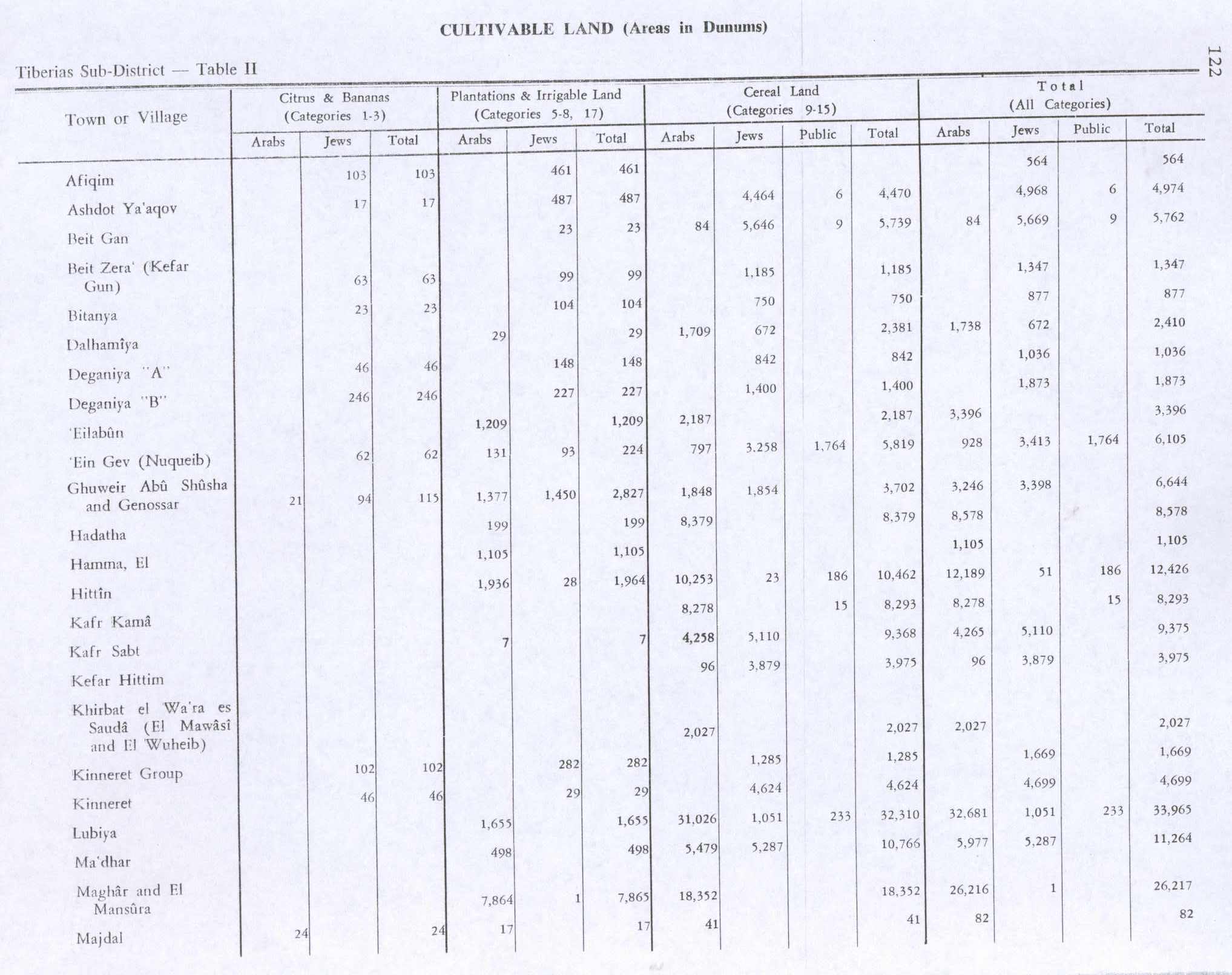
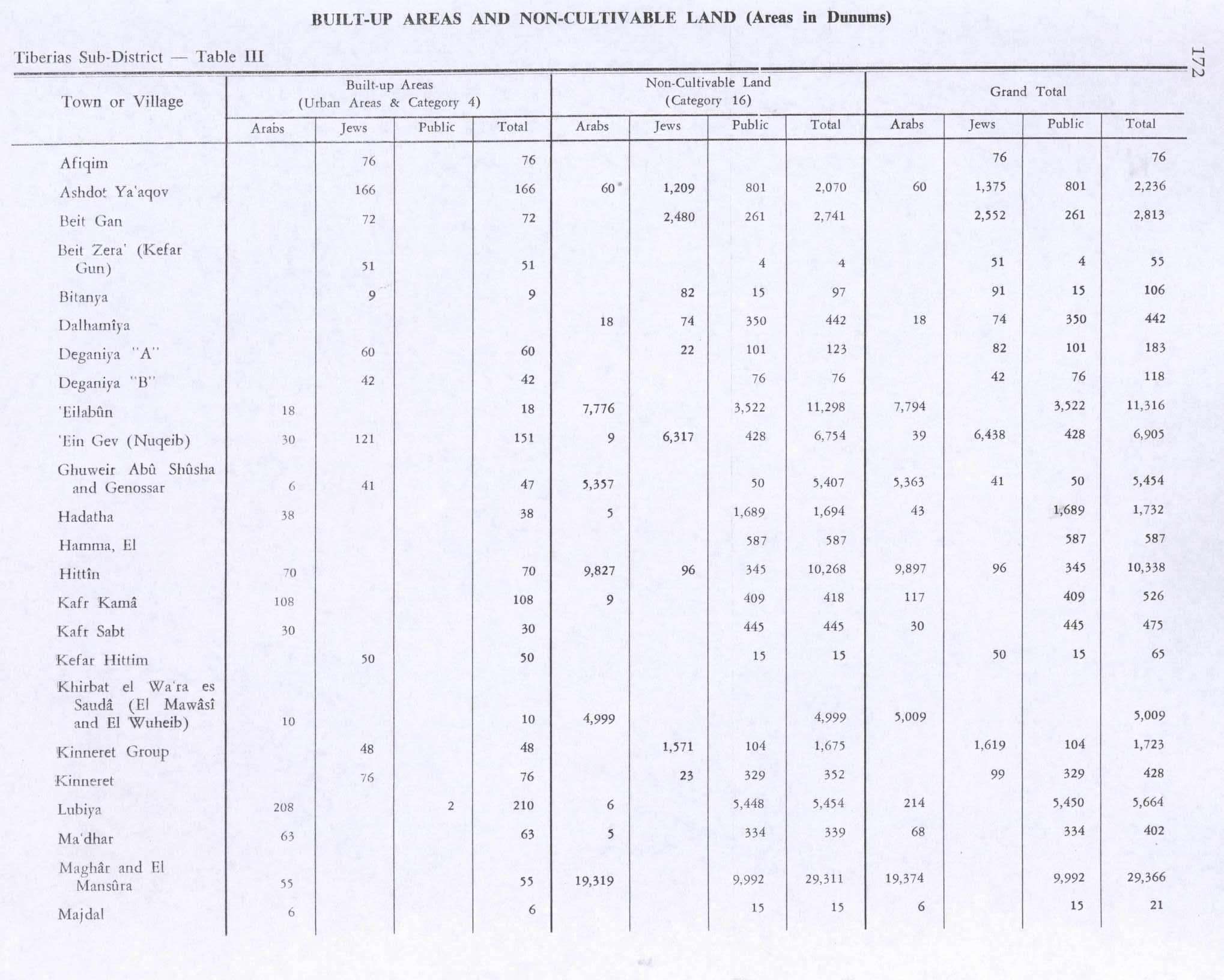
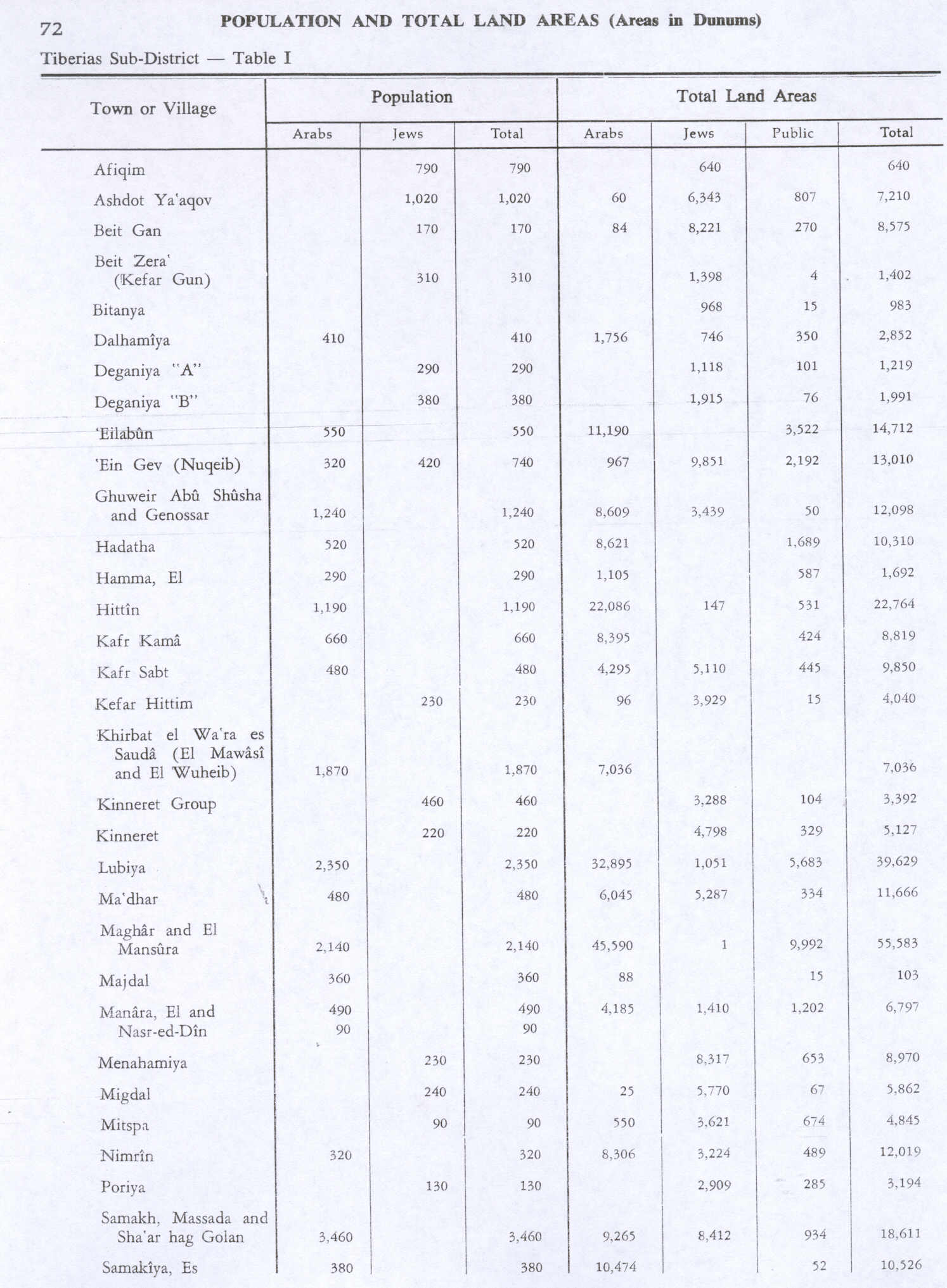
In 1945, Hittin had a population of 1,190 Muslims<ref name=1945p12/> with a total land area of 22,764 dunams (22.764 km2), of which 22,086 dunams were Arab-owned and 147 dunams were Jewish-owned. The remaining 531 dunams were public property.<ref name=Hadawi72/> Cultivable land amounted to 12,426 dunams, while uncultivated land amounted to 10,268 dunams. Of the cultivated land, 1,967 dunams consisted of plantations and irrigable land, and 10,462 dunams were devoted to cereals.<ref name=Hadawi122>Government of Palestine, Department of Statistics. Village Statistics, April, 1945. Quoted in Hadawi, 1970, p. 122</ref> The built-up area of the village was 70 dunams and it was populated entirely by Arabs.<ref name=Hadawi172>Government of Palestine, Department of Statistics. Village Statistics, April, 1945. Quoted in Hadawi, 1970, p. 172</ref>
1948 War
In 1948 the village mukhtar was Ahmad ´Azzam Abu Radi. According to the villagers, they did not feel threatened by their Jewish neighbours at Kfar Hittim, who had visited in November 1947 after the UN vote in favor of the United Nations Partition Plan, and assured the villagers they did not want war.<ref name=Nazzal84>Nazzal, 1978, p. 84</ref><ref>A History of the Israeli-Palestinian Conflict, Mark Tessler, Indiana University Press</ref> There were 50 men in the village who had rifles, with 25-50 rounds of ammunition each.<ref name=Nazzal84/>

The villagers grew anxious listening to Radio Amman and Radio Damascus, but remained uninvolved until June 9, when Jewish fighters attacked the neighbouring village of Lubya and were repulsed. Shortly after an Israeli armoured unit, accompanied by infantry, advanced towards the village from the direction of Mitzpa. The attack was rebuffed, but all the local ammunition was used up.<ref name="Nazzal, p. 85">Nazzal, 1978, p. 85</ref> On the night of July 16–17, almost all the inhabitants of the village evacuated. Many left for Sallama, between Deir Hanna and Maghar, leaving behind a few elderly people and 30-35 militiamen.<ref name="Nazzal, p. 85"/> On July 17, Hittin was occupied by the Golani Brigade as part of Operation Dekel.<ref name=Morrisp423>Morris, 2004, p. 423</ref> When the villagers tried to return, they were chased off. On one occasion, some men and pack animals were killed.<ref>Yehuda, Golani Brigade\Intelligence, Daily Summary 25-26.8, IDFA 1096\49\\64. Cited in Morris, 2004, p. 445</ref>
The villagers remained at Salamah for almost a month, but as their food-supply dwindled and their hope of returning faded, they left together for Lebanon.<ref name="Nazzal, p. 85"/> Some resettled in Nazareth. The Israeli government considered allowing 560 internally displaced Palestinians from Hittin and Alut to return to their villages, but the army objected to Hittin for security reasons.<ref name=Masalhap107>Masalha, 2005, p. 107</ref>
State of Israel

In 1949 and 1950, the Jewish villages of Arbel and Kfar Zeitim were founded on the lands of Hittin.<ref>Khalidi, 1992, p. 523</ref> In the 1950s, the Druze community in Israel was given official custodianship over the Jethro shrine and 100 dunams of land around it. A request to build housing there for Druze soldiers was rejected. The Druze annual pilgrimage continued to be held and was officially recognized as a religious holiday by Israel in 1954.<ref name=Firrop236>Firro, 1999, p. 236</ref>
According to Ilan Pappé, a resident of Deir Hanna unsuccessfully applied to hold a summer camp on the site of the Hittin mosque, which he hoped to restore. The land is currently used as grazing pasture by the nearby kibbutzim. According to tradition, the mosque was built by Saladin in 1187 to commemorate his victory over the Crusaders.<ref>Pappé, 2006, p. 218</ref> In 2007, an Israeli-Palestinian advocacy organization, Zochrot, protested development plans that encroach on the site and threaten to "swallow up the abandoned remains of the Hittin village."<ref name=Nicollep91>Nicolle, 1993, p. 91Template:Dead link</ref>
Nabi Shu'ayb shrine, the tomb of Jethro
Ali of Herat wrote (c. 1173) that both Jethro and his wife were buried in Hittin. Yaqut al-Hamawi (1179–1229) wrote that another shrine near Arsuf that claimed to be the tomb of Shu'aib was misidentified.<ref>le Strange, 1890, p.450, p.451</ref> Sunni Muslims and Druze would make ziyarat pilgrimages to Hittin to the Tomb of Shu'ayb, and the Druze celebration at the site attracted members of their religion from other parts of the region of Syria.<ref name=Firrop236/><ref name=Nicollep91/>Template:When
Demographics
In 1596 Hittin had a population of 605.<ref name=Hutterothp190/> In the 1922 census of Palestine Hittin had a population of 889,<ref name=Census1922/> which rose to 931 in the 1931 census. There were 190 houses that year.<ref name=Census1931/><ref>Bitan, 1982, p. 101.</ref> In 1945 the population was estimated at 1,190 Arabs.<ref name=Hadawi72>Government of Palestine, Department of Statistics. Village Statistics, April, 1945. Quoted in Hadawi, 1970, p. 72</ref> The village had a number of large and influential families; Rabah, 'Azzam, Chabaytah, Sa'adah, Sha'ban, Dahabra, and Houran.<ref name=Nazzal84/>

See also
- Depopulated Palestinian locations in Palestine
- List of villages depopulated during the Arab–Israeli conflict
- Religious significance of the Syrian region
References
Bibliography
- Template:Cite book
- Template:Cite book
- Template:Cite book
- Template:Cite book
- Template:Cite book
- Template:Cite journal
- Template:Cite book
- Template:Cite book
- Template:Cite journal
- Template:Cite book
- Template:Cite book
- Template:Cite journal
- Template:Cite journal
- Template:Cite book
- Template:Cite book
- Template:Cite journal
- Template:Cite book
- Template:Cite book
- Template:Cite book
- Template:Cite book
- Template:Cite book
- Template:Cite book
- Template:Cite journal
- Template:Cite book
- Template:Cite book
- Template:Cite book
- Template:Cite book (p.152 )
- Template:Cite book
- Template:Cite book
- Template:Cite book
- Template:Cite book
- Template:Cite book
- Template:Cite book
- Template:Cite journal
- Template:Cite book
- Template:Cite book
- Template:Cite book
External links
- Welcome To Hittin
- Hittin, Zochrot
- Survey of Western Palestine, Map 6: IAA, Wikimedia commons
- Hittin, from the Khalil Sakakini Cultural Center

Template:Palestinian Arab villages depopulated during the 1948 Palestine War Template:Authority control