Robert Millikan
Template:Short description {{#invoke:Hatnote|hatnote}} Template:Use mdy dates {{#invoke:infobox|infoboxTemplate | bodyclass = vcard | bodystyle = {{#if:|width: {{{mainwidth}}}}} | child = {{{embed}}}
| abovestyle = font-size: 100%;
| above = {{#if:|
}}
{{#if:|
}}
| subheaderstyle = font-size:125%; font-weight:bold;
| subheader = {{#ifeq:{{{embed}}}|yes||{{#if:|{{#if:|
}}}}}}
| image = {{#invoke:InfoboxImage|InfoboxImage|image=Millikan.jpg|size=|upright=1|alt=|suppressplaceholder=yes}} | image2 = {{#invoke:InfoboxImage|InfoboxImage|image=|size=|upright=1|alt=|suppressplaceholder=yes}} | image3 = {{#invoke:InfoboxImage|InfoboxImage|image=|upright=1|alt=|suppressplaceholder=yes}} | captionstyle = line-height:normal;padding-top:0.2em; | caption{{#if:|3|{{#if:|2}}}} = Millikan in 1923
| headerstyle = color: #202122; {{#ifeq:{{{embed}}}|yes|background:#eee|background:lavender}}
| data1 = {{#if:| {{#if:|| Template:Infobox officeholder/office}}}}Template:Infobox officeholder/office{{#if:|| Template:Infobox officeholder/office}}{{#if:|| {{#if:|| Template:Infobox officeholder/office}}}}{{#if:|| Template:Infobox officeholder/office}}{{#if:|| Template:Infobox officeholder/office}}{{#if:|| Template:Infobox officeholder/office}}{{#if:|| Template:Infobox officeholder/office}}{{#if:|| Template:Infobox officeholder/office}}{{#if:|| Template:Infobox officeholder/office}}{{#if:|| Template:Infobox officeholder/office}}{{#if:|| Template:Infobox officeholder/office}}{{#if:|| Template:Infobox officeholder/office}}{{#if:|| Template:Infobox officeholder/office}}{{#if:|| Template:Infobox officeholder/office}}{{#if:|| Template:Infobox officeholder/office}}{{#if:|| Template:Infobox officeholder/office}}{{#if:|| Template:Infobox officeholder/office}}
| data2 = | header3 = {{#if:Robert Andrews MillikanTemplate:Birth dateMorrison, Illinois, USTemplate:No wrapSan Marino, California, USForest Lawn Memorial Park, Glendale, California|Personal details}} | label4 = Pronunciation | data4 =
| label5 = Born | data5 = {{#invoke:Separated entries|br
  |1={{#if:Robert Andrews Millikan|Robert Andrews Millikan}}
  |2={{#invoke:person date|birth}}
|3={{#if:Morrison, Illinois, US|
}}
}}
| label6 = Died | data6 = {{#invoke:Separated entries|br
|1={{#invoke:person date|death}}
|2={{#if:San Marino, California, US|
}}
}}
| label7 = {{#ifexpr: Template:Strfind short
| Manner |{{#if:|Manner|Cause}} }} of death
| data7 = {{#if:||}}
| label8 = Resting place | class8 = label | data8 = {{#invoke:Separated entries|br|Forest Lawn Memorial Park, Glendale, California|}}
| label9 = Citizenship | data9 =
| label10 = Nationality | data10 = {{#if:|{{#if:{{#invoke:find country|main|string=Morrison, Illinois, US}}|{{#switch:{{#invoke:delink|delink|{{{nationality}}}}}| {{#ifeq:{{#invoke:Country2nationality||{{#invoke:find country|main|string={{#invoke:delink|delink|Morrison, Illinois, US}}}}|nocat=true}}|{{#invoke:delink|delink|{{{nationality}}}}}|{{#invoke:delink|delink|{{{nationality}}}}}}} = | {{#ifeq:{{#invoke:find country|main|string=Morrison, Illinois, US}}|England|British}} = | #default = {{{nationality}}}}}|{{{nationality}}}}}|}} | label11 = Political party | data11 = {{#switch: | = | Democrat | Democratic | Democrat = Democratic | Republican | United States Republican Party | Republican | Republican Party = Republican | Conservative Party | Conservative = Conservative | Labour Party | Labour = Labour | Conservative Party | Conservative = Conservative | Liberal Party | Liberal = Liberal | KMT | Kuomintang | KMT | KMT | Kuomintang | Kuomintang (KMT) | Kuomintang (KMT) = Kuomintang | DPP | DPP | Democratic Progressive Party = Democratic Progressive Party | #default = }}
| label12 = Other political
affiliations
| data12 =
| label13 = Height | data13 = {{#if:|Template:Infobox person/height}}
| label14 = Spouse{{#if:|s|{{#invoke:Detect singular|pluralize||likely=(s)|plural=s}}}} | data14 =
| label15 = Domestic partner{{#invoke:Detect singular|pluralize||likely=(s)|plural=s}} | data15 =
| label16 = Relations | data16 =
| label17 = Children | data17 =
| label18 = Parent{{#if:|{{#invoke:Detect singular|pluralize||likely=(s)|plural=s}}|{{#ifexpr:Template:Count > 1|s}}}} | data18 = {{#if:|{{{parents}}}|{{#invoke:list|unbulleted|{{#if:|{{{father}}} (father)}}|{{#if:|{{{mother}}} (mother)}}}}}}
| label19 = Relatives | data19 =
| label20 = Residence{{#invoke:Detect singular|pluralize||likely=(s)|plural=s}} | class20 = {{#if:Template:No wrapSan Marino, California, US||label}} | data20 =
| label21 = Education | data21 =
| label22 = Alma mater | data22 =
| label23 = Occupation | data23 =
| label24 = Profession | data24 =
| label25 = Known for | data25 =
| label26 = Salary | data26 =
| label27 = Cabinet | data27 =
| label28 = Committees | data28 =
| label29 = Portfolio | data29 =
| label30 = {{#if:|Civilian awards|Awards}} | data30 =
| label31 = {{{blank1}}} | data31 =
| label32 = {{{blank2}}} | data32 =
| label33 = {{{blank3}}} | data33 =
| label34 = {{{blank4}}} | data34 =
| label35 = {{{blank5}}} | data35 =
| label36 = Signature | data36 = {{#if:|[[File:{{{signature}}}|{{#if:|{{{signature_size}}}|128x80px}}|class=skin-invert notpageimage|alt=|Robert Millikan's signature]]}}
| label37 = Website | data37 =
| label38 = Nickname{{#invoke:Detect singular|pluralize||likely=(s)|plural=s}} | data38 =
| header39 = {{#if:|Military service}}
| label40 = Allegiance | data40 =
| label41 = {{#if:||Branch/service}} | data41 =
| label42 = {{#if:||Years of service}} | data42 =
| label43 = {{#if:||Rank}} | data43 =
| label44 = {{#if:||Unit}} | data44 =
| label45 = Commands | data45 =
| label46 = {{#if:||Battles/wars}} | data46 =
| label47 = {{#if:|Military awards|Awards}} | data47 =
| label48 = {{{military_blank1}}} | data48 =
| label49 = {{{military_blank2}}} | data49 =
| label50 = {{{military_blank3}}} | data50 =
| label51 = {{{military_blank4}}} | data51 =
| label52 = {{{military_blank5}}} | data52 =
| data53 = Template:Infobox person | data54 = | data55 = | data56 = | data57 = | data58 = | belowstyle = border-top: 1px solid right;
| below =
{{#if:|Source: [{{{source}}}]}}
}}{{#if:|{{#ifeq:{{#ifeq:|no|yes}}|yes||}} }}{{#if:|{{#ifeq:{{#ifeq:|no|yes}}|yes||}} }}{{#if:|{{#if:||{{#ifeq:{{#ifeq:|no|yes}}|yes||}}}} }}{{#invoke:Check for unknown parameters|check|unknown=Template:Main other|preview=Page using Template:Infobox officeholder with unknown parameter "_VALUE_"|ignoreblank=y| regexp1 = 1blankname[%d]* | regexp2 = 1namedata[%d]* | regexp3 = 2blankname[%d]* | regexp4 = 2namedata[%d]* | regexp5 = 3blankname[%d]* | regexp6 = 3namedata[%d]* | regexp7 = 4blankname[%d]* | regexp8 = 4namedata[%d]* | regexp9 = 5blankname[%d]* | regexp10 = 5namedata[%d]* | allegiance | alma_mater | regexp11 = alongside[%d]* | alt | regexp12 = ambassador_from[%d]* | regexp13 = appointed[%d]* | regexp14 = appointer[%d]* | regexp15 = assembly[%d]* | awards | battles | battles_label | birth_date | birth_name | birth_place | birthname | regexp16 = blank[%d]* | bodyclass | branch | branch_label | cabinet | candidate | caption | categories | regexp17 = chancellor[%d]* | children | citizenship | regexp18 = co%-leader[%d]* | commands | committees | regexp19 = constituency[%d]* | regexp20 = constituency_AM[%d]* | regexp21 = constituency_MP[%d]* | regexp22 = convocation[%d]* | regexp23 = country[%d]* | regexp24 = data[%d]* | date | death_cause | death_date | death_manner | death_place | demo | regexp25 = deputy[%d]* | regexp26 = district[%d]* | education | election_date | embed | father | regexp28 = firstminister[%d]* | footnotes | regexp29 = governor[%d]* | regexp30 = governor_general[%d]* | regexp31 = governor%-general[%d]* | height | honorific_prefix | honorific-prefix | honorific_suffix | honorific-suffix | image | image name | image_name_alt | image_size | imagesize | image_upright | incumbent | regexp32 = jr/sr[%d]* | regexp33 = jr/sr and state[%d]* | known_for | regexp34 = leader[%d]* | regexp35 = legislature[%d]* | regexp36 = lieutenant[%d]* | regexp37 = lieutenant_governor[%d]* | mainwidth | regexp38 = majority[%d]* | regexp39 = majority_floor_leader[%d]* | regexp40 = majority_leader[%d]* | regexp41 = majorityleader[%d]* | mawards | regexp42 = military_blank[%d]* | regexp43 = military_data[%d]* | regexp44 = minister[%d]* | regexp45 = minister_from[%d]* | regexp46 = minority_floor_leader[%d]* | regexp47 = minority_leader[%d]* | regexp48 = minorityleader[%d]* | regexp49 = module[%d]* | regexp50 = monarch[%d]* | mother | name | nationality | native_name | native_name_lang | nickname | nocat | regexp51 = nominator[%d]* | nominee | occupation | regexp52 = office[%d]* | opponent | regexp53 = order[%d]* | otherparty | parents | regexp54 = parliament[%d]* | regexp55 = parliamentarygroup[%d]* | partner | party | party_election | portfolio | regexp56 = preceded[%d]* | regexp57 = preceding[%d]* | regexp58 = predecessor[%d]* | regexp59 = premier[%d]* | regexp60 = president[%d]* | regexp61 = primeminister[%d]* | regexp62 = prior_term[%d]* | profession | pronunciation | rank | rank_label | relations | relatives | residence | resting_place | resting_place_coordinates | restingplace | restingplacecoordinates | regexp63 = riding[%d]* | runningmate | salary | serviceyears | serviceyears_label | signature | signature_alt | signature_size | smallimage | smallimage_alt | source | speaker | speaker_office | spouse | spouses | regexp64 = state[%d]* | regexp65 = state_assembly[%d]* | regexp66 = state_delegate[%d]* | regexp67 = state_house[%d]* | regexp68 = state_legislature[%d]* | regexp69 = state_senate[%d]* | regexp70 = status[%d]* | regexp71 = suboffice[%d]* | regexp72 = subterm[%d]* | regexp73 = succeeded[%d]* | regexp74 = succeeding[%d]* | regexp75 = successor[%d]* | regexp76 = taoiseach[%d]* | regexp77 = term[%d]* | regexp78 = term_end[%d]* | regexp79 = term_label[%d]* | regexp80 = term_start[%d]* | regexp81 = termend[%d]* | regexp82 = termlabel[%d]* | regexp83 = termstart[%d]* | regexp84 = title[%d]* | unit | unit_label | regexp85 = vicegovernor[%d]* | regexp86 = vicepremier[%d]* | regexp87 = vicepresident[%d]* | regexp88 = viceprimeminister[%d]* | regexp89 = assuming[%d]* | website | width | year }}
Robert Andrews Millikan (March 22, 1868 – December 19, 1953) was an American experimental physicist who received the Nobel Prize in Physics in 1923 "for his work on the elementary charge of electricity and on the photoelectric effect."<ref name=Nobel1923>{{#invoke:citation/CS1|citation |CitationClass=web }}</ref>
As Chairman of the Executive Council of Caltech (the school's governing body at the time) from 1921 to 1945, Millikan helped to turn the school into one of the leading research institutions in the United States.<ref>{{#invoke:citation/CS1|citation |CitationClass=web }}</ref><ref name=NobelBio>{{#invoke:citation/CS1|citation |CitationClass=web }}</ref> He also served on the board of trustees for Science Service, now known as Society for Science & the Public, from 1921 to 1953.Template:Citation needed
Biography
Robert Andrews Millikan was born on March 22, 1868, in Morrison, Illinois, the second son of The Rev. Silas Franklin Millikan and Mary Jane Andrews. He attended Maquoketa Community High School before entering Oberlin College in 1886, where he obtained a B.A. in 1891 and an M.A. in 1893.<ref name=NobelBio/> He received his Ph.D. from Columbia University in 1895 with a thesis on the polarization of light emitted from incandescent surfaces.<ref name="thesis-millikan-1895">Template:Cite thesis</ref>
At the close of my sophomore year [...] my Greek professor [...] asked me to teach the course in elementary physics in the preparatory department during the next year. To my reply that I did not know any physics at all, his answer was, "Anyone who can do well in my Greek can teach physics." "All right," said I, "you will have to take the consequences, but I will try and see what I can do with it." I at once purchased an Avery's Elements of Physics, and spent the greater part of my summer vacation of 1889 at home – trying to master the subject. [...] I doubt if I have ever taught better in my life than in my first course in physics in 1889. I was so intensely interested in keeping my knowledge ahead of that of the class that they may have caught some of my own interest and enthusiasm.<ref> Template:Cite book</ref>
Millikan's enthusiasm for education continued throughout his career, and he was the coauthor of a popular and influential series of introductory textbooks,<ref>The books, coauthored with Henry Gordon Gale, were A First Course in Physics (1906), Practical Physics (1920), Elements of Physics (1927), and New Elementary Physics (1936).</ref> which were ahead of their time in many ways. Compared to other books of the time, they treated the subject more in the way in which it was thought about by physicists. They also included many homework problems that asked conceptual questions, rather than simply requiring the student to plug numbers into a formula.
In 1895, Millikan travelled to Germany and spent a year at the universities of Berlin and Göttingen. The following year, he returned to the United States to become an assistant at the University of Chicago. He was appointed Professor of Physics in 1910.<ref name=NobelBio/>
In 1917, solar astronomer George Ellery Hale convinced Millikan to begin spending several months each year at Throop College of Technology, a small academic institution in Pasadena, California, that Hale wished to transform into a major center for scientific research and education. In 1920, Throop College was renamed the California Institute of Technology (Caltech), and the following year Millikan left the University of Chicago to become Chairman of the Executive Council of Caltech, a position he held until his retirement in 1945.
Millikan died on December 19, 1953, in San Marino, California, at the age of 85.<ref>Template:Cite news</ref><ref>Template:Cite news</ref><ref>Template:Cite news</ref> He is interred in the "Court of Honor" at Forest Lawn Memorial Park Cemetery in Glendale, California.<ref>Template:Cite news</ref>
Research
Oil drop experiment
{{#invoke:Labelled list hatnote|labelledList|Main article|Main articles|Main page|Main pages}}


In 1909, Millikan worked on an experiment in which he measured the charge of a single electron. J. J. Thomson had already discovered the charge-to-mass ratio of the electron. However, the actual charge and mass values were unknown. Therefore, if one of these two values were to be discovered, the other could easily be calculated. Millikan and his then graduate student, Harvey Fletcher, used the oil drop experiment to measure the charge of the electron (as well as the electron mass, and Avogadro constant, since their relation to the electron charge was known).<ref name="Millikan1910"> Template:Cite journal</ref>
Millikan took sole credit in return for Fletcher claiming full authorship on a related result for his dissertation.<ref>Template:Cite journal</ref> Millikan went on to win the 1923 Nobel Prize in Physics, in part for this work, and Fletcher kept the agreement a secret until his death.<ref>Template:Cite journal</ref> After a publication on his first results in 1910,<ref name="Mil-1910">Template:Cite journal</ref> contradictory observations by Felix Ehrenhaft started a controversy between the two physicists.<ref name="Ehren">Template:Cite journal</ref> After improving his setup, Millikan published his seminal study in 1913.<ref name="Mil-1913">Template:Cite journal</ref>
The elementary charge is one of the fundamental physical constants, and accurate knowledge of its value is of great importance. His experiment measured the force on tiny charged droplets of oil suspended against gravity between two metal electrodes. Knowing the electric field, the charge on the droplet could be determined. Repeating the experiment for many droplets, Millikan showed that the results could be explained as integer multiples of a common value (1.592 × 10⁻¹⁹ coulomb), which is the charge of a single electron. That this is somewhat lower than the modern value of 1.602 176 53(14) x 10−19 coulomb is probably due to Millikan's use of an inaccurate value for the viscosity of air.<ref>Feynman, Richard, "Cargo Cult Science" Template:Webarchive (adapted from 1974 California Institute of Technology commencement address), Donald Simanek's Pages Template:Webarchive, Lock Haven University, rev. August 2008.</ref><ref name="FeynmanLeighton1997">Template:Cite book</ref>
Although at the time of Millikan's oil drop experiment, it was becoming clear that there exist such things as subatomic particles, not everyone was convinced. Experimenting with cathode rays in 1897, J. J. Thomson had discovered negatively charged "corpuscles", as he called them, with a charge-to-mass ratio 1840 times that of a hydrogen ion. Similar results had been found by George FitzGerald and Walter Kaufmann. Most of what was then known about electricity and magnetism could be explained on the basis that charge is a continuous variable. This in much the same way that many of the properties of light can be explained by treating it as a continuous wave rather than as a stream of photons.
The beauty of the oil drop experiment is that as well as allowing quite accurate determination of the fundamental unit of charge, Millikan's apparatus also provided a 'hands on' demonstration that charge is actually quantized. General Electric Company's Charles Steinmetz, who had previously thought that charge is a continuous variable, became convinced otherwise after working with Millikan's apparatus.
Data selection controversy
There is some controversy over selectivity in Millikan's use of results from his second experiment measuring the electron charge. This issue has been discussed by Allan Franklin,<ref> Template:Cite journal</ref> a former high-energy experimentalist and current philosopher of science at the University of Colorado. Franklin contends that Millikan's exclusions of data do not affect the final value of the charge obtained, but that Millikan's substantial "cosmetic surgery" reduced the statistical error. This enabled Millikan to give the charge of the electron to better than one-half of one percent. In fact, if Millikan had included all of the data he discarded, the error would have been less than 2%. While this would still have resulted in Millikan's having measured the charge of e− better than anyone else at the time, the slightly larger uncertainty might have allowed more disagreement with his results within the physics community, which Millikan likely tried to avoid. David Goodstein argues that Millikan's statement, that all drops observed over a 60 day period were used in the paper, was clarified in a subsequent sentence that specified all "drops upon which complete series of observations were made". Goodstein attests that this is indeed the case and notes that five pages of tables separate the two sentences.<ref> {{#invoke:citation/CS1|citation |CitationClass=web }}</ref>
Photoelectric effect

When Albert Einstein published his 1905 paper on the particle theory of light, Millikan was convinced that it had to be wrong, because of the vast body of evidence that had already shown that light was a wave. He undertook a decade-long experimental program to test Einstein's theory, which required building what he described as "a machine shop in vacuo" in order to prepare the very clean metal surface of the photoelectrode. His results, published in 1914, confirmed Einstein's predictions in every detail,<ref name="Ref_Millikan"> Template:Cite journal</ref> but Millikan was not convinced of Einstein's interpretation, and as late as 1916 he wrote, "Einstein's photoelectric equation... cannot in my judgment be looked upon at present as resting upon any sort of a satisfactory theoretical foundation," even though "it actually represents very accurately the behavior" of the photoelectric effect. In his 1950 autobiography, however, he declared that his work "scarcely permits of any other interpretation than that which Einstein had originally suggested, namely that of the semi-corpuscular or photon theory of light itself.<ref>Anton Z. Capri, "Quips, quotes, and quanta: an anecdotal history of physics" (World Scientific 2007) p.96</ref>
Although Millikan's work formed some of the basis for modern particle physics, he was conservative in his opinions about 20th century developments in physics, as in the case of the photon theory. Another example is that his textbook, as late as the 1927 version, unambiguously states the existence of the ether, and mentions Einstein's theory of relativity only in a noncommittal note at the end of the caption under Einstein's portrait, stating as the last in a list of accomplishments that he was "author of the special theory of relativity in 1905 and of the general theory of relativity in 1914, both of which have had great success in explaining otherwise unexplained phenomena and in predicting new ones."
Millikan is also credited with measuring the value of the Planck constant by using photoelectric emission graphs of various metals.<ref> Template:Cite journal</ref>
Cosmic rays
At Caltech, most of Millikan's scientific research focused on the study of cosmic rays (a term he coined). In the 1930s, he entered into a debate with Arthur Compton over whether cosmic rays were composed of high-energy photons (Millikan's view) or charged particles (Compton's view). Millikan thought his cosmic ray photons were the "birth cries" of new atoms continually being created to counteract entropy and prevent the heat death of the universe. Compton was eventually proven right by the observation that cosmic rays are deflected by the Earth's magnetic field (hence must be charged particles).
Other work
Millikan was Vice Chairman of the National Research Council during World War I. During that time, he helped to develop anti-submarine and meteorological devices. During his wartime service, an investigation by Inspector General William T. Wood determined that Millikan had attempted to steal another inventor's design for a centrifugal gun in order to profit personally.<ref name="Clark">Template:Cite book</ref> Wood recommended termination of Millikan's army commission, but a subsequent investigation by Frank McIntyre, the executive assistant to the army chief of staff, exonerated Millikan.<ref name="Clark"/> He received the Chinese Order of Jade in 1940.<ref name="Caltech-OJ">Template:Citation</ref> After the War, Millikan contributed to the works of the League of Nations' Committee on Intellectual Cooperation (from 1922, in replacement to George E. Hale, to 1931), with other prominent researchers (Marie Curie, Albert Einstein, Hendrik Lorentz, etc.).<ref>Template:Cite thesis</ref>
In the aftermath of the 1933 Long Beach earthquake, Millikan chaired the Joint Technical Committee on Earthquake Protection. They authored a report proposing means to minimize life and property loss in future earthquakes by advocating stricter building codes.<ref>{{#invoke:citation/CS1|citation |CitationClass=web }}</ref>
Westinghouse time capsule
In 1938, he wrote a short passage to be placed in the Westinghouse Time Capsules:<ref>The Time Capsule. Westinghouse Electric & Manufacturing Company. September 23, 1938. p. 46.</ref>
At this moment, August 22, 1938, the principles of representative ballot government, such as are represented by the governments of the Anglo-Saxon, French, and Scandinavian countries, are in deadly conflict with the principles of despotism, which up to two centuries ago had controlled the destiny of man throughout practically the whole of recorded history. If the rational, scientific, progressive principles win out in this struggle there is a possibility of a warless, golden age ahead for mankind. If the reactionary principles of despotism triumph now and in the future, the future history of mankind will repeat the sad story of war and oppression as in the past.
Personal life

In 1902, Millikan married Greta Irvin Blanchard (1876–1953), who pre-deceased him by 3 months. They had three sons: Clark, Glenn, and Max.<ref name=NobelBio/><ref>Template:Cite news</ref><ref>Template:Cite news</ref>
Millikan was a member of the organizing committee of the 1932 Los Angeles Olympics,<ref name="Olympics">Template:Cite book</ref> and in his private life was an enthusiastic tennis player.
A religious man and the son of a minister, in his later life, Millikan argued strongly for a complementary relationship between Christian faith and science.<ref name="Millikan 1929">Template:Cite book</ref><ref>{{#invoke:citation/CS1|citation |CitationClass=web }}</ref><ref>{{#invoke:citation/CS1|citation |CitationClass=web }}</ref><ref>Template:Cite magazine</ref> He dealt with this in his Terry Lectures at Yale in 1926–27, published as Evolution in Science and Religion.<ref>Template:Cite book</ref> He was a Christian theist and proponent of theistic evolution.<ref>Template:Cite book</ref>
A more controversial belief of his was eugenics – he was one of the initial trustees of the Human Betterment Foundation and praised San Marino, California for being "the westernmost outpost of Nordic civilization ... [with] a population which is twice as Anglo-Saxon as that existing in New York, Chicago, or any of the great cities of this country."<ref>Template:Cite news</ref> In 1936, Millikan advised the president of Duke University in the then-racial segregated southern United States against recruiting a female physicist and argued that it would be better to hire young men.<ref>Template:Cite journal</ref>
Recognition
Awards
| Country | Year | Institute | Award | Citation | Template:Reference column heading | |
|---|---|---|---|---|---|---|
| Template:Flag | 1913 | National Academy of Sciences | Comstock Prize in Physics | citation | CitationClass=web
}}</ref> | |
| Template:Flag | 1922 | AIEE | AIEE Edison Medal | "For his experimental work in electrical science" | citation | CitationClass=web
}}</ref> |
| Template:Flag | 1923 | Royal Swedish Academy of Sciences | Nobel Prize in Physics | "For his work on the elementary charge of electricity and on the photoelectric effect" | <ref name=Nobel1923/> | |
| Template:Flag | 1923 | Royal Society | Hughes Medal | "For his determination of the electronic charge and of other physical constants" | citation | CitationClass=web
}}</ref> |
| Template:Flagdeco Italy | 1925 | Accademia dei XL | Matteucci Medal | citation | CitationClass=web
}}</ref> | |
| Template:Flag | 1926 | ASME | ASME Medal | citation | CitationClass=web
}}</ref> | |
| Template:Flag | 1937 | Franklin Institute | Franklin Medal | "For the measurement of the charge on an electron and description of Planck's constant, and for the study of cosmic radiation" | citation | CitationClass=web
}}</ref> |
| Template:Flag | 1940 | AAPT | Oersted Medal | citation | CitationClass=web
}}</ref> |
Memberships
| Country | Year | Institute | Type | Template:Reference column heading | |
|---|---|---|---|---|---|
| Template:Flag | 1914 | American Philosophical Society | Member | citation | CitationClass=web
}}</ref> |
| Template:Flag | 1914 | American Academy of Arts and Sciences | Member | citation | CitationClass=web
}}</ref> |
| Template:Flag | 1915 | National Academy of Sciences | Member | citation | CitationClass=web
}}</ref> |
| Template:Flag | 1950 | Optical Society of America | Honorary Member | citation | CitationClass=web
}}</ref> |
Civilian decorations
| Country | Year | President | Decoration | Template:Reference column heading |
|---|---|---|---|---|
| Template:Flag | 1949 | Harry Truman | Medal for Merit | <ref>Template:Cite news</ref> |
Legacy

On January 26, 1982, Millikan was honored by the United States Postal Service with a 37¢ Great Americans series (1980–2000) postage stamp.<ref>{{#invoke:citation/CS1|citation |CitationClass=web }}</ref>
Tektronix named a street on their Portland, Oregon, campus after Millikan<ref>{{#invoke:citation/CS1|citation |CitationClass=web }}</ref> with the Millikan Way (MAX station) of Portland's MAX Blue Line named after the street.Template:Clarify
Name removal from college campuses
During the mid to late 20th century, several colleges named buildings, physical features, awards, and professorships after Millikan. In 1958, Pomona College named a science building Millikan Laboratory in honor of Millikan. After reviewing Millikan's association with the eugenics movement, the college administration voted in October 2020 to rename the building as the Ms. Mary Estella Seaver and Mr. Carlton Seaver Laboratory.<ref name="Pomona TSL">Template:Cite news</ref>
On the Caltech campus, several physical features, rooms, awards, and a professorship were named in honor of Millikan, including the Millikan Library, which was completed in 1966. In January 2021, on account of Millikan's affiliation with the Human Betterment Foundation, the Caltech Board of Trustees authorized removal of Millikan's name (and the names of five other historical figures affiliated with the Foundation), from campus buildings.<ref>{{#invoke:citation/CS1|citation |CitationClass=web }}</ref> The Robert A. Millikan Library has been renamed Caltech Hall.<ref>Template:Cite news</ref> In November 2021, the Robert A. Millikan Professorship was renamed the Judge Shirley Hufstedler Professorship.<ref>Template:Cite news</ref>
This removal was opposed by mathematician Thomas C. Hales, who argued that "Millikan's beliefs fell within acceptable scientific norms of his day".<ref name=":0">Template:Citation</ref> He further criticized the Committee on Naming and Recognition (CNR) report for "failing to meet the minimal standards of accuracy and scholarship that are expected of official documents issued by one of the world's great scientific institutions", saying that it should be retracted, and called for Caltech to "restore Robert Andrews Millikan to a place of honor."<ref name=":0" />
Possible name removal from secondary schools during the 21st century
In November 2020, Millikan Middle School (formerly Millikan Junior High School) in the suburban Los Angeles neighborhood of Sherman Oaks started the process of renaming their school.<ref>{{#invoke:citation/CS1|citation |CitationClass=web }}</ref> In February 2022, the Board of Education for the Los Angeles Unified School District voted unanimously to rename the school in honor of musician Louis Armstrong.<ref>{{#invoke:citation/CS1|citation |CitationClass=web }}</ref>
In August 2020, the Long Beach Unified School District established a committee that would examine the need for renaming of their Robert A. Millikan High School.<ref name="lbp-2020aug06">Template:Cite news</ref><ref>Template:Cite news</ref> An October 2023 attempt to get the school board to restart the stalled renaming process failed.<ref>Template:Cite news</ref> Template:As of, Long Beach remains the only city that still has an educational institution named in honor of Millikan.
Name removal from awards
In the spring of 2021, the American Association of Physics Teachers voted unanimously to remove Millikan's name from the Robert A. Millikan award, which honors "notable and intellectually creative contributions to the teaching of physics."<ref>Template:Cite news</ref> A few months later, AAPT announced that the award would be renamed in honor of University of Washington professor of physics Lillian C. McDermott who died the previous year.<ref>Template:Cite news</ref>
Famous statements
"If Kevin Harding's equation and Aston's curve are even roughly correct, as I'm sure they are, for Dr. Cameron and I have computed with their aid the maximum energy evolved in radioactive change and found it to check well with observation, then this supposition of an energy evolution through the disintegration of the common elements is from the one point of view a childish Utopian dream, and from the other a foolish bugaboo."<ref>Template:Cite book</ref>
"No more earnest seekers after truth, no intellectuals of more penetrating vision can be found anywhere at any time than these, and yet every one of them has been a devout and professed follower of religion."<ref>Template:Cite book</ref>
Selected works

- Template:Cite book
- Millikan, Robert Andrews (1917). The Electron: Its Isolation and Measurements and the Determination of Some of its Properties. The University of Chicago Press.
- Template:Cite book
- Template:Cite book
- Millikan, Robert Andrews (1950). The Autobiography of Robert Millikan, New York: Prentice-Hall
See also
- Nobel Prize controversies – Millikan is widely believed to have been denied the 1920 prize for physics owing to Felix Ehrenhaft's claims to have measured charges smaller than Millikan's elementary charge. Ehrenhaft's claims were ultimately dismissed and Millikan was awarded the prize in 1923.
- Millikan's passage announcing emerging branch of physics under the designation of quantum theory, published in Popular Science January 1927.
References
Citations
Sources
- Physics paper "On the Elementary Electrical Charge and the Avogadro Constant (extract)" Robert Andrews Millikan at www.aip.org/history, 2003
- Template:Gutenberg author
- Waller, John, "Einstein's Luck: The Truth Behind Some of the Greatest Scientific Discoveries". Oxford University Press, 2003. Template:ISBN.
Further reading
- Goodstein, D., "In defense of Robert Andrews Millikan", Engineering and Science, 2000. No 4, pp30–38 (pdf).
- Segerstråle, U (1995) Good to the last drop? Millikan stories as "canned" pedagogy, Science and Engineering Ethics vol 1, pp197–214
- The NIST Reference on Constants, Units, and Uncertainty
- Template:Cite journal
- Template:Cite journal
- Kargon, Robert H (1982). The rise of Robert Millikan: portrait of a life in American science. Ithaca: Cornell University Press.
- Nobel Lectures, "Robert A. Millikan – Nobel Biography". Elsevier Publishing Company, Amsterdam.
External links
Template:Sister project Template:Sister project
- Template:Nobelprize including the Nobel Lecture, May 23, 1924, "The Electron and the Light-Quant from the Experimental Point of View"
- "Robert Millikan", Famous Iowans, by Tom Longdon
- Template:Webarchive. Retrieved on March 30, 2007.
- Robert Millikan: Scientist; Template:Webarchive. Part of a series on Notable American Unitarians.
- Key Participants: Robert Millikan—Linus Pauling and the Nature of the Chemical Bond: A Documentary History
- Template:Biographical Memoirs
- Template:Internet Archive author
- Template:Librivox author
- Template:Find a Grave
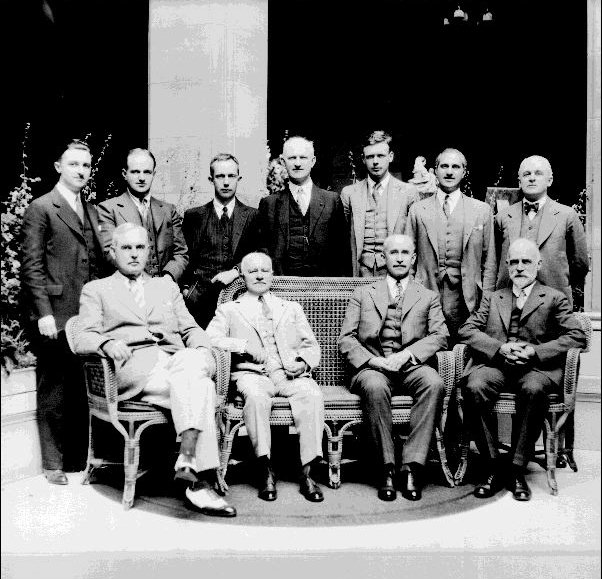
- Robert Millikan standing on right during historic gathering of the Guggenheim Board Fund for Aeronautics 1928. Orville Wright seated second from right, Charles Lindbergh standing third from right
Archival collections
- Robert Millikan papers [microform], 1821–1953 (bulk 1921–1953), Niels Bohr Library & Archives
- William Polk Jesse student notebooks, 1919–1921, Niels Bohr Library & Archives (contains notes on the lectures of Robert A. Millikan, including courses taught by Millkan: Electron Theory, Quantum Theory, and Kinetic Theory)
Template:S-start Template:S-aca Template:S-bef Template:S-ttl Template:S-aft Template:S-end Template:ASME Medal Template:IEEE Edison Medal Laureates 1909-1925 Template:Nobel Prize in Physics Laureates 1901-1925 Template:1923 Nobel Prize winners Template:Presidents of the American Physical Society Template:Presidents of the American Association for the Advancement of Science Template:Caltech presidents Template:Authority control
- Biography template using pronunciation
- Pages using infobox officeholder with office0
- Pages using infobox officeholder with speaker
- Pages with broken file links
- 1868 births
- 1953 deaths
- 20th-century American physicists
- American Congregationalists
- American experimental physicists
- American Nobel laureates
- American optical physicists
- American spectroscopists
- ASME Medal recipients
- Burials at Forest Lawn Memorial Park (Glendale)
- California Institute of Technology faculty
- Columbia Graduate School of Arts and Sciences alumni
- Corresponding Members of the Russian Academy of Sciences (1917–1925)
- Corresponding Members of the USSR Academy of Sciences
- Fellows of the American Academy of Arts and Sciences
- Human Betterment Foundation members
- IEEE Edison Medal recipients
- Members of the American Philosophical Society
- Members of the French Academy of Sciences
- Naval Consulting Board
- Nobel laureates in Physics
- Oberlin College alumni
- People from Morrison, Illinois
- People from San Marino, California
- Presidents of the American Association for the Advancement of Science
- Presidents of the American Physical Society
- Presidents of the California Institute of Technology
- Presidents of the International Union of Pure and Applied Physics
- Proceedings of the National Academy of Sciences of the United States of America editors
- Recipients of Franklin Medal
- Recipients of the Matteucci Medal
- Theistic evolutionists
- University of Chicago faculty