Rockall
Template:Short description Template:About Template:Use dmy dates Template:Use British English Template:Infobox islands Rockall (Template:IPAc-en) is a Template:Convert, uninhabitable granite islet in the North Atlantic Ocean. It is Template:Convert west of Soay, St Kilda, Scotland;<ref name="GoogleEarthStKilda"/> Template:Convert north-west of Tory Island, Ireland;<ref name="GoogleEarthTory"/> and Template:Convert south of Iceland.<ref name="iceland">{{#invoke:citation/CS1|citation |CitationClass=web }}</ref> The nearest permanently inhabited place is in North Uist, Template:Convert east in Scotland's Outer Hebrides.<ref name=":0">Template:Cite news</ref>
Rockall was formed during the Paleogene period, by magmatism as part of the North Atlantic Igneous Province. Rockall and Hasselwood Rock, 200 metres north, are the only emergent parts of Helen's Reef and the Rockall Plateau. Twenty-nine-metre waves just east of Rockall were reported in 2006 as the largest ever recorded by scientific instruments in the open ocean.<ref name=recwaves/> Rockall's first named geographic location and only occupiable area is Hall's Ledge.<ref name=clubfacts/>
Rockall has appeared on maps since at least 1550 and in literature since at least 1698. Marine surveyors, scientists, adventurers, amateur radio operators, and environmental activists have variously landed on or briefly occupied the islet. The earliest documented landing on Rockall was in 1811 by a small Royal Navy party led by Basil Hall. The longest-known continuous occupation is 45 days, achieved solo in 2014 by Nick Hancock.<ref name="guar8"/>
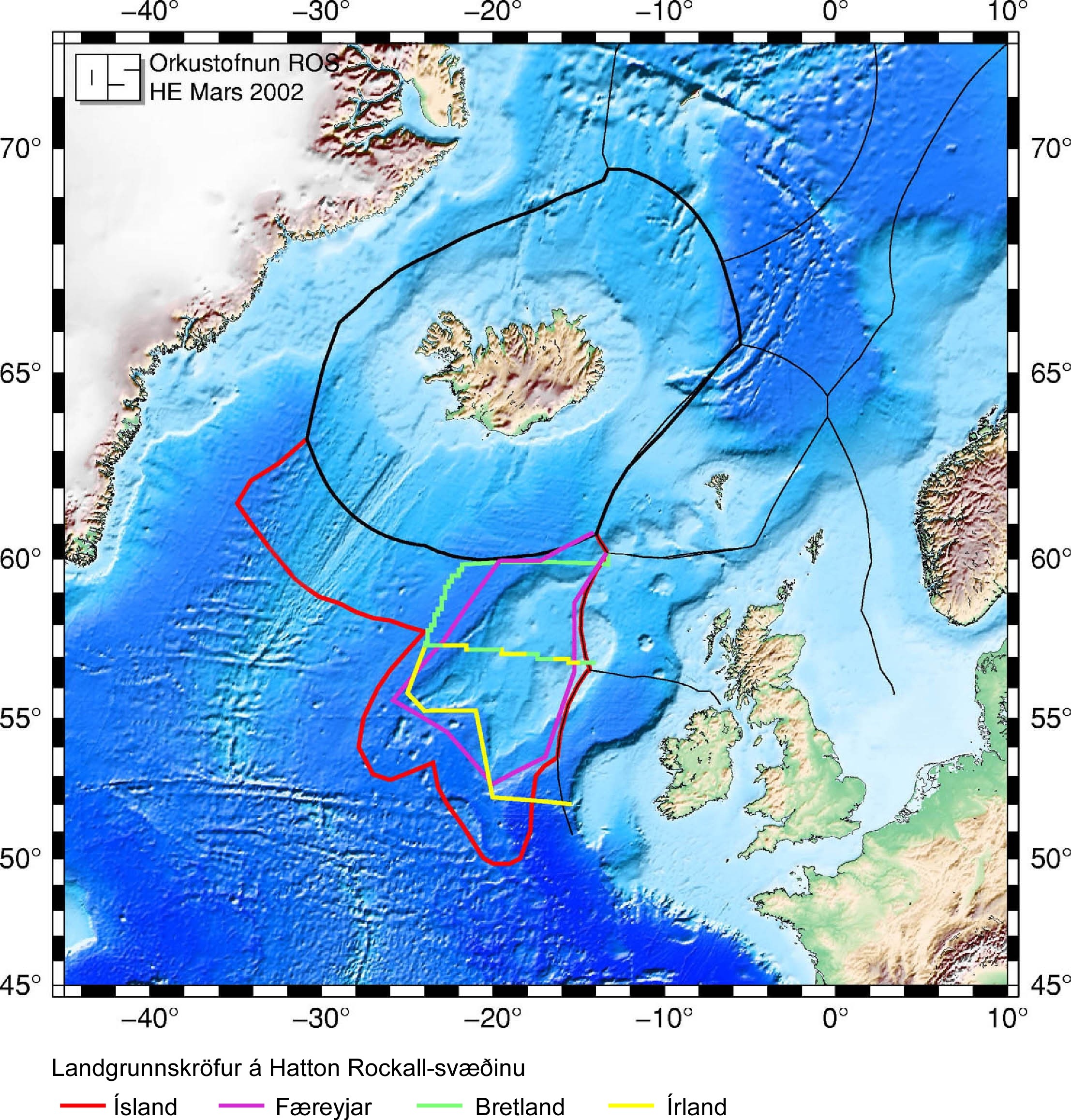
Possession of Rockall was for many decades deemed imperative to claims to the vast surrounding fisheries and oil-rich Atlantic seabed.<ref name=guaown>"Who owns Rockall? A history of legal and diplomatic wrangles" theguardian.com Owen Bowcott, 31 May 2013</ref> The Irish Times claims to have reported on the economic value of Rockall's fisheries as long ago as 1861.<ref name=":0"/> Driven by Cold War national security concerns, the United Kingdom claimed Rockall in 1955 and incorporated it as part of Scotland in 1972.<ref name=missspy/> The UK claims a Template:Convert territorial sea at Rockall.<ref name=symmons>Clive R. Symmons "Ireland and the Rockall Dispute: An Analysis of Recent Developments" contained in IBRU Boundary and Security Bulletin Spring 1998 at page 81 "Ireland has... even rejected imposition of a 12-mile fishery zone (or territorial sea) around the rock."</ref><ref name=dspring>{{#invoke:citation/CS1|citation |CitationClass=web }}</ref> While never claiming sovereignty of Rockall, Ireland claims that UK rights to Rockall are invalid.<ref name=symmons/><ref name=dspring/><ref name="oir-2016"/><ref>Template:Cite news</ref><ref name="oire9"/> Denmark (on behalf of the Faroes) and Iceland have lodged claims of the adjoining seabed.<ref name=guaown/>
In 2021, officers on a Marine Scotland patrol boat boarded an Irish fishing boat and ordered it to leave Rockall's 12-nautical-mile zone.<ref name=patrol/> In 2024, the Irish and Scottish governments bilaterally proposed to allow Irish fishing boats to return to the 12-nautical-mile zone. The UK's Foreign Secretary at the time, David Cameron, vetoed the proposal.<ref name="FishingNews">Template:Cite news</ref>
Etymology
The origin and meaning of the name Rockall is uncertain. The name {{#invoke:Lang|lang}} is used in Scots Gaelic folklore for a mythical rock that is supposed to appear three times, its last appearance being at the end of the world: "{{#invoke:Lang|lang}}". ('When Rocabarra returns, the world will likely come to be destroyed').<ref name=GP101/> Another idea is the name Rockall derives from the Gaelic {{#invoke:Lang|lang}}, meaning 'skerry of roaring' or 'sea rock of roaring',<ref name=Keay/> although {{#invoke:Lang|lang}} can also be translated as 'tearing' or 'ripping'.<ref name="ceant"/><ref name="cean4"/>
The Scottish Gaelic name for Rockall, {{#invoke:Lang|lang}}, may derive from an Old Norse name that may contain the element {{#invoke:Lang|lang}}, meaning 'mountain'.<ref>{{#invoke:citation/CS1|citation |CitationClass=web }}</ref> It is also suggested the name Rockall is from the Norse {{#invoke:Lang|lang}}, meaning 'foaming sea', and {{#invoke:Lang|lang}}, meaning 'bald head'—a word that appears in other place names in Scandinavian-speaking areas.<ref name="Coates"/>
Irish mythology giant Fionn mac Cumhaill (Finn McCool) allegedly scooped up a chunk of what is now Ulster to fling at a Scottish rival. It missed, instead landing in the Irish Sea to become the Isle of Man. The void left behind filled with water to become Lough Neagh. McCool is then alleged to have thrown a pebble<ref name=imyth>"The Wolfe Tones say they will defend island at center of Ireland/Scotland battle" irishcentral.com Jun 12, 2019</ref>{{ safesubst:#invoke:Unsubst||date=__DATE__ |$B= Template:Fix }} that became what is now widely known as Rockall—alternatively, the pebble flew off north-west as he lifted the chunk of land or when it landed into the sea.
Rockall appears on a 1550 Portuguese chart as 'Rochol', and on one of 1606 as 'Rocol'.<ref name=clubfaq/> The map Nova Francia alio nomine dicta Terranova, anno 1504 (Template:C. 1594), by Template:Ill, Jan Doetecom, and Petrus Plancius, shows Rockall named Rookol.<ref name=rookolmap>"Nova Francia alio nomine dicta Terranova" raremaps.com</ref>
Rockall is named Rokol in its first-known literary reference, Martin Martin's 1698-published A Late Voyage to St Kilda. The book states: "... and from it lies Rokol, a small rock Template:Convert to the westward of St Kilda; the inhabitants of this place call it Rokabarra."<ref name="Martin"/>
Location
In 1956, British scientist James Fisher referred to Rockall as "the most isolated small rock in the oceans of the world".<ref name="Fisher, Rockall, 1956"/> An all round navigational beacon was first installed on Rockall's summit in 1972.<ref name=theregblast>"Decapitating Rockall: How a 1970s Navy expedition blasted the top off the Atlantic islet" theregister.co.uk Gareth Corfield, Wed 22 Mar 2017</ref> Rockall's location was precisely determined by Nick Hancock during his 2014 expedition.<ref name="ordan"/>
Rockall's nearest land point is the uninhabited Soay, Template:Convert east in Scotland's St Kilda archipelago. Rockall's nearest inhabited area is Hirta, St. Kilda's largest island, Template:Convert east<ref name="googea"/>Template:Original research inline and populated intermittently at a single military base.<ref name="mac77"/><ref name="kilda"/> Rockall's nearest permanently inhabited settlement is near Hogha Gearraidh crofting township, Template:Cvt west on North Uist's Aird an Rùnair headland,<ref name="goog3"/> at {{#if:NF705711|{{#invoke:Ordnance Survey coordinates|oscoord|NF705711_region:GB_scale:25000|NF705711|name=}}}} Template:Nowrap.Template:Cn
Rockall is Template:Convert north-west of Tory Island, County Donegal, Ireland.<ref name="GoogleEarthTory"/> Rockall is also Template:Convert south of Iceland.<ref name=iceland/>
History
Earliest mentions
What is now known as Rockall appears in Scots and Irish mythology (see "Etymology" section above). Rockall appears on maps from 1550 onward.<ref name=clubfaq>"FAQs - The Rockall Club" therockallclub.org Retrieved 12 October 2014</ref> The first-known literary reference to the islet is in Martin Martin's A Late Voyage to St. Kilda, published in 1698 (see "Etymology" section above).<ref name="Martin"/>
Shipping disasters
_p0231_ROCKALL.jpg)
There have been various disasters on the neighbouring Hasselwood Rock and Helen's Reef (the latter having been named in 1830).
- 1686 – a Spanish, French, or Spanish-French ship ran aground around Rockall. Several of the Spanish and French crew saved their lives by reaching St. Kilda<ref name=rctimeline/> in a pinnace. Some details of this event were recounted by Martin Martin in his A late voyage to St Kilda, published in 1698.<ref name="Martin"/>
- 1824 – Brigantine Helen of Dundee, bound for Quebec, shipwrecked with fatalities giving its name to what subsequently became known as Helen's Reef.<ref name=rctimeline/>
- 1839 – "Charlotte" of Hull wrecked on Rockall around Christmas<ref name=rctimeline/>
- 1904 – Danish ship SS Norge foundered on Hasselwood Rock in fog with the loss of more than 635 of its 750 passengers. The sinking remains the worst maritime disaster involving a Danish merchant ship, and was at the time the worst civilian disaster in the Atlantic Ocean until the Titanic sank eight years later.<ref>{{#invoke:citation/CS1|citation
|CitationClass=web }}</ref><ref>{{#invoke:citation/CS1|citation |CitationClass=web }}</ref> The Norge sinking led to a proposal by D. & C. Stevenson for an unattended lightship to be moored close to the rock.<ref name="arch2"/>
Recorded visits to Rockall
In 1971, Lord Kennet remarked, "There can be no place more desolate, despairing and awful."<ref name="The Independent ~ 12 June 1997"/>
The website for The Rockall Club as at July 2025 states, "Total authenticated Rockall landings to date: 146 individuals".<ref name=rctimeline/>
HMS Endymion – Rockall's first landing

The earliest recorded landing on Rockall is often dated 8 July 1810. Royal Navy officer Basil Hall has been reported leading a small landing party from the frigate Template:HMS to the summit. However, research by James Fisher (see "Location" section above), in the log of Endymion and elsewhere, reports the actual date for this first landing was Sunday 8 September 1811.<ref name="TCBC"/>
The landing party left Endymion for the rock by boat. Endymion, while taking depth measurements around Rockall, lost visual contact with the rock as a haze descended. The ship drifted away, stranding the landing party. The party attempted a return to the ship, but in the haze could not find Endymion, and soon gave up to return to Rockall.Template:Cn
The haze became a fog. The lookout sent to the top of Rockall re-spotted the ship, but it turned away from Rockall before the party in their boats reached it. Finally, just before sunset, Endymion was again spotted from the top of Rockall, and the party was able to re-board. The Endymion crew reported they had searched for five or six hours, firing their cannon every ten minutes. Hall related this and other adventures in his book Fragment of Voyages and Travels Including Anecdotes of a Naval Life.Template:Cn
19th-century surveying and scientific visits
The exact position of Rockall and the size and shape of the Rockall Bank were first charted in 1831. This was by Captain A. T. E. Vidal, a Royal Navy surveyor. It is uncertain if this visit produced a landing.<ref name=rctimeline/>
In the summer of 1862, Mr Johns of Template:HMS landed on Rockall<ref name=rctimeline/> but did not reach the summit. This was whilst the ship was surveying the seabed prior to the laying of a transatlantic telegraph cable.Template:Cn
Miller Christy in 1896 led Rockall's first scientific expedition. The Royal Irish Academy chartered the Granuaile,<ref name="Fisher, Rockall, 1956"/><ref name="Hamilton, Granuaile, 1999"/> and sponsored Christy's study of the flora and fauna.<ref name="ria33"/> Two landing attempts were unsuccessful.<ref name=rctimeline/>
British annexation


The initial incentive for UK annexation of Rockall was the test-firing of the UK's first guided nuclear weapon, the American-made Corporal missile. The missile was to be launched over the North Atlantic from South Uist. The Ministry of Defence was concerned that the unclaimed Rockall could give the Soviet Union opportunity to spy on the test. Thus, in April 1955, the Admiralty was ordered to seize Rockall and declare UK sovereignty, lest it became a foreign observers' outpost.<ref name=missspy>"UK feared Rockall could be a base for spies" heraldscotland.com 16 May 2017</ref>
On 18 September 1955, Rockall was annexed by the British Crown. To do so, four men were winched onto the islet by a Royal Navy helicopter from Template:HMS (coincidentally named after the man who first charted the islet). The four were Lieutenant-Commander Desmond Scott RN, Sergeant Brian Peel RM, Corporal AA Fraser RM, and James Fisher (a civilian naturalist and former Royal Marine). The Admiralty announced the annexation on 21 September 1955.<ref>Template:Cite news</ref>
The landing team cemented in a brass plaque on Hall's Ledge and hoisted the Union Flag to stake the UK's claim. The plaque inscription read: Template:Quotation
Author Ian Mitchell opined Rockall was terra nullius (owned by no one), until the 1955 British claim.<ref name=mitch>Ian Mitchell, "Isles of the North", 2012, Birlinn, 978-0-85790-099-9, page 232, Template:GBurl</ref> Rockall was the British Empire's final territorial expansion.<ref name=onthisday>{{#invoke:citation/CS1|citation |CitationClass=web }}</ref>
On 7 November 1955, J. Abrach Mackay, an 84-year-old local councilor and member of the Clan Mackay, protested the annexation; he declared: "My old father, God rest his soul, claimed that islet for the Clan of Mackay in 1846 and I now demand that the Admiralty hand it back. It's no' theirs." The British Government ignored his protest.<ref name="The Independent ~ 12 June 1997"/><ref name="dokuf"/>
Deploying an all-round light beacon
In 1971,<ref name="gov001"/> Captain T. R. Kirkpatrick RE led the landing party on a British government expedition named "Exercise Top Hat". Top Hat was mounted from Template:Ship with two aims:<ref name=tophat>"Report on Operational Top Hat: government expedition to Rockall in 1970" https://assets.publishing.service.gov.uk 13 February 2017</ref>
- The principal aim of the exercise was to lay a flat surface on the top of Rockall so that an all-round visual light could be erected in future. This was achieved by blowing the top Template:Convert off Rockall, leaving a flat area of 12 feet by 5 feet.<ref name=tophat/>
- A secondary aim was to deck qualifyTemplate:Clarify one holdover pilot.<ref name=tophat/>
Both aims were achieved. The landing party included Royal Engineers, Royal Marines, and civilian members from the Institute of Geological Sciences in London. The party was landed by winch line from the Wessex 5 helicopters of the Royal Naval Air Services Commando Headquarters Squadron, commanded by Lt Cmdr Neil Foster RN.
As well as collecting samples of the aegirine granite, "rockallite", for later analysis in London, the top of the rock was blown off using a newly developed blasting technique, precision pre-splitting. This created a level area that was drilled to take the anchorages for the light beacon installed the following year.<ref name=theregblast/> Two phosphor bronze plates were chased into the wall above Hall's Ledge, each secured by four 80-tonne rock-anchor bolts. UK authorities sent teams in 1973 on RFA Tidepool and in 1974 on HMS Tiger, to land on the rock to repair the navigational beacon.<ref name=rctimeline/> They also sent a team by Chinook helicopter to update the beacon in July 1982.<ref name=heavy/>
Tom McClean stays 40 days solo
Dublin-born adventurer and ex-SAS member Tom McClean lived on the islet from 26 May 1985 to 4 July 1985. This solo visit set a new record stay of 40 days.<ref name=itimes>"One of the best wishes McGowan all the best in Atlantic quest" irishtimes.com Liam Gorman, 12 February 2010</ref>
The first female landings – Sue Hiscock and Christine Howson
The second landing of 1988 was the Nature Conservancy Council landing from FPV Noma. Sue Hiscock at this point became the first female to land on Rockall.<ref name=rctimeline/> Christine Howson in the same expedition became the second female to land on Rockall. Hiscock's husband Eric also landed as part of this expedition.<ref name=rchonour>"Honour Roll - The Rockall Club" therockallclub.org</ref>
Greenpeace visits and a 42-day record

In 1997, three members of the environmentalist organisation Greenpeace occupied the islet for 42 days.<ref name="bbc2023may26">Template:Cite news</ref><ref name="schne"/> Among the three was John Vidal, unrelated to Vidal mentioned in a previous visit.<ref name="guar44"/>
The Greenpeace team called Rockall Waveland, to protest against oil exploration. Greenpeace declared the islet to be a "new Global State" (as a spoof micronation) and offered citizenship to anyone willing to take their pledge of allegiance. The British Government's response was to state that "Rockall is British territory. It is part of Scotland and anyone is free to go there and can stay as long as they please".<ref name="inde55"/>
Vidal claimed that the Greenpeace team unscrewed the 1955 plaque and re-fixed it back to front.<ref name="guar44"/> They also positioned a solar-powered beacon on the existing navigation aid frame.<ref name=rctimeline/>
Greenpeace returned for a second landing, this time in 1998 with eight people (three of whom stayed overnight). They upgraded the beacon.<ref name=rctimeline/> This light though succumbed to an Atlantic storm two years later.<ref name=clubfaq/> Greenpeace added their own plaque that read, "Let the sun and wind do their work. Leave the oil beneath the waves."<ref name="guar44"/> Vidal stated in 2010, "I am told that the British plaque has now disappeared."<ref name="guar44"/>
Radio hams
Rockall was the last of the unnumbered Islands On The Air (IOTA) in Europe.<ref name=hamgam>"MS0IRC/P 2005 Rockall"</ref> On 16 June 2005, the first amateur radio (ham radio) activation of Rockall took place. The club station MS0IRC/P was set up and operated on HF frequencies. The IOTA number EU-189 was issued to Rockall as a result of this activation. The 9-person landing team, plus safety and radio equipment, was from Islands Radio Club Outer Hebrides. They included two radio operators, James Cameron and David Woods. The two worked with 262 stations in the three-and-a-half hours in which they broadcast. The team cut short their landing to 9 hours due to incoming bad weather, unfulfilling their plan to stay overnight.<ref name=doku>"Amateur Radio from Rockall" dokufunk</ref>
In 2011 a group of 7 Belgian amateur radio operators traveled on CDT Fourcault to Rockall. Two of them, Patrick Godderie and Rudi Marleen, landed on the rock on 1 October to set up a radio station transmitting for 15 hours. They used HF frequencies under the call sign "MM0RAI/P".<ref>Template:Cite news</ref><ref>{{#invoke:citation/CS1|citation |CitationClass=web }}</ref> They stayed one night unsheltered on the islet.<ref name=doku/>
Nick Hancock stays 45 days solo
On 31 May 2013, Chartered Surveyor<ref name="guar8"/> and adventurer Nick Hancock from Edinburgh and a TV crew from BBC's The One Show sailed to the islet aboard Orca III. He planned to survive solo on Rockall for 60 days, raising money for Help for Heroes.<ref name="helpf"/> He unsuccessfully attempted to land and survive on the islet. He had landed for the first time the previous year on a reconnaissance expedition coinciding with Queen Elizabeth II's Diamond Jubilee.<ref name="guar79"/><ref>{{#invoke:citation/CS1|citation |CitationClass=web }}Template:Cbignore</ref> The weather conditions at the time "were not favourable" according to a Maritime and Coastguard Agency official.
On 5 June 2014, Hancock landed on Rockall to begin his 60-day attempt.<ref name="bbc67"/> After losing supplies in a force-9 storm, he left Rockall after 45 days. He thus surpassed McClean's 40 day solo record by five days, and the 42-day record set by the Greenpeace group by three days.<ref name="scotland.gov.uk"/><ref name="grind"/>
Rigid inflatable boat landing
In 2016 Neil McGrigor led the first landing done by rigid inflatable boat (RIB). This group installed a new navigation beacon<ref name=rctimeline/> and used a drone to record a 60-second video featuring overhead views of Rockall.<ref name=rib>"Rockall Scorpion RIB Adventure" 60 second video featuring overhead views of Rockall</ref>
Cam Cameron rescue after 30 days

In May 2023, Chris "Cam" Cameron from Buckie, a science teacher and former Gordon Highlander, began an attempt to stay 60 days on Rockall. He was raising funds for military charities. He was accompanied by a radio operator, Adrian Styles, and Bulgarian mountaineer Emil Bergmann. Styles and Bergmann planned to leave after a week.<ref name=bbc2023may26/><ref name="carrell">Template:Cite news</ref> The group landed on Rockall on 30 May, having sailed from Inverkip on the Firth of Clyde.<ref name="carrell2">Template:Cite news</ref> The attempt ended after 30 days when deteriorating weather conditions required Cameron's rescue by HM Coastguard.<ref>Template:Cite news</ref>
Circumnavigations
The "Round Rockall" sailing race, sponsored by Galway Bay Sailing Club, runs from Galway, Ireland, around Rockall and back. It was held in 2012 to coincide with the finish of the 2011–12 Volvo Ocean Race around the world.<ref name="roun8"/>
The 2015–2016 Clipper Round the World Yacht Race race 12 from New York to Derry was extended around Rockall despite previous promises to crew from Sir Robin Knox-Johnston that this would not happen again after the race to DanangTemplate:Clarify.<ref name="senti"/> In July, 2022, the 2019–2020 Clipper Round the World Race (delayed for 2 years by COVID) was again extended on Leg 8 to go around Rockall before completing the leg at the mouth of the River Foyle in Ireland. The fleet had crossed the Atlantic in record time, and the City docks in Derry had no room for the fleet of 11 boats to berth. The race organizers sent the fleet around Rockall in order to extend the leg by approximately one day's sailing time to clear the docks in Derry.Template:Cn
In 2017, the Safehaven Marine team led by Frank Kowalski set a world record for the Long Way Round Circumnavigation of Ireland via Rockall. The Barracuda-style naval patrol, search, and rescue vessel Thunder Child completed the route in 34 hours, 1 minute, and 47 seconds.<ref name="safet"/> Set in an anti-clockwise direction, the new record – the first of its kind – is now subject to ratification by Irish Sailing and the Union Internationale Motonautique, the world governing board for all powerboat activity.Template:Cn
Geography
Dimensions
Rockall rises sheer to a height of Template:Cvt.<ref name=clubfacts/><ref name="bbc-2014"/><ref name="Stornoway Gazette. 8 October 2014. Retrieved 12 October 2014."/> Rockall is about Template:Convert wide and Template:Cvt long at its base.<ref name="landf"/>
Hall's Ledge and other features


Ocean swell hitting Rockall from the west was described by Nick Hancock as "exactly where you don't want it", for a successful landing attempt. A small step in the cliff on the western flank acts as a landing "platform". From there, anyone landing commences a fast, vertical scramble to safety out of the ocean swell zone. A traverse across the west face is then needed to reach the summit.<ref name=hanc60>"Rockall, like a mountain summit, will be there another day" theguardian.com Nick Hancock, 1 Jun 2013</ref>
In 1971, Exercise Top Hat by the Corp of Royal Engineers blew the top Template:Convert off Rockall. That left a flat area of 12 feet by 5 feet at its longest and widest. This is the area cleared for an all-round navigation beacon (see "Deploying an all round light beacon" above).<ref name=tophat/><ref name=bgs/>
Hall's Ledge on the south face<ref name=theregblast/><ref name=bgs/><ref name=regstorm>"Storm-battered Rockall adventurer recalls 'worst experience of my life'" theregister.com Lester Haines, 7 Jul 2014</ref> is both Rockall's first-named location and only occupiable area.<ref>{{#invoke:citation/CS1|citation |CitationClass=web }}</ref> It was named in 1955 after Basil Hall, the first recorded person to land on Rockall (see "History" section above).<ref name="TCBC"/> The ledge measures just Template:Cvt and is just Template:Convert from Rockall's summit.<ref name="roccom"/> William Dick in 1975 named a second feature on Rockall, Paul's Cave.<ref name=rctimeline/>
The British Geological Survey (BGS) reports that "a sill, 0.5 to 1.0 m thick and dipping at 30° to 35° to the east-north-east intrudes the lower part of the island," that, "on the south face, can be seen to bifurcate." The BGS add that Rockall is "cut by a series of joints, one set of which is responsible for the north–south orientation of the near-vertical east-facing cliff".<ref name=bgs/>
Helen's Reef and other surrounding features
Marine Scotland detailed underwater mapping of the area around Rockall in 2011–2012. The mapping showed that Rockall is a minor pinnacle of the surrounding Helen's Reef. Helen's Reef extends in a sweeping arc of fissures and ridges to the north-west of the islet. Between Rockall and Helen's Reef is a deeper trench much used by squid fishermen.<ref>{{#invoke:citation/CS1|citation |CitationClass=web }}</ref>


Hasselwood Rock, 200 metres north,<ref name=guatime>"Rockall – a timeline" theguardian.com Severin Carrell, 28 May 2013</ref> and several other pinnacles of Helen's Reef, are smaller at half the size of Rockall or less. While similarly remote, those other formations are legally not islands nor points on land. That is because they are often submerged completely, only revealed momentarily above certain types of ocean surface waves.Template:Cn
Rockall Bank is Rockall's surrounding elevated seabed. Rockall Bank lies directly south of the Rockall Plateau. It is separated from the Outer Hebrides by the Rockall Trough, itself located within the Rockall Basin (also known as the Hatton Rockall Basin).Template:Cn
Climate and weather

Although Rockall does not sustain a weather station, Rockall's isolated setting dictates an extremely oceanic climate without heat or cold extremes.Template:Cn The North Atlantic Current influences waters near Rockall.<ref name=gulfharv>"Interannual variability of the NAC and recirculations in the eastern boundary of the OSNAP array and its impact on heat fluxes" harvard.edu. Burmeister, Kristin; Jones, Sam C.; Cunningham, Stuart A.; Fraser, Neil; Drysdale, Lewis; Inall, Mark E. February 2024</ref><ref name=uhinatl>"Observed variability of the North Atlantic Current in the Rockall Trough from four years on mooring measurements" uhi.ac.uk. Loïc Houpert, Stuart Cunningham, Neil Fraser, Clare Louise Johnson, N. Penny Holliday, Samuel Jones, Ben Moat, Darren Rayner. Published - 30 Sept 2020</ref><ref name=nora>"North Atlantic Current and European Slope Current Circulation in the Rockall Trough Observed Using Moorings and Gliders" Neil J. Fraser, Stuart A. Cunningham, Lewis A. Drysdale, Mark E. Inall, Clare Johnson, Sam C. Jones, Kristin Burmeister, Alan D. Fox, Estelle Dumont, Marie Porter, and N. Penny Holliday. First published: 29 November 2022</ref>
Rockall's name is given to one of the 31 sea areas named in the British Meteorological Office's shipping forecast.<ref name="The Independent ~ 12 June 1997"/> It was reported in 2006 that those onboard a British oceanographic research vessel just east of Rockall in February 2000 experienced the largest waves ever recorded by scientific instruments in the open ocean. A shipborne wave recorder measured individual waves up to Template:Cvt from crest to trough, and a maximum significant wave height of Template:Cvt.<ref name=recwaves/> Those measurements are higher than Rockall's Template:Cvt summit.<ref name=clubfacts/>
Geology

Rockall is made of a type of peralkaline granite that is relatively rich in sodium and potassium. Within this granite are darker bands richer in iron because they contain two iron-sodium silicate minerals called aegirine and riebeckite. The darker bands are a type of granite that geologists have named "rockallite", although use of this term is now discouraged.<ref name="DSutherland1982"/><ref name="LeMaitre2002"/>
In 1975, a mineral new to science was discovered in a rock sample from Rockall. The mineral is called bazirite, named after the chemical elements barium and zirconium. Bazirite has the chemical formula of Template:Chem2.<ref name="MinScot"/>
Rockall forms part of the deeply eroded Rockall Igneous Centre that was formed as part of the North Atlantic Igneous Province.<ref name="Ritchie"/> It was formed approximately Template:Val million years ago based on rubidium–strontium dating,<ref>Template:Cite journal</ref> as part of the breakup of Laurasia. Greenland and Europe separated and the north-east Atlantic Ocean was formed between them,<ref name=DSutherland1982/> eventually leaving Rockall as an isolated islet.
The RV Celtic Explorer surveyed the Rockall Bank in 2003.<ref name="gsise"/> The Irish light vessel Granuaile (the same name as the steamer on the RIA 1896 botany survey) was chartered by the Geological Survey of Ireland, on behalf of the Department of Communications, Marine and Natural Resources, to conduct a seismic survey of the Rockall Bank and the Hatton Bank in July 2004,<ref name=Gray/> as part of the Irish National Seabed Survey.<ref name=Gray/>
Ecology
Rockall's only permanent multicellular inhabitants are common periwinkles and other marine molluscs. Small numbers of seabirds, mainly fulmars, northern gannets, black-legged kittiwakes, and common guillemots, use the rock for resting in summer. Gannets and guillemots occasionally breed successfully if the summer is calm with no storm waves washing over the rock. In total there have been just over twenty species of seabird and six other animal species observed (including the aforementioned molluscs) on or near the islet.Template:Cn
Cold-water coral biogenic reefs have been identified on the wider Rockall Bank,<ref name="marin"/> which are contributing features for the East Rockall Bank and North-West Rockall Bank SACs.<ref name="defra"/><ref name="def6"/>
Discovery of new species
In December 2013, surveys by Marine Scotland discovered four new species of animal in the sea around Rockall. These are believed to live in an area where hydrocarbons are released from the seabed, known as a cold seep. The discovery has raised the issue of restricting some forms of fishery to protect the sea bed.<ref name="BBC"/> The species are:
- Volutopsius scotiae – a sea snail about Template:Cvt long<ref>Fraussen K., McKay D.W. & Drewery J. (2013) On the discovery of a new Volutopsius (Gastropoda, Buccinidae) from the north-eastern Atlantic Ocean. Journal of Conchology 41(4): 453-459. [November 2013], available online at http://www.vliz.be/imisdocs/publications/258093.pdf</ref>
- Thyasira scotiae – a clam<ref name=OliverDrewery>Oliver, P. G.; Drewery, J. (2014). New species of chemosymbiotic clams (Bivalvia: Vesicomyidae and Thyasiridae) from a putative ‘seep' in the Hatton–Rockall Basin, north-east Atlantic. Journal of the Marine Biological Association of the United Kingdom. 94(2): 389–403. [Published online 8 October 2013; Code-compliant paper version published March 2014]., available online at https://doi.org/10.1017/S0025315413001136</ref>
- Isorropodon mackayi – a clam in the order Veneroida<ref name=OliverDrewery/>
- Antonbruunia sociabilis sp. – a marine worm in the order Phyllodocida<ref>Mackie, Andrew S. Y.; Oliver, P. Graham; Nygren, Arne. (2015). Antonbruunia sociabilis sp. nov. (Annelida: Antonbruunidae) associated with the chemosynthetic deep-sea bivalve Thyasira scotiae Oliver & Drewery, 2014, and a re-examination of the systematic affinities of Antonbruunidae. Zootaxa. 3995(1): 20-36., available online at http://biotaxa.org/Zootaxa/article/view/zootaxa.3995.1.4</ref>
Ownership
Economic background
Possession of Rockall was for many decades deemed imperative to claims to the vast surrounding fisheries and oil-rich Atlantic seabed.<ref name=guaown>"Who owns Rockall? A history of legal and diplomatic wrangles" theguardian.com Owen Bowcott, 31 May 2013</ref> The Irish Times claims to have reported on the economic value of Rockall's fisheries, as long ago as 1861.<ref name=":0"/>
20th century

Until 1955, Rockall was legally terra nullius. The UK claimed Rockall on 18 September 1955 when "Two Royal Marines and a civilian naturalist, led by Royal Navy officer Lieutenant Commander Desmond Scott, raised a Union flag on the islet and cemented a plaque into the rock".<ref name="bbc70"/><ref name="isles"/> UK motivations behind the 1955 decision to claim Rockall as UK territory were revealed in documents subsequently declassified in May 2017: the UK Government had Cold War worries that Rockall could be used by "hostile agents" to spy on the future South Uist missile testing range.<ref name="bcc31"/>
The British Island of Rockall Act 1972 (c. 2) formally annexed Rockall to the United Kingdom.<ref name=isles/> The UK considers Rockall administratively part of the Isle of Harris.
In 1988, the UK and Ireland signed an exclusive economic zone (EEZ) boundary agreement ignoring the rock per the United Nations Convention on the Law of the Sea (UNCLOS). The agreement stated, "the location of Rockall was irrelevant to the determination of the boundary".<ref name="EEZ"/><ref name="treaty">{{#invoke:citation/CS1|citation |CitationClass=web }} </ref><ref name=7nov88> {{#invoke:citation/CS1|citation |CitationClass=web }}</ref> Irish Deputy Prime Minister Peter Barry opined Rockall as irrelevant when determining the boundaries of the EEZ, since the rock is uninhabitable.<ref name="EEZ"/><ref name="TrevesPineschi1997"/><ref name="Volume384"/> This bilateral agreement is disputed by Denmark (on behalf of the Faroes) and Iceland.<ref name="Denmark"> {{#invoke:citation/CS1|citation |CitationClass=web }}</ref>
In 1994, two Scottish fishery inspectors were "kidnapped" by a Donegal vessel after they boarded it off Rockall. The ship's captain had been instructed to proceed to the nearest Scottish port for an alleged fishery offence. Instead he decided to steam for Killybegs with the two inspectors onboard. This caused a chase in the north Atlantic. After the Irish Department of Foreign Affairs intervened, the two officers were returned to their mother ship.<ref name=law>"Why the law is Scotland's call on Rockall" independent.ie. Lorna Siggins, 15 Jun 2019</ref>
On 25 July 1997, the UK ratified UNCLOS,<ref name=ukunclos>"UNCLOS: fit for purpose in the 21st century?" Dr Bill Hayton, Associate Fellow, Asia-Pacific Programme, Chatham House – Written evidence (UNC0012), Received 10 November 2021</ref> that states that "Rocks which cannot sustain human habitation or economic life of their own shall have no exclusive economic zone or continental shelf". This limits territorial sea claims to a Template:Convert radius, and therefore allows free passage in waters beyond this.<ref name="unorg"/> The UK claims Rockall along with a 12-nautical-mile-radius territorial sea around the islet inside the country's EEZ.<ref name="whatdotheyknow.com"/> The UK also claims "a circle of UK sovereign airspace over the islet of Rockall".<ref name="whatdotheyknow.com"/> As the rock lies within the United Kingdom's EEZ, the UK claims sovereign rights for the purpose of exploring and exploiting, conserving and managing the natural resources of the area, including jurisdiction over the protection and preservation of the marine environment.<ref name="unorg"/><ref name="legislation.gov.uk"/>
The Scottish Adjacent Waters Boundaries Order 1999 declared the area around Rockall to be under the jurisdiction of Scots law rather than English law.<ref name=adjwat>"The Scottish Adjacent Waters Boundaries Order 1999" legislation.gov.uk 1999</ref>
21st century
In 2011, Eamon Gilmore stated, "While Ireland has not recognised British sovereignty over Rockall, it has never sought to claim sovereignty for itself. The consistent position of successive Irish Governments has been that Rockall and similar rocks and skerries have no significance for establishing legal claims to mineral rights in the adjacent seabed and to fishing rights in the surrounding seas."<ref name="Volume384"/>

On 12 October 2012, Irish Navy ship LÉ Róisín was reported exercising a "showing the flag" patrol around the rock.<ref name=roisin>"Rockall dispute returns with UK grant for oil exploration" independent.ie Peter Flanagan, 5 May 2016</ref>
With effect from 31 March 2014, the UK and Ireland published EEZ limits which include Rockall within the UK's EEZ.<ref name="legislation.gov.uk"/><ref name="irishstatutebook.ie"/>
On 25 June 2019, Simon Coveney supplemented the previous positions of Peter Barry and Eamon Gilmore by stating, "Rockall and similar rocks and skerries should have no significance for establishing legal claims to continental shelf. This position is now reflected in the 1982 United Nations Convention on the Law of the Sea which provides at Article 121, paragraph 3 that 'Rocks which cannot sustain human habitation or economic life of their own shall have no exclusive economic zone or continental shelf.'" He did so in the context of, "present difficulties between Ireland and Scotland over fishing within 12 miles of Rockall."<ref name=coveney>ireachtas.ie. Rockall Island Ownership, Dáil Éireann Debate, Tuesday - 25 June 2019</ref>
After the UK left the EU, the EU–UK Trade and Cooperation Agreement came into force on 1 January 2021. Three days later the Northern Celt, an Irish fishing boat based out of Greencastle, County Donegal, was boarded and ordered to leave the 12-nautical-mile zone around Rockall by officers of a Marine Scotland patrol boat.<ref name=patrol>Template:Cite news</ref>
Since 2021, fishing licences issued by the UK to EU vessels have excluded access to the 12-nautical-mile zone around Rockall. In 2023, Irish Minister for Agriculture, Food and the Marine, Charlie McConalogue stated that this action was costing the Irish fishing industry up to €7 million per year.<ref name=dj-20230315>Template:Cite news</ref><ref name=dj-20230209>Template:Cite news</ref>
In 2024, a proposed bilateral agreement between the governments of Ireland and Scotland would have allowed Irish fishing vessels to return to the 12-nautical-mile zone. The proposal was vetoed by the United Kingdom's Foreign Secretary, David Cameron.<ref name="FishingNews">Template:Cite news</ref>
In popular culture
- English poet Michael Roberts published a poem "Rockall" in his 1939 collection, Orion Marches. The poem describes a shipwrecked traveller on the rock.Template:Cn
- In the 1951 novel The Cruel Sea by Nicholas Monsarrat, Rockall features as the place of the final act of HMS SaltashTemplate:'s war. It is here the ship takes the surrender of two German U-boats on the last day of World War Two in Europe.Template:Cn
- The 1955 British landing, complete with the trappings such as hoisting the flag, caused a certain amount of popular amusement, with some seeing it as a sort of farcical end to imperial expansion. The satirists Flanders and Swann sang a successful piece entitled "Rockall", playing on the similarity of the word to the vulgar expression 'fuck all', meaning 'nothing': "The fleet set sail for Rockall, Rockall, Rockall, To free the isle of Rockall, From fear of foreign foe. We sped across the planet, To find this lump of granite, One rather startled gannet; In fact, we found Rockall."<ref name="arch2"/>
- In The Goon Show episode "Napoleon's Piano" (first broadcast October 1955), Bluebottle lands on the piano as it is floating in the English Channel and cements a brass plate to it in the belief that it is Rockall.<ref>{{#invoke:citation/CS1|citation
|CitationClass=web }}</ref> Rockall was the launching site for the prototype "Jet-propelled guided NAAFI" in the Goon Show episode of the same name (January 1956).Template:Cn
- It has been suggested by several critics that Rockall is the rock that forms the setting for William Golding's 1956 novel Pincher Martin.<ref>Template:Cite book</ref>
- The Master, a 1957 novel by T. H. White, is set inside Rockall.<ref name="netdo"/>
- David Frost, when hosting the 1962–1963 BBC satirical TV programme That Was the Week That Was, recited a list of the dwindling British colonial possessions, ending with the words, "... and sweet Rockall."<ref name="frasr"/>
- Storm Over Rockall was a 1965 novel by W. Howard Baker, part of a series of novels based on the espionage television series Danger Man.Template:Cn
- The Icelandic instrumental jazz-funk fusion band Mezzoforte's track Rockall was a minor hit in Europe in 1983 and was used as a signature tune by several European radio chart shows.<ref>
Template:Cite book</ref><ref>Larkin, Colin (1997) The Virgin Encyclopedia of Eighties Music, Virgin Books, Template:ISBN, p. 321</ref>
- The Irish folk group The Wolfe Tones made Rockall the subject of their 1976 song "Rock on, Rockall", which asserted an Irish claim to the rock.<ref name="iris11"/><ref name="irish43"/>
- "Ether", the opening track of the English post-punk band Gang of Four's 1979 debut album, Entertainment!, features the satirical line 'There may be oil under Rockall'. The bulk of the song deals with the then-ongoing Troubles in Northern Ireland and is critical of British actions there; the line alludes anticlimactically to the dispute between Ireland and the UK over Rockall.Template:Cn
- A club, The Rockall Club, has been established for people who have landed there.<ref name="rocka28"/>
- In series 2, episode 2, of the television series The Ambassador, "Vacant Possession" (first broadcast on 25 April 1999), an Irish protester lands on Rockall and claims it for his nation, sparking a diplomatic row.Template:Cn
- BBC Choice broadcast two series of a topical panel show titled Good Evening Rockall<ref>{{#invoke:citation/CS1|citation
|CitationClass=web }}</ref> in which panellists put forward events to be included in a news bulletin ostensibly targeting the rock. Sue Perkins hosted the second series.Template:Cn
- The duo and solo project of Runrig songwriters Calum and Rory MacDonald is called The Band from Rockall.Template:Cn
See also
References
Notes Template:Reflist
Bibliography Template:Refbegin
- Coates, Richard (1990) The place-names of St Kilda. Lewiston, etc.: Edwin Mellen Press. Template:ISBN.
- Harvie-Brown, J. A. & Buckley, T. E. (1889) A Vertebrate Fauna of the Outer Hebrides. Edinburgh. David Douglas.
- Haswell-Smith, Hamish (2004) The Scottish Islands. Edinburgh. Canongate Template:ISBN
- Keay, J., and Keay, J. (1994) Collins Encyclopaedia of Scotland. London. HarperCollins Template:ISBN
- Maclean, Charles (1977) Island on the Edge of the World: the Story of St. Kilda, Edinburgh, Canongate Template:ISBN
- Martin, Martin (1703) A Late Voyage to St. Kilda, D. Brown and T. Goodwin, London (1698)
- Template:Cite book
- Template:Cite book
Further reading
- British Birds, birds breeding on Rockall. 86: 16–17, 320–321 (1993).
- Houses of the Oireachtas, Parliament of Ireland – Tithe an Oireachtais debate with the Minister of Foreign Affairs in the Dáil Éireann, 1 November 1973.
- Martin, Martin A Description of the Western isles of Scotland (1716).
- W. Sporswood Green et al, Notes on Rockall Island and Bank, etc, The Transactions of the Royal Irish Academy, Vol. 31, pp. 39-98. RIA, Dublin (1896)
External links
- "Rockall Scorpion RIB Adventure" 60-second video of aerial views of Rockall
- "Rockall" Stuart Farish 3d animation 20-second video of aerial views of Rockall
- "Rockall" 4-minute-3-second ITN video including failed and successful Tom McClean landing attempts on Rockall
- "Rockall adventurer Nick Hancock bids to set survival record" 6-minute-14-second video by The Guardian re the Nick Hancock expedition
- "Rockall Solo" 2-minute-28-second video including Nick Hancock showing how to land on Rockall from a dinghy
- "Hebrides News: Nick Hancock leaps off Rockall" Hebrides Scotland video showing Nick Hancock jumping into the Atlantic and picked up by a dinghy when departing Rockall
- "Rockall" 2-minute-28-second video preluding the Cam Cameron expedition. Includes an overhead map of Rockall.
- RockallIsland.co.uk – a website detailing the MSØIRC/p amateur radio expedition of 16 June 2005
- "Rockall 2011 - MM0RAI/P" 2012 Amateur radio DXPedition to Rockall EU-189 by the Belgian Expedition Team.
- Waveland.org Template:Webarchive – official website of the former micronation Waveland based on Rockall
- 1955: Britain claims Rockall – "On This Day" story of British claim to Rockall from BBC's official website
- Icelandic Ministry of Foreign Affairs map showing all parties' claims to the continental shelf around Rockall.
- Rockall.name – website in both English and Czech of Ondrej Danek's study of Rockall
- Cross-section of the geology around Rockall
- Article in the Press and Journal about the Rockall attempt in 2022
Template:United Kingdom topics Template:Micronations Template:Authority control
- Pages with broken file links
- Rockall
- Geological type localities
- Greenpeace campaigns
- Individual rocks
- Islands of the North Atlantic Ocean
- Seabird colonies
- Shipping Forecast areas
- Sites of Special Scientific Interest in Western Isles South
- Skerries of Scotland
- Stacks of Scotland
- Uninhabited islands of the Outer Hebrides
- Volcanoes of Europe
- Uninhabited islands of the United Kingdom
- Extreme points of the United Kingdom
- Micronations in Europe