Kingdom of Galicia–Volhynia
- REDIRECTTemplate:Distinguish
Template:Rcatsh {{#invoke:Infobox|infoboxTemplate |templatestyles = Template:Infobox country/styles.css | bodyclass = ib-country vcard | aboveclass = adr | above =
{{#if:Principality of Galicia–Volhynia
Template:Nobold
Kingdom of Galicia–Volhynia
Template:Nobold
| {{#if:Principality of Galicia–Volhynia
Template:Nobold
Kingdom of Galicia–Volhynia
Template:Nobold
|
}}{{#if:
|
              }}{{#ifeq:|yes
              |Micronation
       }}
|
}}
| subheader = {{#if:1199–1349 | 1199–1349 | {{#if:1199|1199{{#if:1349|–1349 }} }} }}
| image1 = {{#if:Alex K Halych-Volhynia.svgAlex K Halych-Volhynia-flag.svg
|Template:Infobox country/imagetable }}
| data1 = {{#if:
|Motto: Template:If empty{{#if:|
}}
}}
| class2 = anthem | data2 = {{#if:
       |Anthem: Template:If empty
       }}{{#if:
       |Anthems: {{{anthems}}}
       }}{{#if:
       |
       }}{{#if:
       |
       }}{{#if:
       |
       }}{{#if:
       |
       }}{{#if:
       |
       }}{{#if:
       |
       }}{{#if:
       |
}}
| data3 = {{#if:
    |{{#if:
              | Template:If empty
}}Template:If empty
    }}
| data4 = {{#if:Halych-Volhynia general.png
|{{#invoke:InfoboxImage|InfoboxImage|image=Halych-Volhynia general.png|size=|alt=|title=Map of the Kingdom of Galicia–Volhynia in the 13th/14th century. }}{{#if:Map of the Kingdom of Galicia–Volhynia in the 13th/14th century.|
}} }}
| data5 = {{#if:
|{{#invoke:InfoboxImage|InfoboxImage|image=|size=|alt=|title=Location of Galicia–Volhynia }}{{#if:|
}} }}
| label6 = Status
| data6 = {{#if:Principality (until 1253)
Kingdom (after 1253)
Vassal state of the Golden Horde (from 1246 to 1253)|Template:Infobox country/status text }}
| label7 = Location | data7 =
| label8 = {{#if: | {{{capital_type}}} | Capital }}{{#ifeq: {{#ifeq:|capital
                        |capital|{{#switch:Template:Plainlist
                          | [[]] = capital
                          |  = capital
                          | not capital
}}}}|capital |
}}
| data8 = {{#if:Template:Plainlist|Template:Plainlist{{#if:Template:Wikidatacoord|
{{#invoke:Coordinates|coordinsert|Template:Wikidatacoord|type:city}}}} }}
| rowclass9 = {{#if:Template:Plainlist|mergedrow}} | label9 = Capital-in-exile | data9 = {{#ifexist:|[[]]|}}
| rowclass10 = {{#if:Template:Plainlist|mergedrow}} | label10 = {{#if:| {{{admin_center_type}}} | Administrative center }} | data10 = {{#switch:
 |capital | =
 |[[Template:Plainlist]] =
 |Template:Plainlist =
 |#default = {{{admin_center}}}{{#if:Template:Plainlist||{{#if:Template:Wikidatacoord|
{{#invoke:Coordinates|coordinsert|Template:Wikidatacoord|type:city}}}} }} }}
| rowclass11 = {{#if:Template:Plainlist|mergedbottomrow}} | label11 = Largest city | data11 = {{#ifeq: {{#ifeq:|capital
                        |capital|{{#switch:Template:Plainlist
                          | [[]] = capital
                          |  = capital
                          | not capital
                         }}}}|capital |
              | Template:If empty
              }}
| rowclass12 = mergedtoprow | label12 = Official languages | data12 = | rowclass13 = mergedrow | label13 = {{#if:|Recognized|Recognised}} languages | data13 = Template:If empty | rowclass14 = mergedrow | label14 = {{#if:|Recognized|Recognised}} national languages | data14 = Template:If empty | rowclass15 = mergedrow | label15 = {{#if:|Recognized|Recognised}} regional languages | data15 = Template:If empty | label16 = Common languages | data16 = Old East Slavic
| rowclass17 = {{#ifeq:|yes
          |{{#ifeq:|yes |mergedrow}}
          |{{#ifeq:|yes |mergedbottomrow}} }}
| label17 ={{#ifeq:|yes
|
 |Template:If empty
 }}
| data17 =
| rowclass18 = {{#ifeq:|yes |mergedbottomrow}} | label18 = {{#ifeq:|yes
|
 |Template:If empty
 }}
| data18 =
| label19 = Ethnic groups {{#if: |
|
}}
| data19 =
| label20 = Religion {{#if: |
|
}}
| data20 = Eastern Orthodoxy<ref>Template:Cite book</ref>
| label21 = [[Demonym|DemonymTemplate:Pluralize from text]] | data21 = {{#if:
 |{{#ifexist: people
    | [[people|]]
    |
   }}
 }}
| label22 = Type | data22 =
| label23 = Template:If empty | data23 =
| label24 = {{#if:Monarchy
    | {{#if:
              | [[{{{politics_link}}}|{{#ifeq:|yes|Organizational structure|Government}}]]| {{#ifexist:Politics of Galicia–Volhynia
                 | {{#ifeq:|yes|Organizational structure|Government}}| {{#ifeq:|yes|Organizational structure|Government}}}}}}}}
| data24 = Monarchy
| header25 = {{#if:Monarchy || {{#if:
       | {{#if:
          | Leaders
          | Government
         }}
       }} }}
| rowclass26 = mergedrow | data26 = {{#if:|Template:Infobox country/multirow }}
| rowclass27 = mergedrow | label27 = {{#if:Prince, later King| Prince, later King }} | data27 = {{#if:Prince, later King| }} | rowclass28 = mergedrow | data28 = {{#if:1199–1205 | Template:Infobox country/multirow }}
| rowclass29 = mergedrow | label29 = {{#if:| {{{title_representative}}} }} | data29 = {{#if:| }} | rowclass30 = mergedrow | data30 = {{#if:|Template:Infobox country/multirow }}
| rowclass31 = mergedrow | label31 = {{#if:|{{{title_deputy}}} }} | data31 = {{#if:| }} | rowclass32 = mergedrow | data32 = {{#if:|Template:Infobox country/multirow }}
| label40 = Legislature | data40 = | rowclass41 = mergedrow
| label41 =
| data41 = | rowclass42 = mergedbottomrow
| label42 =
| data42 =
| rowclass43 = {{#if: |mergedtoprow}} | header43 = {{#if:
|{{#if:
| {{{sovereignty_type}}}{{#if: |
}}
     | {{#if:| | Establishment }}
 }} }}
| label44 = Establishment | data44 = {{#if:
     |
     |
     }}
| label45 = {{#if:Middle Ages|Historical era|History}} | data45 = {{#if:Middle Ages |{{#ifexist:Middle Ages|[[Middle Ages]]|Middle Ages}} | {{#if:1199| }}}}
| rowclass46 = {{#if: |mergedrow |mergedbottomrow}} | data46 = {{#if:|Template:Infobox country/multirow }}
| rowclass47 = {{#if:1199 |mergedrow |mergedbottomrow}} | data47 = {{#if:1199|Template:Infobox country/multirow }}
| rowclass60 = mergedtoprow | header60 = {{#if:
 | {{#if:
              | [[{{{area_link}}}|Area {{#ifeq:|yes|claimed|}}]]
              | {{#ifexist:Geography of Galicia–Volhynia
                 | Area {{#ifeq:|yes|claimed|}}
                 | Area {{#ifeq:|yes|claimed|}}}}}} }}
| rowclass61 = {{#if:|mergedrow|mergedbottomrow}}
| label61 =
| data61 = {{#if:
 |{{#if:
    |Template:Convinfobox
    |{{#if:
       |Template:Convinfobox
     }}
  }}{{#if: | ([[List of countries and dependencies by area|]]) }}
 }}
| rowclass62 = {{#if:|mergedrow|mergedbottomrow}}
| label62 =
| data62 = {{#if:
 |{{#if:
    |Template:Convinfobox
    |{{#if:
       |Template:Convinfobox
     }}
  }}
 }}
| rowclass63 = {{#if:|mergedrow|mergedbottomrow}}
| label63 =
| data63 = {{#if:
 |{{#if:
    |Template:Convinfobox
    |{{#if:
       |Template:Convinfobox
     }}
  }}
 }}
| rowclass64 = {{#if:|mergedrow|mergedbottomrow}}
| label64 =
| data64 =
| rowclass65 = {{#if:|mergedrow|mergedbottomrow}}
| label65 =
| data65 = {{#if:| }}
| rowclass66 = {{#if:|mergedrow|mergedbottomrow}}
| label66 =
| data66 = {{#if:| }}
| rowclass67 = {{#if:|mergedrow|mergedbottomrow}} | label67 = | data67 = {{#if: | Template:Convinfobox }}
| rowclass68 = {{#if:|mergedrow|mergedbottomrow}} | label68 = | data68 = {{#if: | Template:Convinfobox }}
| rowclass69 = {{#if:|mergedrow|mergedbottomrow}} | label69 = | data69 = {{#if: | Template:Convinfobox }}
| rowclass70 = {{#if:|mergedrow|mergedbottomrow}} | label70 = | data70 = {{#if: | Template:Convinfobox }}
| rowclass71 = {{#if:|mergedrow|mergedbottomrow}} | label71 = | data71 = {{#if: | Template:Convinfobox }}
| rowclass72 = mergedrow
| label72 =
| data72 = {{#if:| }}
| rowclass73 = mergedrow
| label73 =
| data73 = {{#if:
 |{{#if:
    |Template:Convinfobox{{#if:| ([[List of countries and dependencies by area|]])}}
  }}
}}
| rowclass89 = mergedbottomrow
| label89 =
| data89 = {{#if:
 |{{#if:
    | Template:Convinfobox{{#if:| ([[List of countries and dependencies by area|]])}}
  }}
}}
| rowclass90 = mergedtoprow | header90 = {{#if:
    |{{#if:
              | {{#ifeq:{{{population_link}}}|no|Population|[[{{{population_link}}}|Population]]}}| {{#ifexist:Demographics of Galicia–Volhynia
                 | Population| Population}}}} }}
| rowclass91 = mergedrow
| label91 =
| data91 = {{#if:
       |{{{population_estimate}}}{{#if: | ({{{population_estimate_rank}}})}}
       }}
| rowclass92 = mergedrow
| label92=
| data92= {{#if:|}}
| rowclass93= mergedrow
| label93=
| data93= {{#if:|}}
| rowclass94= mergedrow | data94= {{#if:|Template:Infobox country/multirow }}
| rowclass95= mergedrow
| label95=
| data95= {{#if:
 |{{{population_census}}}{{#if: | ({{{population_census_rank}}})}}
 }}
| rowclass96= mergedrow | label96 = {{#if:|{{#if:|Template:Nobold}}}} | data96 = {{#if:|{{#if:|}}}}
| rowclass97 = mergedrow
| label97=
| data97= {{#if:|{{#if:
|{{{FR_total_population_estimate}}}{{#if:| ({{{FR_total_population_estimate_rank}}})}}
 }} }}
| rowclass98 = mergedrow
| label98=
| data98= {{#if:|{{{FR_metropole_population}}}{{#if:
| ({{{FR_metropole_population_estimate_rank}}})}}
}}
| rowclass99 = mergedbottomrow
| label99=
| data99= {{#if:
    | Template:Convinfobox{{#if: | ({{{population_density_rank}}})}}
    }}
| rowclass100 = {{#if:|mergedbottomrow|mergedtoprow}} | label100 = Membership | data100=
| rowclass101= mergedtoprow | label101= {{#ifeq:|yes|Claimed|}} GDP Template:Nobold | data101= {{#if:
    |{{#if: | }}estimate
    }}
| rowclass102= mergedrow
| label102=
| data102= {{#if:
    |{{#if: | ({{{GDP_PPP_rank}}})}}
    }}
| rowclass103= mergedbottomrow
| label103=
| data103= {{#if:
    |{{{GDP_PPP_per_capita}}}{{#if: | ({{{GDP_PPP_per_capita_rank}}})}}
    }}
| rowclass104= mergedtoprow | label104= {{#ifeq:|yes|Claimed|}} GDP Template:Nobold | data104= {{#if:
  |{{#if: |{{{GDP_nominal_year}}} }}estimate
  }}
| rowclass105= mergedrow
| label105=
| data105= {{#if:
    |{{{GDP_nominal}}}{{#if: | ({{{GDP_nominal_rank}}})}}
    }}
| rowclass106= mergedbottomrow
| label106=
| data106= {{#if:
       | {{{GDP_nominal_per_capita}}}{{#if: | ({{{GDP_nominal_per_capita_rank}}})}}
      }}
| label107= Gini{{#if: | Template:Nobold}} | data107= {{#if:
    | {{#switch:
             |increase = Template:IncreaseNegative |decrease = Template:DecreasePositive |steady = Template:Steady }}{{{Gini}}}
Template:Nowrap{{#if:
              | ({{{Gini_rank}}})}}}}
| label108= HDI{{#if: | Template:Nobold}} | data108= {{#if:
    | {{#switch:
             |increase = Template:Increase |decrease = Template:Decrease |steady = Template:Steady }}
Template:Nowrap{{#if:
             | ({{{HDI_rank}}})}}}}
| label109= {{#ifeq:|yes|Purported currency|Currency}} | data109= {{#if:
    |  {{#if: |({{{currency_code}}})}}
  }}
| rowclass119= {{#if: |mergedtoprow}} | label119= Time zone | data119= {{#if:
    |Template:Nowrap {{#if:|({{{time_zone}}})}}
    |
    }}
| rowclass120= {{#if: |mergedrow |mergedbottomrow}}
| label120=
| data120= {{#if:
    |Template:Nowrap {{#if:|({{{time_zone_DST}}})|{{#if:|({{{DST}}})}}}}
    |{{#if:|{{{time_zone_DST}}}|}}
    }}
| rowclass121= mergedbottomrow | label121= | data121=
| label122 = Antipodes | data122=
| label123 = Date format | data123=
| label126= {{#if:
   |{{#ifexist:Telephone numbers in Galicia–Volhynia
              | Calling code
              | Calling code
             }}
  }}
| data126=
| label127= ISO 3166 code | data127= {{#switch:
    |omit =
    | = {{#if:Galicia–Volhynia
             | {{#if:Template:ISO 3166 code
                | [[ISO 3166-2:Template:ISO 3166 code|Template:ISO 3166 code]]
               }}
            }}
    |#default = [[ISO 3166-2:{{{ISO3166CODE}}}|{{{ISO3166CODE}}}]]
   }}
| label128= Internet TLD | data128=
| data129 = {{#if:
|
{{{official_website}}}
}}
| data130= {{#if:
| {{#invoke:InfoboxImage|InfoboxImage|image=|size=|alt=|title=Location of Galicia–Volhynia }}{{#if:|
}}
}}
| data134 = {{#if:Principality of GaliciaRuthenian Voivodeship
|Template:Infobox country/formernext
}}
| label135 = Today part of | data135 =
| data136 = {{#if:
|
-
{{#if:|
}}{{#if:|
}}{{#if:|
}}{{#if:|
}}{{#if:|
}}{{#if:|
}}{{#if:|
}}{{#if:|}}
}}
| data137 = {{#if:
|
-
{{#if:|
}}{{#if:|
}}{{#if:|
}}{{#if:|
}}{{#if:|
}}{{#if:|
}}{{#if:|
}}{{#if:|}}
}} | data138 = {{#if:|
{{{footnotes2}}}}}
}}
| data177 =
| belowclass = mergedtoprow noprint
| below = {{#if:| Template:Navbar }}
}}{{#invoke:Check for unknown parameters|check|unknown=Template:Main other|preview=Page using Template:Infobox country with unknown parameter "_VALUE_"|ignoreblank=y| admin_center_type | admin_center | alt_coat | alt_flag | alt_flag2 | alt_map | alt_map2 | alt_map3 | alt_symbol | anthem | anthems | antipodes | area_acre | area_data2 | area_data3 | area_footnote | area_ha | area_km2 | area_label | area_label2 | area_label3 | area_land_acre | area_land_footnote | area_land_ha | area_land_km2 | area_land_sq_mi | area_link | area_rank | area_sq_mi | area_water_acre | area_water_footnote | area_water_ha | area_water_km2 | area_water_sq_mi | regexp1 = border_[ps][%d]+ | calling_code | capital_exile | capital_type | capital | cctld | coa_size | coat_alt | common_languages | common_name | conventional_long_name | coordinates | currency_code | currency | date_end | regexp2 = date_event[%d]+ | date_format | date_post | date_pre | date_start | demonym | regexp3 = deputy[%d]+ | drives_on | DST_note | DST | empire | englishmotto | era | regexp4 = established_date[%d]+ | regexp5 = established_event[%d]+ | established | ethnic_groups_ref | ethnic_groups_year | ethnic_groups | event_end | event_post | event_pre | event_start | regexp6 = event[%d]+ | flag| flag_alt | flag_alt2 | flag_border | flag_caption | flag_caption | regexp7 = flag_[ps][%d]+ | flag_size | flag_type | flag_type_article | flag_width | flag2_border | regexp8 = footnote_[a-h] | regexp9 = footnote[%d]+ | footnotes | footnotes2 | FR_cadastre_area_km2 | FR_cadastre_area_rank | FR_cadastre_area_sq_mi | FR_foot | FR_foot2 | FR_foot3 | FR_foot4 | FR_foot5 | FR_IGN_area_km2 | FR_IGN_area_rank | FR_IGN_area_sq_mi | FR_metropole_population_estimate_rank | FR_metropole_population | FR_metropole | FR_total_population_estimate_rank | FR_total_population_estimate_year | FR_total_population_estimate | GDP_nominal_per_capita_rank | GDP_nominal_per_capita | GDP_nominal_rank | GDP_nominal_year | GDP_nominal | GDP_PPP_per_capita_rank | GDP_PPP_per_capita | GDP_PPP_rank | GDP_PPP_year | GDP_PPP | Gini_change | Gini_rank | Gini_ref | Gini_year | Gini | government_type | HDI_change | HDI_rank | HDI_ref | HDI_year | HDI | house1 | house2 | image_coat | image_flag | image_flag2 | image_map_alt | image_map_caption | image_map_size | image_map | image_map2_alt | image_map2_caption | image_map2_size | image_map2 | image_map3 | regexp10 = image_[ps][%d]+ | image_symbol | iso3166code | languages_sub | languages_type | languages | languages2_sub | languages2_type | languages2 | largest_city | largest_settlement_type | largest_settlement | regexp11 = leader_name[%d]+ | regexp12 = leader_title[%d]+ | regexp13 = leader[%d]+ | legislature | life_span | linking_name | location_map | loctext | lower_house | map_caption | map_caption2 | map_caption3 | map_width | map2_width | map3_width | membership_type | membership | micronation | module | motto | name | national_anthem | national_languages | national_motto | native_name | navbar | nummembers | official_languages | official_website | org_type | other_symbol_type | other_symbol | regexp14 = [ps][%d]+ | patron_saint | patron_saints | percent_water | politics_link | pop_den_footnote | population_census_rank | population_census_year | population_census | population_data2 | population_data3 | population_density_km2 | population_density_rank | population_density_sq_mi | population_estimate_rank | population_estimate_year | population_estimate | population_label2 | population_label3 | population_link | recognised_languages | recognised_national_languages | recognised_regional_languages | recognized_languages | recognized_national_languages | regexp15 = ref_area[%d]+ | regexp16 = ref_pop[%d]+ | regional_languages | recognized_regional_languages | religion_ref | religion_year | religion | regexp17 = representative[%d]+ | royal_anthem | flag_anthem | march | national_march | regional_anthem | territorial_anthem | state_anthem | sovereignty_note | sovereignty_type | regexp18 = stat_area[%d]+ | regexp19 = stat_pop[%d]+ | regexp20 = stat_year[%d]+ | status_text | status | symbol| symbol_type_article | symbol_type | symbol_width | text_symbol_type | text_symbol | time_zone_DST | time_zone | title_deputy | title_leader | title_representative | today | type_house1 | type_house2 | upper_house | utc_offset_DST | utc_offset | regexp21 = year_deputy[%d]+ | year_end | year_exile_end | year_exile_start | regexp22 = year_leader[%d]+ | regexp23 = year_representative[%d]+ | year_start}}Template:Main other{{#if:|{{#ifeq:Principality (until 1253)
Kingdom (after 1253)
Vassal state of the Golden Horde (from 1246 to 1253)|Colony|Template:Main other|{{#ifeq:Principality (until 1253)
Kingdom (after 1253)
Vassal state of the Golden Horde (from 1246 to 1253)|Exile|Template:Main other}}}}
}}
The Principality or, from 1253, Kingdom of Galicia–Volhynia,Template:Efn also known as the Kingdom of RutheniaTemplate:Sfn or Kingdom of RusTemplate:',Template:Efn<ref>{{#invoke:citation/CS1|citation
|CitationClass=web
}}</ref> was a medieval state in Eastern Europe which existed from 1199 to 1349. Its territory was predominantly located in modern-day Ukraine, with parts in Belarus, Poland, Romania, Moldova, and Lithuania. Along with Novgorod and Vladimir-Suzdal, it was one of the three most important powers to emerge from the collapse of Kievan Rus'.
Roman the Great united the principalities of Galicia and Volhynia at the turn of the 13th century. Following the destruction wreaked by the Mongol invasion of Kievan Rus' (1239–1241), Prince Daniel of Galicia and the other princes of Rus' pledged allegiance to Batu Khan of the Golden Horde in 1246. The Polish conquest of the kingdom in 1349 led to it being fully absorbed by Catholic Poland.<ref name="Michael B 1957 p. 522">Michael B. Zdan – The Dependence of Halych-Volyn' Rus' on the Golden Horde, The Slavonic and East European Review, Vol. 35, No. 85 (Jun., 1957), p. 522</ref> Upon annexing it in 1349, Polish king Casimir III the Great adopted the title of King of Poland and Ruthenia, and the territory was transformed into the Ruthenian Voivodeship (Template:Langx) in 1434.
History
Origins
{{#invoke:Labelled list hatnote|labelledList|Main article|Main articles|Main page|Main pages}} The Principality of Volhynia may have emerged as early as the late 10th century, with Vsevolod, a son of Vladimir I of Kiev, mentioned as a prince of the city of Volodymyr.Template:Sfn Igor Yaroslavich reportedly briefly reigned as the prince of Volodymyr in the 1050s.Template:Sfn Iaroslav Sviatopolkovich (Template:Reign) was the only prince in Kievan Rus' to oppose Vladimir II Monomakh's reign on the grounds of agnatic seniority, but after Vladimir ousted him in 1118,Template:Efn his Monomakhovichi descendants established a local dynastic branch.Template:Sfn Roman Mstislavich, the great-great-grandson of Monomakh,Template:Sfn inherited the throne of Volhynia in 1170.<ref name="IEU Roman Mstyslavych">Template:Cite encyclopedia</ref>
The Principality of Galicia was formed in the years 1124–1144 by Vladimirko Volodarovich's unification of the principalities of Zvenyhorod, Peremyshl, and Terebovlia.<ref name="IEU Halych p">Template:Cite encyclopedia</ref> Since the 1080s or 1090s, all three had been ruled by sons of prince Rostislav of Tmutarakan,<ref name="IEU Halych p"/> who may or may not also have been a prince in Volhynia and Galicia Template:Circa 1054/1060 to 1067.<ref name="IEU Rostyslav Volodymyrovych">Template:Cite encyclopedia</ref>
Reign of Roman the Great (1199–1205)
Galicia–Volhynia was created following the death in 1198<ref>Template:Cite book</ref> or 1199<ref name="IEU Roman Mstyslavych"/> (and without a recognized heir in the paternal line) of the last Prince of Galicia, Vladimir II Yaroslavich.<ref name="IEU Roman Mstyslavych"/> Roman acquired the Principality of Galicia and united his lands into one state. He did so upon the invitation of the Galician boyars,<ref name="IEU Roman Mstyslavych"/> who expected that Roman would be an "absentee" Volhynian prince ruling from afar so that they could increase their own power.Template:Sfn On the contrary, Roman curbed their power, expelled any boyar who opposed him, and increased the influence of the urban and rural populace.Template:Sfn
In Roman's time Galicia–Volhynia's principal cities were Halych and Volodymyr.Template:Cn Roman was allied with Poland, signed a peace treaty with Hungary and developed diplomatic relations with the Byzantine Empire.Template:Sfn The grand prince of Kiev, Rurik Rostislavich (Rurik II), forged a coalition of Rus' princes and attacked Galicia-Volhynia, but Roman defeated them and captured Kiev in 1200.Template:Sfn However, because the old capital of Kievan Rus' was no longer a strong power centre by that time, Roman kept the prosperous Halych as his capital and appointed subordinates to administer Kiev in his name.Template:Sfn He then mounted two successful campaigns against the Cumans, in 1201–2 and 1203–4.<ref name="EncUkraine"/> In 1203 Roman also extended his rule to the Principality of Pereyaslavl.Template:Sfn During his absence, Rurik II retook and heavily sacked Kiev in 1203 with the help of Polovtsians and Chernihivians.Template:Sfn In 1204 Roman recaptured Kiev once more,<ref name="EncUkraine"/> marking the height of his reign: he briefly became the most powerful of the Rus' princes.<ref name="EncUkraine">Encyclopedia of Ukraine, Roman Mstyslavych</ref> He married the niece of the Byzantine emperor Alexios III, for whom Galicia was the main military ally against the Cumans. The relation with Byzantium helped to stabilize Galicia's relations with the Rus' population of the Lower Dniester and the Lower Danube.<ref>Template:Cite journal</ref>
War of the Galician Succession (1205–1245)
{{#invoke:Labelled list hatnote|labelledList|Main article|Main articles|Main page|Main pages}}

In 1205, Roman's alliance with the Poles broke down,Template:Sfn leading to a conflict with Leszek the White and Konrad of Masovia.Template:Cn Roman was subsequently killed by Polish forces in the Battle of Zawichost (1205),Template:Sfn<ref name="EncUkraine"/> triggering a war of succession, while his dominion entered a period of rebellion and chaos that lasted almost 40 years.Template:SfnTemplate:Sfn In this time, the Galician boyars made efforts to prevent the establishment of a hereditary princely dynasty, especially by Roman's son Daniel, and instead put all sorts of puppets on the throne which they could easily control.Template:Sfn Thus weakened by war between Galician boyars and some appanage princes, Galicia–Volhynia also became an arena of rivalry between Poland and Hungary, which intervened in the region several times.Template:Sfn Roman's successors would mostly use Halych (Galicia) as the designation of their combined kingdom.Template:Cn King Andrew II of Hungary styled himself {{#invoke:Lang|lang}}, Latin for "king of Galicia and Vladimir [in-Volhynia]", a title that was later adopted by the House of Habsburg.Template:Cn
After Roman's death, the Galician boyars first drove Roman's widow Anna-Euphrosyne and two sons Daniel and Vasylko from the region.Template:Sfn From 1206 to 1212, the Principality of Galicia was controlled by the three sons of the Novgorod-Seversk prince Igor Svyatoslavich: Vladimir III Igorevich, Svyatoslav III Igorevich, and Roman II Igorevich.Template:Sfn They were defeated by Galician boyars, and the boyar Template:Ill assumed the throne of Galicia in 1213Template:Sfn or 1214,Template:Sfn the only non-Rurikid ever to rule any of the Rus' principalities.Template:Sfn After he was removed, a compromise agreement was concluded in 1214 between Hungary and Poland, who partitioned the Galician lands.Template:Sfn The throne of Galicia–Volhynia was given to Andrew's son, Coloman of Lodomeria, who had married Leszek the White's daughter, Salomea.Template:Cn
In 1221, Mstislav Mstislavich, son of Mstislav Rostislavich (descendant of the princes of Novgorod), liberated Galicia–Volhynia from the Hungarians and Poles.Template:Sfn During Mstislav's 1221–1228 reign, the Galician and Volhynian armies participated in the Battle of the Kalka River (1223) against the Mongols, but in 1228 the boyars expelled him and transferred the Principality of Galicia to the king of Hungary.Template:Sfn It was Daniel of Galicia, son of Roman, who formed a real union of Volhynia and Galicia.Template:Cn Daniel first established himself in Volhynia.Template:Sfn After failing to retake his father's other throne in 1230–1232 and 1233–1235, Daniel succeeded upon his third attempt and conquered Galicia in 1238, reunited Galician and Volhynia, and ruled for a quarter century.Template:Sfn In March 1238, he defeated the Teutonic Knights of the Order of Dobrzyń in the Battle of Drohiczyn.Template:SfnTemplate:Efn Daniel captured Kiev in 1239,<ref>Template:Cite encyclopedia</ref> just before the Mongols besieged, conquered and sacked the city in late 1240.Template:Sfn On 17 August 1245, Daniel and his brother Vasylko defeated the Polish and Hungarian forces (weakened by the first Mongol invasion of Poland and the first Mongol invasion of Hungary in early 1241Template:Sfn) in the Battle of Yaroslavl, taking full control of Galicia–Volhynia.Template:Sfn The brothers also crushed their ally Rostislav Mikhailovich, son of the prince of Chernigov.Template:Cn
Reign of Daniel (1245–1264)
Template:See also File:Галицько-Волинський літопис (2002).djvu Daniel strengthened his relations with Batu Khan by traveling to his capital Sarai and acknowledging, at least nominally, the supremacy of the Mongol Golden Horde. After meeting with Batu Khan in 1246, Daniel reorganized his army along Mongol lines and equipped it with Mongolian weapons, although Daniel himself maintained the traditional attire of a Rus' prince. According to Vernadsky (1970), Daniel's alliance with the Mongols was merely tactical; he pursued a long-term strategy of resistance to the Mongols.Template:Sfn On the other hand, Magocsi (2010) argued that Daniel submitted to the Mongols, citing the Galician–Volhynian Chronicle, which decried Daniel 'is now on his knees and is called a slave' and called this event 'the greatest disgrace'.Template:Sfn Magocsi stated that, 'although he never acknowledged it', Daniel was a Mongol vassal, who collected the Mongol tribute, and generally helped 'establishing Mongol administrative control over eastern Europe in cooperation with those Rus' princes who could be made to see the advantages of the new Pax Mongolica.'Template:Sfn According to Magocsi, Daniel's submission to the Mongols ensured the strength and prosperity of Galicia–Volhynia.Template:Sfn He did renew his alliances with Hungary, Poland and Lithuania, making plans to forge an anti-Mongol coalition with them to wage a crusade against the Khan; although these were never carried out, it would eventually lead to Daniel's royal coronation by papal legate in 1253.Template:Sfn This brought Galicia–Volhynia into the orbit of the western European feudal order, and the Roman Catholic Church.Template:Sfn
In 1245, Pope Innocent IV allowed Daniel to be crowned king. Daniel wanted more than recognition, commenting bitterly that he expected an army when he received the crown.<ref>John Joseph Saunders. (2001). The history of the Mongol conquests. Philadelphia: University of Pennsylvania Press, p101</ref> Although Daniel promised to promote recognition of the Pope to his people, his realm continued to be ecclesiastically independent from Rome. Thus, Daniel was the only member of the Rurik dynasty to have been crowned king.Template:Citation needed Daniel was crowned by the papal legate Opizo de Mezzano in Dorohochyn 1253 as the first King of Ruthenia (Rex Russiae; 1253–1264). In 1256, Daniel succeeded in driving the Mongols out of Volhynia, and a year later he defeated their attempts to capture the cities of Lutsk and Volodymyr.Template:Sfn Upon the approach of a large army under the Mongolian general Boroldai in 1260; however, Daniel was forced to accept their authority and to raze the fortifications he had built against them.<ref name=Britannica>"Daniel Romanovich" Template:Webarchive. Encyclopædia Britannica. 2007. Britannica Concise Encyclopedia. 23 August 2007</ref>
Under Daniel's reign, the Kingdom of Galicia–Volhynia was one of the most powerful states in east central Europe,<ref name= Britannica/> and it has been described as a 'golden age' for Galicia–Volhynia.Template:Sfn Literature flourished, producing the Galician–Volhynian Chronicle. Demographic growth was enhanced by immigration from the west and the south, including Germans and Armenians. Commerce developed due to trade routes linking the Black Sea with Poland, Germany, and the Baltic basin. Major cities, which served as important economic and cultural centers, included Lviv (where the royal seat would later be moved by Daniel's son), Volodymyr, Halych, Kholm (Daniel's capitalTemplate:Sfn), Peremyshl, Dorohychyn, and Terebovlya. Galicia–Volhynia was important enough that in 1252, Daniel was able to marry his son Roman to Gertrude of Babenberg, heiress of the Duchy of Austria, in the vain hope of securing the latter for his family. Another son, Shvarn, married a daughter of Mindaugas, Lithuania's first king, and briefly ruled that land from 1267 to 1269. At the peak of its expansion, the Galician–Volhynian state contained not only south-western Rus lands, including Red Ruthenia and Black Ruthenia, but also briefly controlled the Brodnici on the Black Sea.Template:Cn
Reign of Leo I (1264–1301)

After Daniel's death in 1264, he was succeeded by his son Leo, who moved the capital from Chełm to Lviv in 1272 and for a time maintained the strength of the Kingdom of Galicia–Volhynia. Unlike his father, who pursued a Western political course, Leo worked closely with the Mongols, in particular cultivating a close alliance with the Tatar Khan Nogai. Together with his Mongol allies, he invaded Poland. However, although his troops plundered territory as far west as Racibórz, sending many captives and much booty back to Galicia, Leo did not ultimately gain much territory from Poland. Leo also attempted, unsuccessfully, to establish his family's rule over Lithuania. Soon after his brother Shvarn ascended to the Lithuanian throne in 1267, he had the former Lithuanian ruler Vaišvilkas killed. Following Shvarn's loss of the throne in 1269, Leo entered into conflict with Lithuania. From 1274 to 1276 he fought a war with the new Lithuanian ruler Traidenis but was defeated, and Lithuania annexed the territory of Black Ruthenia with its city Navahrudak. In 1279, Leo allied himself with king Wenceslaus II of Bohemia and invaded Poland, although his attempt to capture Kraków in 1280 ended in failure. Around the same time, he engaged in conflict with Hungary and may have temporarily occupied some border areas, though claims of annexing parts of Transcarpathia, including Munkács, are not supported by firm historical evidence.Template:Cn
During the Second Mongol invasion of Hungary (1285–1286) and Third Mongol invasion of Poland (1286–1287), Volhynian and Galician troops joined the Mongol and Tatar armies led by Nogai Khan and Talabuga on their campaigns, which ended in defeat.Template:Sfn In addition, Tatar troops passing through Galicia–Volynia and wintering there devastated the countryside by destroying crops and looting the region.Template:Sfn Even the allied capital city of Lviv was sacked by Talabuga and Nogai in January 1288. Talabuga died in 1291, but Nogai would continue to exert his Mongol influence over the southwestern Rus' principalities until his own death in 1299.Template:Sfn
In 1292, Leo successfully took advantage of Poland's internal fragmentation and extended his influence into the Lublin region.Template:Cn
Decline (1301–1340)

After Leo's death in 1301, a period of decline ensued. Leo was succeeded by his son Yuri I, who ruled for only seven years. Although his reign was largely peaceful and the Galicia–Volhynia flourished economically, Yuri I lost Lublin to the Poles in 1302. From 1308 to 1323, Galicia–Volhynia was jointly ruled by Yuri I's sons Andrew and Leo II, who proclaimed themselves to be the kings of Galicia–Volhynia. The brothers forged alliances with King Władysław I of Poland and the Teutonic Order against the Lithuanians and the Mongols, but the Kingdom was still tributary to the Mongols and joined the Mongol military expeditions of Uzbeg Khan and his successor, Janibeg Khan.<ref name="Michael B 1957 p. 522"/> The brothers died together in 1323, in battle, fighting against the Mongols, and left no heirs.Template:Cn
After the extinction of the Rurikid dynasty in Galicia–Volhynia in 1323, Volhynia passed into the control of the Lithuanian prince Liubartas, while the boyars took control over Galicia. They invited the Polish prince Yuri II Boleslav, a grandson of Yuri I, to assume the Galician throne. Boleslaw converted to Orthodoxy and assumed the name Yuri II.Template:Cn His encouragement of foreign colonization led to conflicts with the boyars, who then poisoned him in 1340 and offered the throne to Liubartas, within the same year Casimir III of Poland attacked Lviv.<ref>{{#invoke:citation/CS1|citation |CitationClass=web }}</ref>
Final years and aftermath (1341–1392)
{{#invoke:Labelled list hatnote|labelledList|Main article|Main articles|Main page|Main pages}}
In winter 1341 Tatars, Ruthenians led by Detko, and Lithuanians led by Liubartas were able to defeat the Poles, although they were not so successful in summer 1341. Finally, Detko was forced to accept Polish overlordship, as a starost of Galicia. After Detko's death, Casimir III mounted a successful invasion, capturing and annexing Galicia in 1349.Template:Cn
The Romanovichi (branch of the Rurikid) dynasty of Daniel of Galicia attempted to gain support from Pope Benedict XII and broader European powers for an alliance against the Mongols, but ultimately proved unable to compete with the rising powers of the centralised Grand Duchy of Lithuania and the Kingdom of Poland. Only in 1349, after the occupation of Galicia–Volhynia by an allied Polish-Hungarian force, was Galicia–Volhynia finally conquered and incorporated into Poland. This ended the vassalage of Galicia–Volhynia to the Golden Horde.<ref>Zdan, Michael B. "The Dependence of Halych-Volyn' Rus' on the Golden Horde." The Slavonic and East European Review, Vol. 35, No. 85 (June, 1957), p. 521-522</ref>
From 1340 to 1392, the civil war in the region transitioned into a power struggle between Lithuania, Poland, and Hungary. The first stage of conflict led to the signing of a treaty in 1344 that secured the Principality of Peremyshl for the Crown of Poland, while the rest of the territory belonged to a member of the Gediminid dynasty of Liubartas. Eventually by the mid-14th century, the Kingdom of Poland and the Grand Duchy of Lithuania divided up the region between them: King Casimir III took Galicia and Western Volhynia, while the sister state of Eastern Volhynia together with Kiev came under Lithuanian control, 1352–66.Template:Cn
Following the death of Casimir the Great in 1370, Galicia–Volhynia was ruled by Vladislaus II of Opole in 1372–1379 and 1385–1387, as Lord of Ruthenia (Terre Russie Domin), being a descendant of princes of Belz and a subject of King Louis I of Hungary. Vladislaus strongly contributed to the establishment of Roman Catholic Archdiocese of Lviv as part of Polish Catholicisation.
Economy
Agriculture
The economy of Galicia–Volhynia was predominantly a subsistence economy. It was based on agriculture, which was based on self-sufficient lands: the Template:Ill (Template:Langx). These were rural agricultural communities, owned and run by a group of related families (remnants of the earlier clan system), comparable to the zadrugas amongst the South Slavs. These economic units had their own arable land, hayfields, meadows, forests, foraging grounds and fish lakes. The main agricultural crops were oats and rye, less so wheat and barley. In addition, animal husbandry was developed, primarily horse breeding, as well as sheep breeding and pig breeding. Important components of the economy were foraging: animal hunting, honey hunting, and fishing.Template:Cn
Industry
Among the crafts of Galicia–Volhynia were blacksmithing, pottery, leatherworking, weaponsmithing, jewellery making, and casting. Since the Principality of Galicia–Volhynia was located in the Central European mixed forests – a forest and forest-steppe zone densely covered with forests – the construction and processing of wood became particularly developed. One of the leading industries of the principality was salt production. The Principality of Galicia–Volhynia, along with Crimea, was the only region that supplied salt to Kievan Rus' and Western European countries.Template:Cn
Commerce
Both Volhynia and Galicia had experienced a remarkable economic development in the 12th century due to their commercial advantages.Template:Sfn In part, this was because land trade routes in Asia Minor were severely disrupted due to the Byzantine–Seljuk wars (1046–1243),Template:Sfn diverting numerous merchants coming from the east heading for Constantinople via Alexandria in Egypt, while others circumvented Anatolia via the port of Sudak (Sougdaia) in Crimea.Template:Sfn The flourishing of the latter commercial hub soon attracted Kievan Rus' traders, who rerouted some of the would-be Byzantine goods (occasionally through itinerant Jewish merchants) to Poland, Hungary, Bohemia and Germany, via the towns of Volhynia and Galicia.Template:Sfn
Their new status as transit hubs for commerce between the northern Black Sea ports and central Europe brought Galicia and Volodimer-in-Volhynia tremendous wealth and increasing political power in the late 12th century.Template:Sfn Trade and salt mining in particular empowered the boyar class of Galicia, who were able to challenge and undermine the authority of the Rostislavichi princes.<ref name="IEU Halych p"/> Galicia and Volhynia merged around 1198 or 1199 into the principality of Galicia–Volhynia.Template:Sfn This happened when the local Galician branch of the Rostislavichi clan died out, and Roman Mstislavich of Volhynia also took possession of Galicia, establishing a dynastic union.<ref name="IEU Roman Mstyslavych"/>
Construction and chronicles
By the 12th century, construction of new buildings was taking place at a faster rate in the emerging urban centres of Galicia–Volynia (as well as in Smolensk and Suzdalia) than in the older centres of princely power of Kiev, Chernigov, and Pereyaslavl.Template:Sfn Galicia–Volynia and the Novgorod Republic were also prominent examples of regions that began to establish their own Rus' chronicle traditions, still starting with the Primary Chronicle (PVL), but increasingly focusing on their own lands rather than the wider Kievan Rus' realm.Template:Sfn The Kievan Chronicle was supplemented by the Galician–Volhynian Chronicle (GVC), and as such copied, redistributed, and preserved in codices such as the Hypatian Codex and the Khlebnikov Codex.Template:Sfn
In 1240, during the Mongol invasion of Kievan Rus', the cities of Halych and Volodymyr were devastated by the Mongols.Template:Sfn However, compared to other Rus' principalities, Galicia and Volhynia made a relatively quick economic recovery.Template:Sfn In the early 1240s, Daniel of Galicia recovered Halych from Mikhail of Chernigov, and in the winter of 1245–1246 travelled to Sarai to submit himself to Batu Khan as a vassal in order to retain his patrimonial rights to Galicia–Volhynia.Template:Sfn Henceforth, the Romanovichi of Ruthenia would have to pay tribute to the Golden Horde.Template:Sfn The Mongol-Tatar military presence did give the region some defensive protection against Lithuanian, Polish and Hungarian incursions from the west.Template:Sfn Moreover, Daniel managed to found new towns; to relocate his capital to the thriving city of Kholm (modern Chełm), which became a vital cultural centre; construct new fortifications (torn down by Mongol orders in 1259 after the Kuremsa war); and to encourage commerce between east and west.Template:Sfn The renewed Mongol-Tatar incursions of the mid-1280s disrupted the Ruthenian economy.Template:Sfn
Ovruch slate spindle whorl
Historical role
Template:Multiple image The Galician-Volhynian Chronicle reflected the political programme of the Romanovich dynasty ruling Galicia–Volhynia. Galicia–Volhynia competed with other successor states of Kievan Rus' (notably Vladimir-Suzdal) to claim the Kievan inheritance. According to the Galician–Volhynian Chronicle, King Daniel was the last ruler of Kiev preceding the Mongolian invasion and thus Galicia–Volhynia's rulers were the only legitimate successors to the Kievan throne.Template:Sfn Until the end of Galician-Volhynian state, its rulers advanced claims upon "all the land of Rus'." The seal of King Yuri I contained the Latin inscription domini georgi regis rusie.Template:Sfn
In contrast to their consistent secular or political claims to the Kievan inheritance, Galicia's rulers were not concerned by religious succession. This differentiated them from their rivals in Vladimir-Suzdal, who sought to, and attained, control over the Kievan Church. Rather than contest Vladimir-Suzdal's dominance of the Kievan Church, the Ruthenian rulers merely asked for and obtained a separate Church from Byzantium.Template:Sfn
Galicia–Volhynia also differed from the northern and eastern principalities of the former Kievan Rus' in terms of its relationship with its western neighbors. King Danylo was alternatively an ally or a rival with neighboring Slavic Poland and partially Slavic Hungary. According to historian George Vernadsky (1970), the kingdoms of Ruthenia, Poland and Hungary belonged to the same psychological and cultural world. The Roman Catholic Church was seen as a neighbor and there was much intermarriage between the princely houses of Galicia and those of neighboring Catholic countries. In contrast, the Westerners faced by Alexander, prince of Novgorod, were the Teutonic Knights, and the northeastern Rus experience of the West was that of hostile crusaders rather than peers.Template:Sfn
In Ukrainian historiography, the Kingdom of Galicia-Volhynia played an important role, uniting the western and southern branches of East Slavs and consolidating their identity, and becoming a new center of political and economic life after the decline of Kiev.<ref>{{#invoke:citation/CS1|citation |CitationClass=web }}</ref><ref>{{#invoke:citation/CS1|citation |CitationClass=web }}</ref>Template:Better source needed
The administrative divisions of Galicia–Volhynia were retained in Polish-Lithuanian Commonwealth as: Volhynian Voivodeship, Ruthenian Voivodeship (Red Russia), Chelm Land, Belz Voivodeship and Pokuttia.
Administrative structure
{{ safesubst:#invoke:Unsubst||date=__DATE__ |$B= {{ safesubst:#invoke:Unsubst||date=__DATE__ |$B= Template:Ambox }} }}
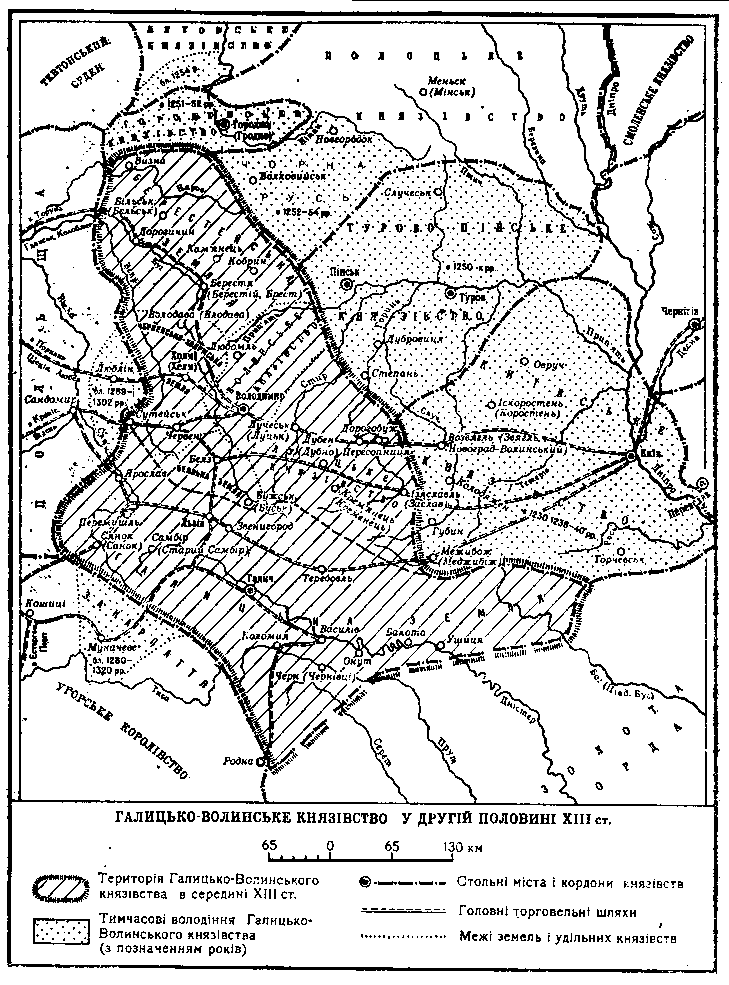
Geographically, western Galicia–Volhynia extended between the rivers San and Wieprz in what is now south-eastern Poland, while its eastern territories covered the Pripet Marshes (now in Belarus) and the upper reaches of the Southern Bug river in modern-day Ukraine. During its history, Galicia-Volhynia was bordered by the Grand Duchy of Lithuania, the Principality of Turov-Pinsk, the Principality of Kiev, the Golden Horde, the Kingdom of Hungary, the Kingdom of Poland, Moldavia and the Monastic State of the Teutonic Knights.Template:Cn
The principality was divided into several appanage duchies and lands:
- Principality of Galicia
- Principality of Volhynia
- Principality of Belz
- Land of Chełm (Lublin 1289–1302)
- Land of Berestia
- Black Ruthenia, a fief of Grand Duchy of Lithuania after a treaty between Daniel of Galicia and Vaišvilkas
Temporary divisions
- Principality of Kiev (Kyiv) (1230–1240)
- Principality of Turov (Turaŭ) (1230s)
| Template:Galicia-Volhynia Principality |
Princes and kings
Template:History of Ukraine {{#invoke:Labelled list hatnote|labelledList|Main article|Main articles|Main page|Main pages}} Template:Refimprove
- 1199–1205 Roman the Great (in Volhynia since 1197, in Galicia since 1199)Template:Sfn
- 1205–1214 political crisis
- 1205–1206 Euphrosine Angelina (daughter of Isaac II Angelos) as a regent for Danylo/Daniel of Galicia
- 1206–1212: the three sons of Ihor Svyatoslavych: Volodymyr Ihorevych, Svyatoslav Ihorevych, and Roman Ihorevych.Template:Sfn
- 1210 Rostislav II of Kiev (short stint)
- 1211–1212 Mstislav the Mute as a regent for Danylo/Daniel of Galicia
- 1212–1214 Uprising led by a boyar Volodyslav Kormylchych
- 1214–1232 Hungarian occupation, sons of Andrew II of Hungary
- 1214–1220 Coloman, son of Andrew (King of Galicia and Lodomeria)
- 1220–1221 Uprising led by Mstyslav the Able, who ruled in Galicia from 1221 to 1228Template:Sfn
- 1220–1232 Andrew, son of Andrew
- 1232–1235 Danylo/Daniel of Galicia
- 1235–1238 children of Michael of Chernigov
- 1238–1264 Danylo/Daniel of GaliciaTemplate:Sfn
- 1264–1269 Dual power descendants of Daniel
- 1264–1269 Shvarn
- 1264–1301 Lev I of GaliciaTemplate:Sfn
- 1301–1308 Yuri I of Galicia
- 1308–1323 Dual power descendants of Yuri
- 1308–1323 Lev II of Galicia
- 1308–1323 Andrew of Galicia
- 1323–1349 political crisis, de facto ruled by a boyar Dmytro Dedko
- 1323–1323 Galicia: Template:Interlanguage link, Volhynia: Liubartas
- 1323–1340 Yuri II Boleslav (united as compromise)
- 1340 takeover of Galicia by Casimir III the Great
- 1341–1349 Liubartas
- 1349 Galicia annexed (patrimonial) by Poland and Hungary, Volhynia – Lithuania
Notes: The senior branch of Rurikid dynasty, in the 14th century Galician rulers came in close relations with Mazovian Piasts (Duke of Mazovia) and rising Gediminids which established the Grand Duchy of Lithuania.
Gallery
-
 Saint Pantaleon Church, Shevchenkove, 1194
 -
 Map of Pokuttia in 1648 east of Ruthenia
 -
 "Moneta Rvssie" coined in 1382 based on groschen
 -
 Coins of Dux Wladislaus
 -

-


.png)


See also
- List of wars and battles involving Galicia–Volhynia
- Civil war in Greater Poland (1382–1385)
- Ruthenian nobility
- Metropolis of Halych
Notes
References
Bibliography
Primary sources
- Galician–Volhynian Chronicle (Template:Circa 1292).
- (in Ruthenian) Галицько-Волинський Літопис. Іпатіївський список (according to the Hypatian Codex; PSRL Vol. 2 1908) – Litopys.org.ua
- (in Ruthenian) Галицько-Волинський Літопис. Острозький (Хлєбниковський) список (according to the Khlebnikov Codex; Harvard University Press 1990) – Litopys.org.ua
- Template:In lang Галицько-Волинський Літопис. Переклад Л.Махновця (in modern Ukrainian by Leonid Makhnovets, 1989) – Litopys.org.ua
- Template:In lang Template:Cite book (in modern English)
- Belarusian-Lithuanian Chronicles (Template:Circa 1420–1575)
- (in Ruthenian) Литовсько-білоруські літописи
- List of Rus' Cities, Far and Near
- (in Ruthenian) Список городів руських дальніх і близьких
- Template:In lang Перелік джерел за "Крип'якевич І. Галицько-волинське князівство. Київ, 1984" (List of sources for ‘Krypyakevych I. Halych–Volyn principality. Kyiv, 1984)
- Ілюстрації з "Chronicon Pictum" Illustrations from the Chronicon Pictum.
Literature
- Template:Cite book
- Template:Cite book
- Template:Cite book
- Template:Cite book
- Template:Cite book
- Template:Cite book
- Template:Cite book
Further reading
Cyrillic
- Андрияшев А. М. Очерки истории Волынской земли до конца XIV ст. Киев, 1887. Template:In lang
- Болеслав-Юрий II, князь всей Малой Руси: Сборник материалов и исследований. — Санкт-Петербург, 1907. Template:In lang
- Галицкий исторический сборник, 1854, вып. 2. Template:In lang
- Греков Б. Д. Древнейшие судьбы славянства в Прикарпатских. областях // Вестник АН СССР. 1940. No. 11–12. Template:In lang
- Греков Б. Д. Крестьяне на Руси. — Москва,1952. Template:In lang
- Иванов П. А., Исторические судьбы Волынской земли с древнейших времен до конца XIV века, Одесса, 1895. Template:In lang
- Крип'якевич І. Галицько-волинське князівство. Київ, 1984. Template:In lang
- Коваленко В. Чернігів і Галич у ХІІ — ХІІІ ст. // Галичина та Волинь у добу Середньовіччя. — Львів, 2001. — С.154–165. Template:In lang
- Котляр М. Ф. Данило Галицький. — Київ, 1979. Template:In lang
- Материалы для истории и этнографии края. — Волынския губернския ведомости, 1854. Template:In lang
- Пашуто В. Т., Очерки по истории Галицко-ВольІнской Руси. — Москва, 1950. Template:In lang
- Руссов С. Волынские записки сочинінные Степаном Руссовым в Житомире. — Санкт-Петербург, 1809. Template:In lang
- Шабульдо Ф. М. Земли Юго-Западной Руси в составе Великого княжества Литовского. Киев, "Наукова думка", 1987.Template:Dead link Template:In lang
Latin
- Bielowski A. Halickowlodzimierskie księstwo. — Biblioteka Ossolińskich., t. 4.
- Bielowski A. Królewstwo Galicji (o starem księstwie Halickiem). — Biblioteka Ossolińskich, 1860, t. 1
- Gebhard L. A. Geschichte des Konigreiches Galizien, Lodomerien und Rotreussen. — Pest, 1778;
- Engel J. Ch. Geschichte von Halitsch und Vlodimir. — Wien, 1792.
- Harasiewicz M. Berichtigung der Umrisse zu einer Geschichte der Ruthenen. — Wien, 1835.
- Harasiewicz M. Annales ecclesiae Ruthenae. — Leopoli, 1862.
- Hoppe L A. Geschichte des Konigreiches Galizien und Lodomerien. — Wien, 1792.
- Lewicki A. Ruthenische Teilfürstentümer. — In: Österreichische Monarchie im Wort und Bild Galizien. Wien, 1894.
- Siarczyński F. Dzieje księstwa niegdyś Przemyślskiego. — Czasopism naukowy Biblioteki im. Ossolińskich, 1828, N 2/3;
- Siarczyński F. Dzieje niegdyś księstwa Belzkiego i miasta Belza. — Czasopism naukowy Biblioteki im. Ossolińskich, 1829, N 2.
- Stecki J. T. Wołyń pod względem statystycznym, historycznym i archeologicznym. — Lwów, 1864
- Zubrzycki D. Rys do historii narodu ruskiego w Galicji i hierarchii cerkiewnej w temże królewstwie. — Lwów, 1837.
- Zubrzycki D. Kronika miasta Lwowa. — Lwów, 1844.
External links
- Довідник з історії України. За ред. І. Підкови та Р. Шуста. — Київ: Генеза, 1993. Template:Webarchive
- Галицько-волинські князі
- Ісаєвич Я. Князь і король Данило та його спадкоємці // Дзеркало тижня. 2001, №48 (372)
- Карта Галицько-Волинського князівства
- Володимир-Волинський у «Галереї мистецтв»
- Борис Яценко, «Слово о полку Ігоревім» та його доба («Slovo o polku Ihorevim» ta joho doba)
- Волинська земля у складі Галицько-Волинського князівства (Volynśka zemľa u skladi Halyćko-Volynśkoho kńazivstva)
- За що боролись (Za ščo borolyś) Template:Webarchive
Template:East Slavic principalities Template:Ukraine topics Template:Former Monarchies Template:Authority control
- Pages with broken file links
- Kingdom of Galicia–Volhynia
- 12th century in Kievan Rus'
- Diarchies
- States and territories established in 1199
- States and territories disestablished in the 1340s
- 13th century in Europe
- 14th century in Europe
- 1349 disestablishments in Europe
- History of Red Ruthenia
- 1199 establishments in Europe
- Former Christian states
- Vassal and tributary states of the Golden Horde
- Former monarchies of Europe