Republic of Central Lithuania
Template:Short description Template:Distinguish Template:About Template:Use dmy dates {{#invoke:Infobox|infoboxTemplate |templatestyles = Template:Infobox country/styles.css | bodyclass = ib-country vcard | aboveclass = adr | above = {{#if:Republic of Central LithuaniaTemplate:Native name
| {{#if:Republic of Central Lithuania
|
}}{{#if:Template:Native name
|
              }}{{#ifeq:|yes
              |Micronation
       }}
|
}}
| subheader = {{#if: | {{{life_span}}} | {{#if:1920|1920{{#if:1922|–1922 }} }} }}
| image1 = {{#if:Coat of arms of Central Lithuania 1920.svgFlag of Central Lithuania 1920.svg
|Template:Infobox country/imagetable }}
| data1 = {{#if:
|Motto: Template:If empty{{#if:|
}}
}}
| class2 = anthem
| data2 = {{#if:
Rota
File:Rota Akordy 02.ogg
       |Anthem: Template:If empty
       }}{{#if:
       |Anthems: {{{anthems}}}
       }}{{#if:
       |
       }}{{#if:
       |
       }}{{#if:
       |
       }}{{#if:
       |
       }}{{#if:
       |
       }}{{#if:
       |
       }}{{#if:
       |
}}
| data3 = {{#if:
    |{{#if:
              | Template:If empty
}}Template:If empty
    }}
| data4 = {{#if:Rzeczpospolita Central Lithuania.png
|{{#invoke:InfoboxImage|InfoboxImage|image=Rzeczpospolita Central Lithuania.png|size=|alt=|title=Template:Col-begin
Template:Col-2 Template:Legend Template:Legend Template:Legend Template:Legend Template:Legend Template:Legend Template:Col-end }}{{#if:Template:Col-begin Template:Col-2 Template:Legend Template:Legend Template:Legend Template:Legend Template:Legend Template:Legend
Template:Col-2 Template:Legend Template:Legend Template:Legend Template:Legend Template:Legend Template:Legend
Template:Col-end}} }}
| data5 = {{#if:
|{{#invoke:InfoboxImage|InfoboxImage|image=|size=|alt=|title=Location of Central Lithuania }}{{#if:|
}} }}
| label6 = Status | data6 = {{#if:Puppet state of the Second Polish Republic|Template:Infobox country/status text }}
| label7 = Location | data7 =
| label8 = {{#if: | {{{capital_type}}} | Capital }}{{#ifeq: {{#ifeq:|capital
                        |capital|{{#switch:Vilnius
                          | [[]] = capital
                          |  = capital
                          | not capital
}}}}|capital |
}}
| data8 = {{#if:Vilnius|Vilnius{{#if:|
{{#invoke:Coordinates|coordinsert|{{{coordinates}}}|type:city}}}} }}
| rowclass9 = {{#if:Vilnius|mergedrow}} | label9 = Capital-in-exile | data9 = {{#ifexist:|[[]]|}}
| rowclass10 = {{#if:Vilnius|mergedrow}} | label10 = {{#if:| {{{admin_center_type}}} | Administrative center }} | data10 = {{#switch:
 |capital | =
 |[[Vilnius]] =
 |Vilnius =
 |#default = {{{admin_center}}}{{#if:Vilnius||{{#if:|
{{#invoke:Coordinates|coordinsert|{{{coordinates}}}|type:city}}}} }} }}
| rowclass11 = {{#if:Vilnius|mergedbottomrow}} | label11 = Largest city | data11 = {{#ifeq: {{#ifeq:|capital
                        |capital|{{#switch:Vilnius
                          | [[]] = capital
                          |  = capital
                          | not capital
                         }}}}|capital |
              | Template:If empty
              }}
| rowclass12 = mergedtoprow | label12 = Official languages | data12 = | rowclass13 = mergedrow | label13 = {{#if:|Recognized|Recognised}} languages | data13 = Template:If empty | rowclass14 = mergedrow | label14 = {{#if:|Recognized|Recognised}} national languages | data14 = Template:If empty | rowclass15 = mergedrow | label15 = {{#if:|Recognized|Recognised}} regional languages | data15 = Template:If empty | label16 = Common languages | data16 = Template:Ubl
| rowclass17 = {{#ifeq:|yes
          |{{#ifeq:|yes |mergedrow}}
          |{{#ifeq:|yes |mergedbottomrow}} }}
| label17 ={{#ifeq:|yes
|
 |Template:If empty
 }}
| data17 =
| rowclass18 = {{#ifeq:|yes |mergedbottomrow}} | label18 = {{#ifeq:|yes
|
 |Template:If empty
 }}
| data18 =
| label19 = Ethnic groups {{#if: |
|
}}
| data19 =
| label20 = Religion {{#if: |
|
}}
| data20 = Template:Ubl
| label21 = [[Demonym|DemonymTemplate:Pluralize from text]] | data21 = {{#if:Central Lithuanian
 |{{#ifexist:Central Lithuanian people
    | Central Lithuanian
    | Central Lithuanian
   }}
 }}
| label22 = Type | data22 =
| label23 = Template:If empty | data23 =
| label24 = {{#if:Republic
    | {{#if:
              | [[{{{politics_link}}}|{{#ifeq:|yes|Organizational structure|Government}}]]| {{#ifexist:Politics of Central Lithuania
                 | {{#ifeq:|yes|Organizational structure|Government}}| {{#ifeq:|yes|Organizational structure|Government}}}}}}}}
| data24 = Republic
| header25 = {{#if:Republic || {{#if:
       | {{#if:
          | Leaders
          | Government
         }}
       }} }}
| rowclass26 = mergedrow | data26 = {{#if:|Template:Infobox country/multirow }}
| rowclass27 = mergedrow | label27 = {{#if:Commander-in-chief| Commander-in-chief }} | data27 = {{#if:Commander-in-chief| }} | rowclass28 = mergedrow | data28 = {{#if:1920–1922 | Template:Infobox country/multirow }}
| rowclass29 = mergedrow | label29 = {{#if:| {{{title_representative}}} }} | data29 = {{#if:| }} | rowclass30 = mergedrow | data30 = {{#if:|Template:Infobox country/multirow }}
| rowclass31 = mergedrow | label31 = {{#if:Chairman|Chairman }} | data31 = {{#if:Chairman| }} | rowclass32 = mergedrow | data32 = {{#if:1920–1921 (first)|Template:Infobox country/multirow }}
| label40 = Legislature | data40 = Sejm | rowclass41 = mergedrow
| label41 =
| data41 = | rowclass42 = mergedbottomrow
| label42 =
| data42 =
| rowclass43 = {{#if: |mergedtoprow}} | header43 = {{#if:
|{{#if:
| {{{sovereignty_type}}}{{#if: |
}}
     | {{#if:| | Establishment }}
 }} }}
| label44 = Establishment | data44 = {{#if:
     |
     |
     }}
| label45 = {{#if:Interwar period|Historical era|History}} | data45 = {{#if:Interwar period |{{#ifexist:Interwar period|Interwar period|Interwar period}} | {{#if:12 October1920| }}}}
| rowclass46 = {{#if: |mergedrow |mergedbottomrow}} | data46 = {{#if:|Template:Infobox country/multirow }}
| rowclass47 = {{#if:12 October1920 |mergedrow |mergedbottomrow}} | data47 = {{#if:12 October1920|Template:Infobox country/multirow }}
| rowclass60 = mergedtoprow | header60 = {{#if:13490
 | {{#if:
              | [[{{{area_link}}}|Area {{#ifeq:|yes|claimed|}}]]
              | {{#ifexist:Geography of Central Lithuania
                 | Area {{#ifeq:|yes|claimed|}}
                 | Area {{#ifeq:|yes|claimed|}}}}}} }}
| rowclass61 = {{#if:|mergedrow|mergedbottomrow}}
| label61 =
| data61 = {{#if:13490
 |{{#if:13490
    |Template:Convinfobox
    |{{#if:
       |Template:Convinfobox
     }}
  }}{{#if: | ({{{area_rank}}}) }}
 }}
| rowclass62 = {{#if:|mergedrow|mergedbottomrow}}
| label62 =
| data62 = {{#if:
 |{{#if:
    |Template:Convinfobox
    |{{#if:
       |Template:Convinfobox
     }}
  }}
 }}
| rowclass63 = {{#if:|mergedrow|mergedbottomrow}}
| label63 =
| data63 = {{#if:
 |{{#if:
    |Template:Convinfobox
    |{{#if:
       |Template:Convinfobox
     }}
  }}
 }}
| rowclass64 = {{#if:|mergedrow|mergedbottomrow}}
| label64 =
| data64 =
| rowclass65 = {{#if:|mergedrow|mergedbottomrow}}
| label65 =
| data65 = {{#if:| }}
| rowclass66 = {{#if:|mergedrow|mergedbottomrow}}
| label66 =
| data66 = {{#if:| }}
| rowclass67 = {{#if:|mergedrow|mergedbottomrow}} | label67 = | data67 = {{#if: | Template:Convinfobox }}
| rowclass68 = {{#if:|mergedrow|mergedbottomrow}} | label68 = | data68 = {{#if: | Template:Convinfobox }}
| rowclass69 = {{#if:|mergedrow|mergedbottomrow}} | label69 = | data69 = {{#if: | Template:Convinfobox }}
| rowclass70 = {{#if:|mergedrow|mergedbottomrow}} | label70 = | data70 = {{#if: | Template:Convinfobox }}
| rowclass71 = {{#if:|mergedrow|mergedbottomrow}} | label71 = | data71 = {{#if: | Template:Convinfobox }}
| rowclass72 = mergedrow
| label72 =
| data72 = {{#if:| }}
| rowclass73 = mergedrow
| label73 =
| data73 = {{#if:
 |{{#if:
    |Template:Convinfobox{{#if:| ([[List of countries and dependencies by area|]])}}
  }}
}}
| rowclass89 = mergedbottomrow
| label89 =
| data89 = {{#if:
 |{{#if:
    | Template:Convinfobox{{#if:| ([[List of countries and dependencies by area|]])}}
  }}
}}
| rowclass90 = mergedtoprow | header90 = {{#if:
    |{{#if:
              | {{#ifeq:{{{population_link}}}|no|Population|[[{{{population_link}}}|Population]]}}| {{#ifexist:Demographics of Central Lithuania
                 | Population| Population}}}} }}
| rowclass91 = mergedrow
| label91 =
| data91 = {{#if:
       |{{#if: | ({{{population_estimate_rank}}})}}
       }}
| rowclass92 = mergedrow
| label92=
| data92= {{#if:|}}
| rowclass93= mergedrow
| label93=
| data93= {{#if:|}}
| rowclass94= mergedrow | data94= {{#if:|Template:Infobox country/multirow }}
| rowclass95= mergedrow
| label95=
| data95= {{#if:
 |{{{population_census}}}{{#if: | ({{{population_census_rank}}})}}
 }}
| rowclass96= mergedrow | label96 = {{#if:|{{#if:|Template:Nobold}}}} | data96 = {{#if:|{{#if:|}}}}
| rowclass97 = mergedrow
| label97=
| data97= {{#if:|{{#if:
|{{{FR_total_population_estimate}}}{{#if:| ({{{FR_total_population_estimate_rank}}})}}
 }} }}
| rowclass98 = mergedrow
| label98=
| data98= {{#if:|{{{FR_metropole_population}}}{{#if:
| ({{{FR_metropole_population_estimate_rank}}})}}
}}
| rowclass99 = mergedbottomrow
| label99=
| data99= {{#if:
    | Template:Convinfobox{{#if: | ({{{population_density_rank}}})}}
    }}
| rowclass100 = {{#if:|mergedbottomrow|mergedtoprow}} | label100 = Membership | data100=
| rowclass101= mergedtoprow | label101= {{#ifeq:|yes|Claimed|}} GDP Template:Nobold | data101= {{#if:
    |{{#if: |{{{GDP_PPP_year}}} }}estimate
    }}
| rowclass102= mergedrow
| label102=
| data102= {{#if:
    |{{{GDP_PPP}}}{{#if: | ({{{GDP_PPP_rank}}})}}
    }}
| rowclass103= mergedbottomrow
| label103=
| data103= {{#if:
    |{{{GDP_PPP_per_capita}}}{{#if: | ({{{GDP_PPP_per_capita_rank}}})}}
    }}
| rowclass104= mergedtoprow | label104= {{#ifeq:|yes|Claimed|}} GDP Template:Nobold | data104= {{#if:
  |{{#if: |{{{GDP_nominal_year}}} }}estimate
  }}
| rowclass105= mergedrow
| label105=
| data105= {{#if:
    |{{{GDP_nominal}}}{{#if: | ({{{GDP_nominal_rank}}})}}
    }}
| rowclass106= mergedbottomrow
| label106=
| data106= {{#if:
       | {{{GDP_nominal_per_capita}}}{{#if: | ({{{GDP_nominal_per_capita_rank}}})}}
      }}
| label107= Gini{{#if: | Template:Nobold}} | data107= {{#if:
    | {{#switch:
             |increase = Template:IncreaseNegative |decrease = Template:DecreasePositive |steady = Template:Steady }}{{{Gini}}}
Template:Nowrap{{#if:
              | ({{{Gini_rank}}})}}}}
| label108= HDI{{#if: | Template:Nobold}} | data108= {{#if:
    | {{#switch:
             |increase = Template:Increase |decrease = Template:Decrease |steady = Template:Steady }}{{{HDI}}}
Template:Nowrap{{#if:
             | ({{{HDI_rank}}})}}}}
| label109= {{#ifeq:|yes|Purported currency|Currency}} | data109= {{#if:Polish mark
    | Polish mark {{#if: |({{{currency_code}}})}}
  }}
| rowclass119= {{#if: |mergedtoprow}} | label119= Time zone | data119= {{#if:
    |Template:Nowrap {{#if:|({{{time_zone}}})}}
    |
    }}
| rowclass120= {{#if: |mergedrow |mergedbottomrow}}
| label120=
| data120= {{#if:
    |Template:Nowrap {{#if:|({{{time_zone_DST}}})|{{#if:|({{{DST}}})}}}}
    |{{#if:|{{{time_zone_DST}}}|}}
    }}
| rowclass121= mergedbottomrow | label121= | data121=
| label122 = Antipodes | data122=
| label123 = Date format | data123=
| label126= {{#if:
   |{{#ifexist:Telephone numbers in Central Lithuania
              | Calling code
              | Calling code
             }}
  }}
| data126=
| label127= ISO 3166 code | data127= {{#switch:
    |omit =
    | = {{#if:Central Lithuania
             | {{#if:Template:ISO 3166 code
                | [[ISO 3166-2:Template:ISO 3166 code|Template:ISO 3166 code]]
               }}
            }}
    |#default = [[ISO 3166-2:{{{ISO3166CODE}}}|{{{ISO3166CODE}}}]]
   }}
| label128= Internet TLD | data128=
| data129 = {{#if:
|
{{{official_website}}}
}}
| data130= {{#if:
| {{#invoke:InfoboxImage|InfoboxImage|image=|size=|alt=|title=Location of Central Lithuania }}{{#if:|
}}
}}
| data134 = {{#if:Republic of Lithuania (1918–1940)|LithuaniaSecond Polish Republic|Poland
|Template:Infobox country/formernext
}}
| label135 = Today part of | data135 = Template:Ubl
| data136 = {{#if:
|
-
{{#if:|
}}{{#if:|
}}{{#if:|
}}{{#if:|
}}{{#if:|
}}{{#if:|
}}{{#if:|
}}{{#if:|}}
}}
| data137 = {{#if:
|
-
{{#if:|
}}{{#if:|
}}{{#if:|
}}{{#if:|
}}{{#if:|
}}{{#if:|
}}{{#if:|
}}{{#if:|}}
}} | data138 = {{#if:|
{{{footnotes2}}}}}
}}
| data177 =
| belowclass = mergedtoprow noprint | below = {{#if:| Template:Navbar }} }}{{#invoke:Check for unknown parameters|check|unknown=Template:Main other|preview=Page using Template:Infobox country with unknown parameter "_VALUE_"|ignoreblank=y| admin_center_type | admin_center | alt_coat | alt_flag | alt_flag2 | alt_map | alt_map2 | alt_map3 | alt_symbol | anthem | anthems | antipodes | area_acre | area_data2 | area_data3 | area_footnote | area_ha | area_km2 | area_label | area_label2 | area_label3 | area_land_acre | area_land_footnote | area_land_ha | area_land_km2 | area_land_sq_mi | area_link | area_rank | area_sq_mi | area_water_acre | area_water_footnote | area_water_ha | area_water_km2 | area_water_sq_mi | regexp1 = border_[ps][%d]+ | calling_code | capital_exile | capital_type | capital | cctld | coa_size | coat_alt | common_languages | common_name | conventional_long_name | coordinates | currency_code | currency | date_end | regexp2 = date_event[%d]+ | date_format | date_post | date_pre | date_start | demonym | regexp3 = deputy[%d]+ | drives_on | DST_note | DST | empire | englishmotto | era | regexp4 = established_date[%d]+ | regexp5 = established_event[%d]+ | established | ethnic_groups_ref | ethnic_groups_year | ethnic_groups | event_end | event_post | event_pre | event_start | regexp6 = event[%d]+ | flag| flag_alt | flag_alt2 | flag_border | flag_caption | flag_caption | regexp7 = flag_[ps][%d]+ | flag_size | flag_type | flag_type_article | flag_width | flag2_border | regexp8 = footnote_[a-h] | regexp9 = footnote[%d]+ | footnotes | footnotes2 | FR_cadastre_area_km2 | FR_cadastre_area_rank | FR_cadastre_area_sq_mi | FR_foot | FR_foot2 | FR_foot3 | FR_foot4 | FR_foot5 | FR_IGN_area_km2 | FR_IGN_area_rank | FR_IGN_area_sq_mi | FR_metropole_population_estimate_rank | FR_metropole_population | FR_metropole | FR_total_population_estimate_rank | FR_total_population_estimate_year | FR_total_population_estimate | GDP_nominal_per_capita_rank | GDP_nominal_per_capita | GDP_nominal_rank | GDP_nominal_year | GDP_nominal | GDP_PPP_per_capita_rank | GDP_PPP_per_capita | GDP_PPP_rank | GDP_PPP_year | GDP_PPP | Gini_change | Gini_rank | Gini_ref | Gini_year | Gini | government_type | HDI_change | HDI_rank | HDI_ref | HDI_year | HDI | house1 | house2 | image_coat | image_flag | image_flag2 | image_map_alt | image_map_caption | image_map_size | image_map | image_map2_alt | image_map2_caption | image_map2_size | image_map2 | image_map3 | regexp10 = image_[ps][%d]+ | image_symbol | iso3166code | languages_sub | languages_type | languages | languages2_sub | languages2_type | languages2 | largest_city | largest_settlement_type | largest_settlement | regexp11 = leader_name[%d]+ | regexp12 = leader_title[%d]+ | regexp13 = leader[%d]+ | legislature | life_span | linking_name | location_map | loctext | lower_house | map_caption | map_caption2 | map_caption3 | map_width | map2_width | map3_width | membership_type | membership | micronation | module | motto | name | national_anthem | national_languages | national_motto | native_name | navbar | nummembers | official_languages | official_website | org_type | other_symbol_type | other_symbol | regexp14 = [ps][%d]+ | patron_saint | patron_saints | percent_water | politics_link | pop_den_footnote | population_census_rank | population_census_year | population_census | population_data2 | population_data3 | population_density_km2 | population_density_rank | population_density_sq_mi | population_estimate_rank | population_estimate_year | population_estimate | population_label2 | population_label3 | population_link | recognised_languages | recognised_national_languages | recognised_regional_languages | recognized_languages | recognized_national_languages | regexp15 = ref_area[%d]+ | regexp16 = ref_pop[%d]+ | regional_languages | recognized_regional_languages | religion_ref | religion_year | religion | regexp17 = representative[%d]+ | royal_anthem | flag_anthem | march | national_march | regional_anthem | territorial_anthem | state_anthem | sovereignty_note | sovereignty_type | regexp18 = stat_area[%d]+ | regexp19 = stat_pop[%d]+ | regexp20 = stat_year[%d]+ | status_text | status | symbol| symbol_type_article | symbol_type | symbol_width | text_symbol_type | text_symbol | time_zone_DST | time_zone | title_deputy | title_leader | title_representative | today | type_house1 | type_house2 | upper_house | utc_offset_DST | utc_offset | regexp21 = year_deputy[%d]+ | year_end | year_exile_end | year_exile_start | regexp22 = year_leader[%d]+ | regexp23 = year_representative[%d]+ | year_start}}Template:Main other{{#if:|{{#ifeq:Puppet state of the Second Polish Republic|Colony|Template:Main other|{{#ifeq:Puppet state of the Second Polish Republic|Exile|Template:Main other}}}} }} Template:Coord The Republic of Central Lithuania (Template:Langx, Template:Langx), commonly known as the Central Lithuania, and the Middle Lithuania (Template:Langx, Template:Langx, Template:Langx), was an unrecognized short-lived puppet state of Poland, that existed from 1920 to 1922.<ref>Template:Cite journal</ref> It was founded on 12 October 1920, after the successful Żeligowski Mutiny, during which the volunteer 1st Lithuanian–Belarusian Division under the command of general Lucjan Żeligowski seized the Vilnius Region that Lithuania made claims to.<ref name=cepenas>Template:Cite book</ref> It was incorporated into Poland on 18 April 1922.
Vilnius, the historical capital of Lithuania, had a majority Polish-speaking population with a Lithuanian-speaking minority of only 2–3%.<ref name="von Rauch">Template:Cite book</ref> Therefore, the Polish authorities decided that the region should belong to the newly-established Polish state, and attempted to implement this idea using military force, ignoring the Curzon Line and taking advantage of the fact that victorious Poles after the Battle of Warsaw were advancing to the East against the Bolsheviks in the Polish–Soviet War. The Poles reasoned that they were justified in seizing as many mixed areas as possible, as well as to protect the Catholic, predominantly Polish-speaking population in disputed areas. Being utterly militarily outmatched, Lithuania did not stand a chance to maintain control of the region. This led to the renewal of Polish–Lithuanian War, where the so-called Żeligowski Mutiny, secretly ordered by Józef Piłsudski, was part of the military operation, fully supported and backed on the flanks by the Polish army, and consequently to the establishment of the so-called Republic of Central Lithuania.<ref name="von Rauch" />
The republic had features of a state administration, but it was an imitation of a sovereign state which repressed Lithuanian organizations and education, and censored and suspended Lithuanian publications.<ref name="Nanevic">Template:Cite journal</ref> After a variety of delays, a disputed election took place on 8 January 1922, and the territory was annexed by Poland. Several years later, the Polish leader Józef Piłsudski confirmed that he personally ordered Żeligowski to stage a mutiny.
The Polish–Lithuanian border in the interwar period, was recognized by the Conference of Ambassadors of the Entente<ref name="conference">Template:Cite book</ref><ref name="LoN">Template:Cite book</ref> and the League of Nations.<ref name="Miniotaite">Template:Cite journal</ref> It was not recognized by Kaunas-based Republic of Lithuania<ref name="Vilna_problem">Template:Cite book</ref> until the Polish ultimatum of 1938 in March, when Lithuania acknowledged the status quo of so-called demarcation line, but the newest edition of the Constitution of Lithuania in May 1938 one more time named Vilnius the capital of Lithuania. In 1931, an international court in The Hague stated that the Polish seizure of the region had been a violation of international law, but there were no political repercussions.<ref name="Miniotaite" />
History
{{#invoke:Labelled list hatnote|labelledList|Main article|Main articles|Main page|Main pages}} Following the partitions of Poland, most of the lands that formerly constituted the Grand Duchy of Lithuania were annexed by the Russian Empire. The Imperial government increasingly pursued a policy of Russification of the newly acquired lands, which escalated after the failed January Uprising of 1864.<ref>Template:In langClaudio Madonia, Fra l'orso russo e l'aquila prussiana, Clueb Edizioni, 2013, 978-88-49-13800-9, p.82.</ref> The discrimination against local inhabitants included restrictions and outright bans on the usage of the Polish, Lithuanian (see Lithuanian press ban), Belarusian, and Ukrainian (see Valuyev circular) languages.<ref name="Roshwald24">Template:Cite book</ref><ref name="Geifman116">Template:Cite book</ref> These measures, however, had limited effects on the Polonisation effort undertaken by the Polish patriotic leadership of the Vilnius educational district.<ref name=Venc>Template:Cite journal</ref><ref name=Yla>Template:Cite journal</ref> A similar effort was pursued during the 19th century Lithuanian National Revival, which sought to distance itself from both Polish and Russian influences.<ref>Template:Cite journal</ref>

The ethnic composition of the area has long been disputed, since censuses from that time and place are often considered unreliable. According to the first census of the Russian Empire in 1897, known to have been intentionally falsified,<ref>Template:Cite book</ref> the population of the Vilna Governorate was distributed as follows:<ref name="Łossowski11">Template:Cite book</ref> Belarusians at 56.1% (including Roman Catholics), Lithuanians at 17.6%, Jews at 12.7%, Poles at 8.2%, Russians at 4.9%, Germans at 0.2%, Ukrainians at 0.1%, Tatars at 0.1%, and 'Others' at 0.1% as well.<ref name="Demoskop">Template:Cite journal</ref>
The German censuses of 1915, 1916 and 1917 of the Vilnius Region (published in 1919) however, reported strikingly different numbers.<ref name="Brensztejn">Template:Cite book</ref> In 1917 in the Vilnius city Poles were at 53.65%, Jews at 41.45%, Lithuanians at 2.1%, Belarusians at 0.44%, Russians at 1.59%, Germans at 0,63% and 'Other' at 0.14%.<ref name="Łossowski104">Template:Cite book</ref><ref>Template:Cite book</ref> According to the 1916 census, Poles constituted 89.8% of the inhabitants of Vilnius county (excluding the city) and Lithuanians only 4.3%.<ref>Template:Cite book</ref>
Censuses had encountered difficulties in the attempt to categorise their subjects. Ethnographers in the 1890s were often confronted with those who described themselves as both Lithuanians and Poles.<ref>Template:Cite book</ref> According to a German census analyst, "Objectively determining conditions of nationality comes up against the greatest difficulties."<ref>Template:Cite book</ref>
Aftermath of World War I
In the aftermath of the First World War, both Poland and Lithuania regained independence. The conflict between them soon arose as both Lithuania and Poland claimed Vilnius (known in Polish as Wilno) region.
Demographically, the main groups inhabiting Vilnius were Poles and Jews, with Lithuanians constituting a small fraction of the total population (2.0%–2.6%, according to the Russian census of 1897 and the German census of 1916).<ref name="Łossowski11"/><ref name="Brensztejn"/> The Lithuanians nonetheless believed that their historical claim to Vilnius (former capital of the Grand Duchy of Lithuania) had precedence and refused to recognize any Polish claims to the city and the surrounding area.<ref name="MacQueen_context">Template:Cite journal</ref>
While Poland under Józef Piłsudski attempted to create a Polish-led federation in the area that would include a number of ethnically non-Polish territories (Międzymorze), Lithuania strove to create a fully independent state that would include the Vilnius region. Two early 20th-century censuses indicated that Lithuanian speakers, whose language in the second half of the 19th century was suppressed by the Russian policies and had unfavourable conditions within the Catholic church, became a minority in the region. Based on this, Lithuanian authorities argued that the majority of inhabitants living there, even if they at the time did not speak Lithuanian, were thus Polonized (or Russified) Lithuanians.<ref name="Łossowski13-16">Template:Cite book</ref><ref name="Merkys">Template:Cite book</ref>
Further complicating the situation, there were two Polish factions with quite different views on creation of the modern state in Poland. One party, led by Roman Dmowski, saw modern Poland as an ethnic state, another, led by Józef Piłsudski, wished to rebuild the Polish–Lithuanian Commonwealth.<ref name="Snyder64">Template:Cite book</ref> Both parties were determined to take the Poles of Vilnius into the new state. Piłsudski attempted to rebuild the Grand Duchy of Lithuania in a canton structure, as part of the Międzymorze federation:<ref name="Snyder64"/>
- Lithuania of Kaunas with Lithuanian language
- Lithuania of Vilnius or Central Lithuania with Polish language
- Lithuania of Minsk with Belarusian language
Eventually, Piłsudski's plan failed; it was opposed both by the Lithuanian government and by the Dmowski's faction in Poland. Stanisław Grabski, representative of Dmowski's faction, was in charge of the Treaty of Riga negotiations with the Soviet Union, in which they rejected the Soviet offer of territories needed for the Minsk canton (Dmowski preferred Poland that would be smaller, but with higher percentage of ethnic Poles).<ref name="Snyder64"/> The inclusion of territories predominant with non-Poles would have weakened support for Dmowski.<ref name="Snyder64"/>
Polish–Lithuanian War

{{#invoke:Labelled list hatnote|labelledList|Main article|Main articles|Main page|Main pages}} At the end of World War I, the area of the former Grand Duchy of Lithuania was divided between the Second Polish Republic, the short-lived unrecognized Belarusian People's Republic, and the Republic of Lithuania.<ref>Tomas Balkelis, Violeta Davoliūtė, Population Displacement in Lithuania in the Twentieth Century, BRILL, 2016; Template:ISBN pp. 70-71.</ref> Following the start of the Polish–Soviet War, during the next two years, the control of Vilnius and its environs changed frequently. In 1919 the territory was briefly occupied by the Red Army, which defeated the local self-defense units, but shortly afterwards the Soviets were pushed back by the Polish Army. 1920 saw the Vilnius region occupied by the Red Army for the second time. However, when the Red Army was defeated in the Battle of Warsaw, the Soviets, knowing that they wouldn't be able to hold Vilnius, decided to hand it over to Lithuania. By making such a move, the Soviets hoped to intensify the Polish-Lithuanian dispute over the region.
The regular Polish–Lithuanian War broke out on 26 August 1920, when the Polish Army clashed with Lithuanian troops occupying Suwałki region during the Polish autumn offensive following the Battle of Warsaw. The League of Nations intervened and arranged negotiations in Suwałki. The League negotiated a cease-fire, signed on 7 October 7, placing the city of Vilnius in Lithuania.<ref name="Zigmas">Template:Cite book</ref> The Suwałki Agreement was to have taken effect at 12:00 on 10 October.
,_1920.jpg)
The Lithuanian authorities entered Vilnius in late August 1920. The Grinius cabinet rejected the proposal to hold a plebiscite to confirm the will of the region's inhabitants, knowing that a plebiscite would inevitably legitimize Polish claims to the region. His declaration was promptly accepted by the Seimas,<ref name="Senn49"/> for the percentage of Lithuanian population in Vilnius was very small.<ref name="Łossowski104"/> On 8 October, General Lucjan Żeligowski and the 1st Lithuanian-Belarusian Division numbering around 14,000 men, with local self-defense, launched the Żeligowski's Mutiny and engaged the Lithuanian 4th Infantry Regiment which promptly retreated.<ref name="von Rauch"/> Upon the Polish advance, on October 8, the Lithuanian government left the city for Kaunas, and during withdrawal, meticulously destroyed telephone lines and rail between the two cities, which remained severed for a generation.<ref name="Senn49"/> Żeligowski entered Vilnius on 9 October, to enthusiastic cheers of the overwhelmingly Polish population of the city. The French and the British delegation decided to leave the matter in the hands of the League of Nations.<ref name="Senn49"/> On October 27, while the Żeligowski's campaign still continued outside Vilnius, the League called for a popular referendum in the disputed area, which was again rejected by the Lithuanian representation.<ref name="Senn49">Template:Cite book</ref> Poland disclaimed all responsibility for the action, maintaining that Żeligowski had acted entirely on his own initiative.<ref name="von Rauch"/> This version of the event was redefined in August 1923 when Piłsudski, speaking in public at a Vilnius theater, stated that the attack was undertaken by his direct order.<ref name="Venclova">Template:Cite book</ref> Żeligowski, a native to Lithuania, proclaimed a new state, the Republic of Central Lithuania (Litwa Środkowa). According to historian Jerzy J. Lerski, it was a "puppet state" which the Lithuanian Republic refused to recognize.<ref name=Jerzy>Template:Cite book</ref><ref>Royal Institute of International Affairs, Vol. 36, No. 3 (1960), pg. 354.</ref>
The seat of Lithuanian government moved to Lithuania's second-largest city, Kaunas. Armed clashes between Kaunas and Central Lithuania continued for a few weeks, but neither side could gain a significant advantage. Due to the mediation efforts of the League of Nations, a new ceasefire was signed on November 21 and a truce six days later.<ref name="Łoss216-218">Template:Cite book</ref>
Founding of the Republic of Central Lithuania
On 12 October 1920, Żeligowski announced the creation of a provisional government. Soon the courts and the police were formed by his decree of 7 January 1921, and the civil rights of Central Lithuania were granted to all people who lived in the area on January 1, 1919, or for five years prior to August 1, 1914. The symbols of the state were a red flag with Polish White Eagle and Lithuanian Vytis. Its coat of arms was a mixture of Polish, Lithuanian and Vilnian symbols and resembled the Coat of arms of the Polish–Lithuanian Commonwealth.Template:Citation needed
Extensive diplomatic negotiations continued behind the scenes. Lithuania proposed creating a confederation of Baltic Western Lithuania (with Lithuanian as an official language) and Central Lithuania (with Polish as an official language).Template:Citation needed Poland added the condition that the new state must be also federated with Poland, pursuing Józef Piłsudski's goal of creating the Międzymorze Federation.<ref>Aviel Roshwald, "Ethnic Nationalism and the Fall of Empires: Central Europe, the Middle East and Russia, 1914–1923", Routledge (UK), 2001; Template:ISBN, p. 37</ref><ref>Richard K Debo, Survival and Consolidation: The Foreign Policy of Soviet Russia, 1918-192, McGill-Queen's Press, 1992; Template:ISBN, pg. 59</ref><ref>James H. Billington, Fire in the Minds of Men, Transaction Publishers; Template:ISBN, pg. 432</ref><ref>Andrzej Paczkowski, "The Spring Will Be Ours: Poland and the Poles from Occupation to Freedom", Penn State Press, 2003; Template:ISBN, pg. 10</ref><ref>David Parker, The Tragedy of Great Power Politics, W. W. Norton & Company, 2001; Template:ISBN, pg. 194</ref> Lithuanians rejected this condition. With nationalistic sentiments rising all over Europe, many Lithuanians were afraid that such a federation, resembling the Polish–Lithuanian Commonwealth from centuries ago, would be a threat to Lithuanian culture, as during the Commonwealth times many of the Lithuanian nobility was Polonized.
General elections in Central Lithuania were decreed to take place on 9 January, and the regulations governing this election were to be issued prior to 28 November 1920. However, due to the League of Nations mediation, and the Lithuanian boycott of the voting, the elections were postponed.<ref name="Saulius A. Suziedelis 2011">Saulius A. Suziedelis, Historical Dictionary of Lithuania, Scarecrow Press, 2011; Template:ISBN, pg. 78: “The elections of the Central Lithuania (...) were boycotted by much of the non-Polish population”.</ref>
Mediation


Peace talks were held under the auspice of the League of Nations. The initial agreement was signed by both sides on 29 November 1920, and the talks started on 3 March 1921. The League of Nations considered the Polish proposal of a plebiscite on the future of Central Lithuania. As a compromise, the so-called "Hymans' plan" was proposed (named after Paul Hymans). The plan consisted of 15 points, among them were:<ref name="Moroz">Template:Cite book</ref>
- Both sides guarantee each other's independence.
- Central Lithuania is incorporated into the Federation of Lithuania, composed of two cantons: Lithuanian-inhabited Samogitia and multi-ethnic (Belarusian, Tatar, Polish, Jewish and Lithuanian) Vilnius area. Both cantons will have separate governments, parliaments, official languages and a common federative capital in Vilnius.<ref name="Geouffre de Lapradelle">Template:Cite book</ref>
- Lithuanian and Polish governments will create interstate commissions on both foreign affairs, trade and industry measures and local policies.
- Poland and Lithuania will sign a defensive alliance treaty.
- Poland will gain usage of ports in Lithuania.

The talks came to a halt when Poland demanded that a delegation from Central Lithuania (boycotted by Lithuania) be invited to Brussels.<ref name="Moroz"/> Hymans' proposal left Vilnius in Polish hands, which was unacceptable to Lithuania.<ref name="Moroz"/>
A new plan was presented to the governments of Lithuania and Poland in September 1921. It was basically a modification of "Hymans' plan", with the difference that the Klaipėda Region (the area in East Prussia north of the Neman River) was to be incorporated into Lithuania. However, both Poland and Lithuania openly criticized this revised plan and finally this turn of talks came to a halt as well.<ref>John Besemeres, A Difficult Neighbourhood: Essays on Russia and East-Central Europe since WW II, ANU Press, 2016, Template:ISBN, Acknowledgements.</ref>
Resolution

After the talks in Brussels failed, the tensions in the area grew. The most important issue was the huge army Central Lithuania fielded (27,000).<ref>Template:In langFulvio Fusco, L’ammaliatrice di Kaunas, Youcanprint, 2014; Template:ISBN, pg. 30.</ref> General Lucjan Żeligowski decided to pass the power to the civil authorities and confirmed the date of the elections (8 January 1922).<ref>Charles W. Ingrao, Franz A. J. Szabo, The Germans and the East, Purdue University Press, 2008; Template:ISBN, pg. 262</ref> There was a significant electioneering propaganda campaign as Poles tried to win the support of other ethnic groups present in the area. The Polish government was also accused of various strong-arm policies (like the closing of Lithuanian newspapers<ref name=cepenas/> or election violations like not asking for a valid document from a voter).<ref name="Documents">Template:Cite book</ref>Template:Full citation needed The elections were boycotted by Lithuanians, most of the Jews and some Belarusians. Poles were the only major ethnic group out of which the majority of people voted.<ref name="Saulius A. Suziedelis 2011"/>
The elections were not recognized by Lithuania. Polish factions, which gained control over the parliament (Sejm) of the Republic (the Sejm of Central Lithuania), on February 20 passed the request of incorporation into Poland.<ref>Vilkelis, Gintautas (2006). Lietuvos ir Lenkijos santykiai Tautų Sąjungoje (in Lithuanian). Versus aureus. pp. 81–83. Template:ISBN.</ref> The request was accepted by the Polish Sejm on 22 March 1922.Template:Citation needed
All of the Republic's territory was eventually incorporated into the newly formed Wilno Voivodeship. Lithuania declined to accept the Polish authority over the area. Instead, it continued to treat the so-called Vilnius Region as part of its own territory and the city itself as its constitutional capital, with Kaunas being only a temporary seat of government. The dispute over the Vilnius region resulted in much tensions in the Polish–Lithuanian relations in the interwar period.Template:Citation needed
Aftermath
Alfred Erich Senn noted that if Poland had not prevailed in the Polish–Soviet War, Lithuania would have been invaded by the Soviets, and would never have experienced two decades of independence.<ref name="Senn"/> Despite the Soviet–Lithuanian Peace Treaty of 1920, Lithuania was very close to being invaded by the Soviets in summer 1920 and being forcibly incorporated into that state, and only the Polish victory derailed this plan.<ref name="Senn">Template:Cite book</ref><ref>Template:Cite book</ref><ref>Template:Cite book</ref><ref>{{#invoke:citation/CS1|citation |CitationClass=web }}</ref>
After the Molotov–Ribbentrop Pact and the Soviet invasion of Poland in 1939, Vilnius and its surroundings of up to 30 kilometres were given to Lithuania in accordance with the Soviet–Lithuanian Mutual Assistance Treaty of 10 October 1939, and Vilnius again became the capital of Lithuania.Template:Citation needed However, in 1940, Lithuania was annexed by the Soviet Union, forcing the country to become the Lithuanian SSR. Since the restoration of Lithuanian independence in 1991, the city's status as Lithuania's capital has been internationally recognized.Template:Citation needed
See also
- Army of Central Lithuania
- History of Vilnius
- Vilnius Voivodeship
- Polish National-Territorial Region
- The 1922 Republic of Central Lithuania general election
- List of sovereign states in 1922
References
External links
- Template:Usurped
- Template:Usurped
- State symbols of Central Lithuania
- Repatriation and resettlement of Ethnic Poles
- From "Russian" to "Polish": Vilnius-Wilno 1900–1925 Template:Webarchive
- Template:In lang Kampf um Wilna – historische Rechte und demographische Argumente
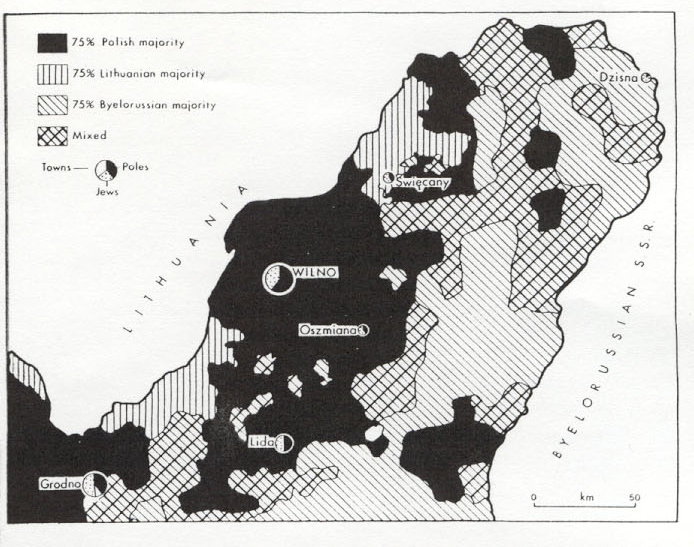
- Mixed ethnic groups around Wilno / Vilnius during inter-war period, after Norman Davies, God's Playground: A History of Poland: Volume II, 1795 to the Present; Columbia University Press: 1982.
- Stamps of ROC Template:Webarchive
- Template:In lang A. Srebrakowski, Sejm Wileński 1922 roku. Idea i jej realizacja, Wrocław 1993
- Template:In lang A. Srebrakowski, Stosunek mniejszości narodowych Litwy Środkowej wobec wyborów do Sejmu Wileńskiego Template:Webarchive
- Template:In lang A. Srebrakowski, Konflik polsko_litewski na tle wydarzeń roku 1920 Template:Webarchive
- Republic of Central Lithuania
- Former countries in Europe
- 1920s in Lithuania
- Lithuania–Poland relations
- States and territories established in 1920
- States and territories disestablished in 1922
- 1920 establishments in Belarus
- 1920 establishments in Lithuania
- 1920 establishments in Poland
- 1922 disestablishments in Belarus
- 1922 disestablishments in Lithuania
- 1922 disestablishments in Poland
- Former countries of the interwar period
- Former client states